
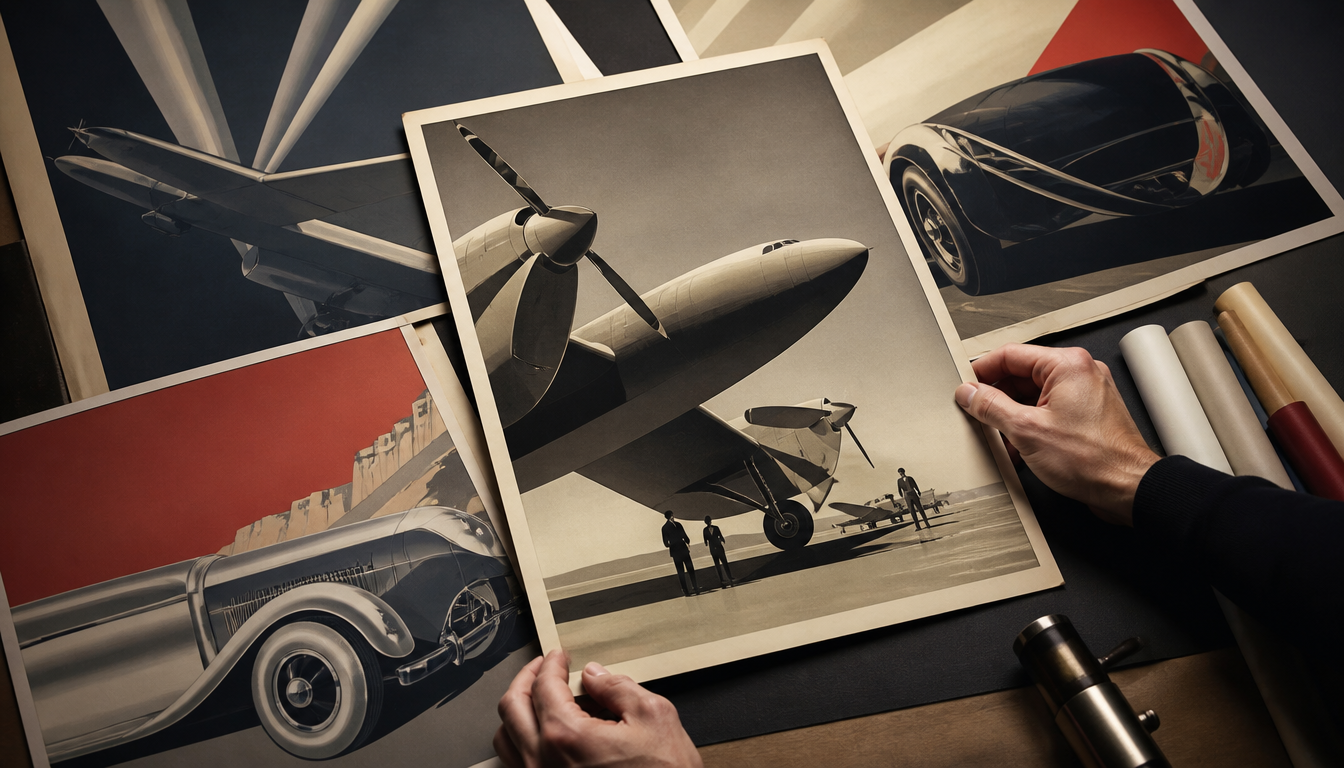
A.M. Cassandre, born Adolphe Jean-Marie Mouron (1901–1968), won the Grand Prix at the Exposition Internationale des Arts Décoratifs in Paris in 1925 for his 1923 poster “Au Bûcheron”, making him the most sought-after advertising graphic designer in France for aviation and automobile campaigns of the interwar period. Cassandre’s posters for luxury sports themes such as aviation and automobiles shaped the visual language of the 1920s and 1930s: with cubist-surrealist forms and monumental typography, he transformed fast machines into icons of modernity. For you as a sneaker and vintage fan, this means: anyone who wants to understand why speed and style remain an unbeatable combination to this day cannot ignore Cassandre. His work shows that genuine graphic craftsmanship is timeless and still serves as a reference for retro aesthetics.
Cassandre and the Luxury Sports Poster: Aviation and Automobiles Between the Wars
Key fact: Adolphe Jean-Marie Mouron, better known by the pseudonym Cassandre, was born on 24 January 1901 in Kharkiv and is still considered one of the most influential poster artists in France. In the years between 1920 and 1938, he created a visual language for speed, technology, and luxury that fundamentally transformed commercial poster design.
Who Was Cassandre?
Adolphe Jean-Marie Mouron grew up as the child of French parents in Russia. In 1915 he moved permanently to Paris, where he studied at the École des Beaux-Arts and the Académie Julian. From 1922 he worked in his first studio in Montparnasse. He chose the pseudonym Cassandre for his commercial work in order to distinguish it from his artistic work, though he occasionally still combined it with the name Mouron until 1928.
His breakthrough came in 1923 with the poster “Au Bûcheron”, which was displayed in large format all across Paris and brought him immediate recognition. In 1925 it won the Grand Prix at the Exposition Internationale des Arts Décoratifs et Industriels Modernes. Cassandre was instantly famous.
Cubism Meets Speed: The Aesthetics of the Interwar Period
Cassandre drew inspiration from Cubism and Surrealism. These influences made his posters so distinctive: forms were simplified into geometric basic structures, movement was suggested through diagonal compositions, and machines were elevated to almost mythical objects. This very visual vocabulary was a perfect fit for the rising enthusiasm for automobiles and aircraft.
Aviation posters of the interwar period had to sell a product that most people had never used. Cassandre’s approach was therefore not documentary, but pure suggestion: the aeroplane as a promise, the car as sculpture, the driver as a modern-day adventurer. This condensation of luxury and progress onto a single surface was his trademark.
4 Things You Should Know as a Vintage Poster Fan
1. Cassandre’s posters are historical documents with market value. Originals from the 1920s and 1930s regularly fetch five-figure sums at auction. Those who aren’t looking for an original but love the look will find high-quality reprints as a genuine alternative for the wall.
2. Format makes the difference. Cassandre worked from the very beginning for public spaces: large-format, visible from a distance, more striking than any illustration. Anyone who wants this effect at home should opt for large-format prints or canvases. Our Poster Shop and the Canvas section offer exactly that.
3. Geometry is no accident. The reduced forms in Cassandre’s work stem from Cubism, not laziness. Anyone who wants to translate his style into their own interior should look for works with clean lines and a limited colour palette. The Bauhaus Exhibition Poster or the Bauhaus Sun Poster follow the same design logic.
4. The travel poster as a sister format. Aviation advertising and the travel poster were the same genre in the 1930s: both sold longing. Cassandre worked for transatlantic shipping lines just as he did for railway companies. Those looking for this spirit will find it in classics such as the Hot Air Balloon Poster “Le Tricolore” or the Shell Advertising Poster in Retro Style.
From Fame to Tragedy
Cassandre founded his own advertising agency with partners and designed not only posters but also typefaces, including the still well-known “Bifur”. However, the Second World War destroyed the market for large commercial posters. In his later years he worked primarily for the theatre and on typographic projects. On 17 June 1968, Cassandre died by suicide in Paris. According to reports, a rejection letter for his last typographic work was found beside him.
Cassandre’s Legacy Today
His posters for automobiles, airlines, and ocean liners defined how speed and luxury are told visually. Anyone interested in vintage poster art from the interwar period cannot overlook Cassandre. Whether as a poster, canvas, or as inspiration for your own interior: the geometric futurism of the 1920s and 1930s doesn’t feel the least bit dated, but rather remarkably timeless.
Browse the reetro Shop if you’re looking for wall art in the spirit of that era. The Retro Travel Poster Hong Kong or the Vintage Travel Poster Yosemite also carry that spirit into the 21st century.
Sources
- Cassandre – Wikipedia
- Artist Biography – The Vintage Poster
- The Great Cassandre 1901/1968 – Grapheine
FAQ
Who was Cassandre, and why did he use a pseudonym?
Cassandre was the artistic pseudonym of Adolphe Jean-Marie Mouron, born on 24 January 1901 in Kharkiv, then part of the Russian Empire. His parents were French, and he moved permanently to Paris in 1915. He chose the name Cassandre to separate his commercial work from his artistic activity. Until 1928, he sometimes still combined the name with his civil name Mouron.
How did Cassandre develop his style, which suited speed and luxury sports posters so well?
Cassandre studied at the École des Beaux-Arts and the Académie Julian in Paris. He drew inspiration from Cubism and Surrealism and developed from these a synthetic, strongly geometric visual language. This reduction to clear forms and dynamism made his style ideal for motifs intended to convey speed, precision, and modernity. His breakthrough came in 1923 with the poster ‘Au Bûcheron’, which caused a sensation across Paris.
What was the first major recognition Cassandre received for his poster work?
The poster ‘Au Bûcheron’ from 1923, originally designed for a furniture dealer, was displayed in large format at numerous locations across Paris and made Cassandre famous overnight. In 1925 it received the first prize at the Exposition Internationale des Arts Décoratifs et Industriels Modernes, the most important design exhibition of the interwar period.
How was Cassandre's working practice as a commercial artist organised?
Cassandre was not only an artist but also entrepreneurially active. With the success of his early works, he founded his own advertising agency together with partners. He set up his first Parisian studio in 1922 on the Rue du Moulin-Vert in Montparnasse. As a lithographer, poster designer, typographer, and stage designer, he covered a broad spectrum that gave him access to the major industrial and luxury brands of the interwar period.
How did Cassandre's life end, and what does that say about his pursuit of perfection?
Cassandre died by suicide on 17 June 1968 in Paris, at the age of 67. According to one account, a rejection letter for his last typographic work was found beside his body. This story is emblematic of the absolute standard he set for his own work throughout his life — a standard that repeatedly drove him away from pure commissioned work and towards independent artistic creation.