
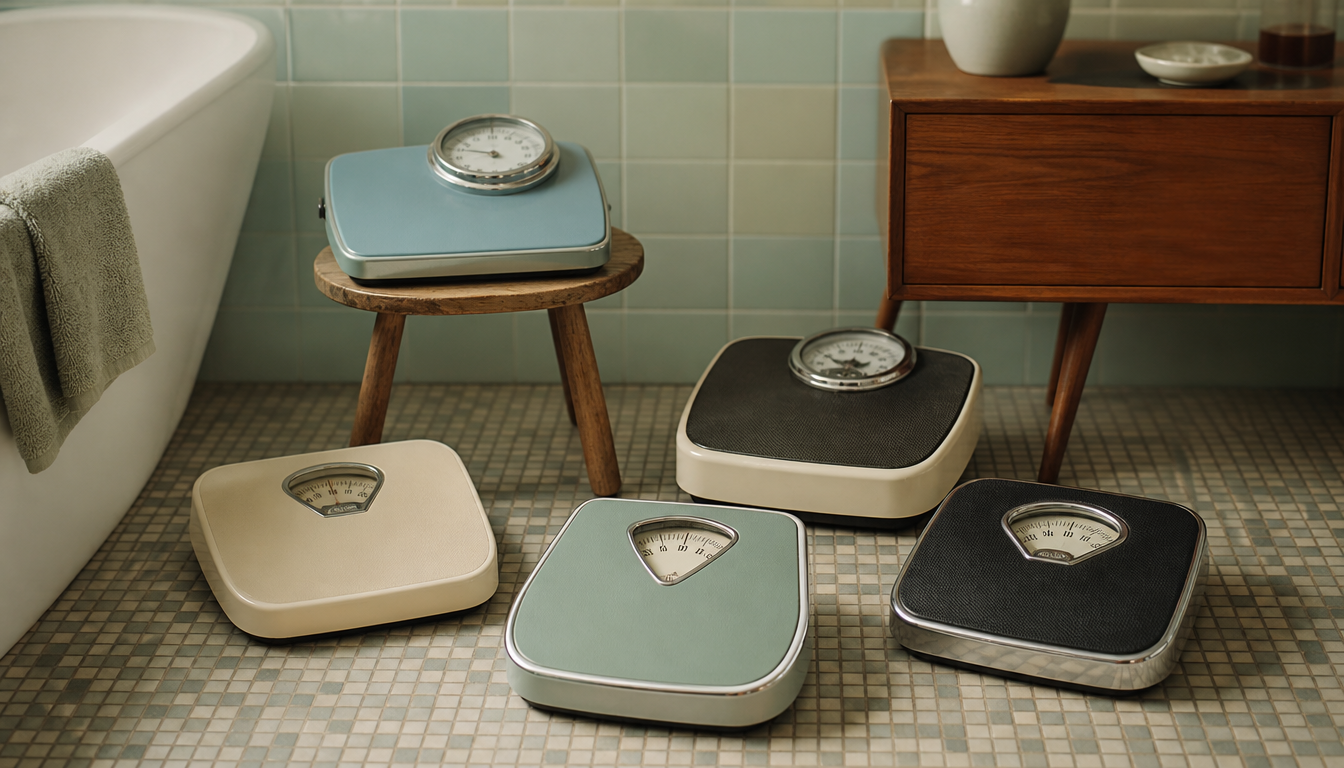
While other manufacturers in the 1970s were still relying on mechanical dial scales, Soehnle was already launching its first electronic personal scales – quietly writing a chapter in the design history of West German industrial culture. For you as a vintage enthusiast, this means: a Soehnle scale from the 1950s to 1970s is not merely a bathroom accessory, but a tangible document of West German functionalism. The brand consistently thought form and function together, long before that became a matter of course. Anyone who owns a piece from this era today holds in their hands a design history that had the courage to go digital before everyone else did.
Soehnle Personal Scales of the 1950s to 1970s: Functionalism in the Bathroom
While other manufacturers in the 1970s were still relying on mechanical dial scales, Soehnle was already launching its first electronic personal scales. A small moment in design history that took place in the bathroom.
Why a Bathroom Scale Can Make Design History
Personal scales rarely take centre stage in industrial design museums. And yet they have quite a lot to say. Between the 1950s and 1970s, Soehnle developed a design language that consistently combined functionalist thinking with technological progress. The early switch to electronics in the 70s was no coincidence, but the result of a philosophy that thought form and function together: less dial nostalgia, cleaner lines, greater precision.
Anyone who holds a Soehnle piece from this era today is not holding a bathroom accessory, but a tangible document of West German industrial culture. Soehnle had the courage to go digital before everyone else did.
What This Means for You as a Vintage Enthusiast
1. Recognise the Difference Between Object and Document A Soehnle from the 50s to 70s is not simply a second-hand household appliance. It is a witness to a design attitude that sits between Bauhaus aesthetics and West German Economic Miracle pragmatism. The clean housing lines and the reduced formal language of these models make them collector’s items that have nothing to hide.
2. Electronics as a Feature, Not a Flaw Many collectors prefer mechanical models for nostalgic reasons. With Soehnle, however, it is particularly worth looking at the early electronic models of the 70s: they mark a turning point at which design language and new technology were thought together for the first time. That makes them rarer and historically more interesting.
3. Placing Them in a Bigger Picture Functionalist design from this era is not confined to the bathroom. Anyone interested in Soehnle scales quickly discovers related objects from the kitchen, office and workshop that breathe the same attitude: reduction, purpose, form. A Soehnle piece fits stylistically well alongside other design objects and art prints from the same period. Our Bauhaus Exhibition Poster or the Bauhaus Advertising Poster Art School show how closely aligned the design philosophies of this era were.
4. Combine Collector’s Piece and Living Aesthetics Vintage industrial design has the greatest impact when placed within a coherent spatial concept. Anyone who has a Soehnle scale from the 60s on the floor can complement the room with contemporary prints and wall objects. The Bauhaus Hexagon Picture or the Mid-Century Modern Hexagon Wall Décor fit thematically well into this context. Those who prefer posters will find further options from similar eras in the reetro poster shop.
Sources
FAQ
What makes Soehnle personal scales from the 1950s to 1970s still so special today?
Soehnle scales from this era are more than old bathroom accessories. They represent West German industrial design that consistently thought function and form together. The clean lines, the reduced formal language and the craftsmanship quality make them tangible documents of a design philosophy that sits somewhere between the kitchen and the Bauhaus.
When did Soehnle actually switch to electronic scales, and why was that so unusual?
Soehnle launched its first electronic personal scales as early as the 1970s. At that time, other manufacturers were still relying on mechanical dials. This technological head start was no coincidence, but the result of a design philosophy that consistently linked technical progress with a clear formal language: less dial nostalgia, cleaner lines, greater precision.
Are Soehnle scales from this period genuine collector's items or merely nostalgic decoration?
Both are true, but feel free to dig deeper: a Soehnle scale from the 1950s to 1970s is a tangible piece of design history. Industrial design museums rarely exhibit such objects, even though they have a great deal to tell. As a vintage enthusiast, you hold in your hands an object that had the courage to go digital before everyone else did.
What design language characterises Soehnle scales from these decades?
The scales of this period follow a functionalist design language: reduced forms, no superfluous ornamentation, a clear structure. This is reminiscent of Bauhaus principles applied to a thoroughly everyday bathroom object. It is precisely this consistency that makes them appealing – beautiful design was not an end in itself here, but a direct consequence of functional thinking.
What should I look out for when buying a Soehnle scale from the 1950s to 1970s?
Pay attention to the difference between mechanical and early electronic models. The electronic variants did not appear until the 1970s and mark a clear technological leap. For the mechanical models from the 1950s and 1960s, it is worth checking the condition of the dial face and the surface. As documents of West German industrial design, both types deserve attention, but the early electronic variants are particularly significant from a design history perspective.
This article was generated automatically by an AI system. Disclosure pursuant to Article 50 of the EU AI Act.