
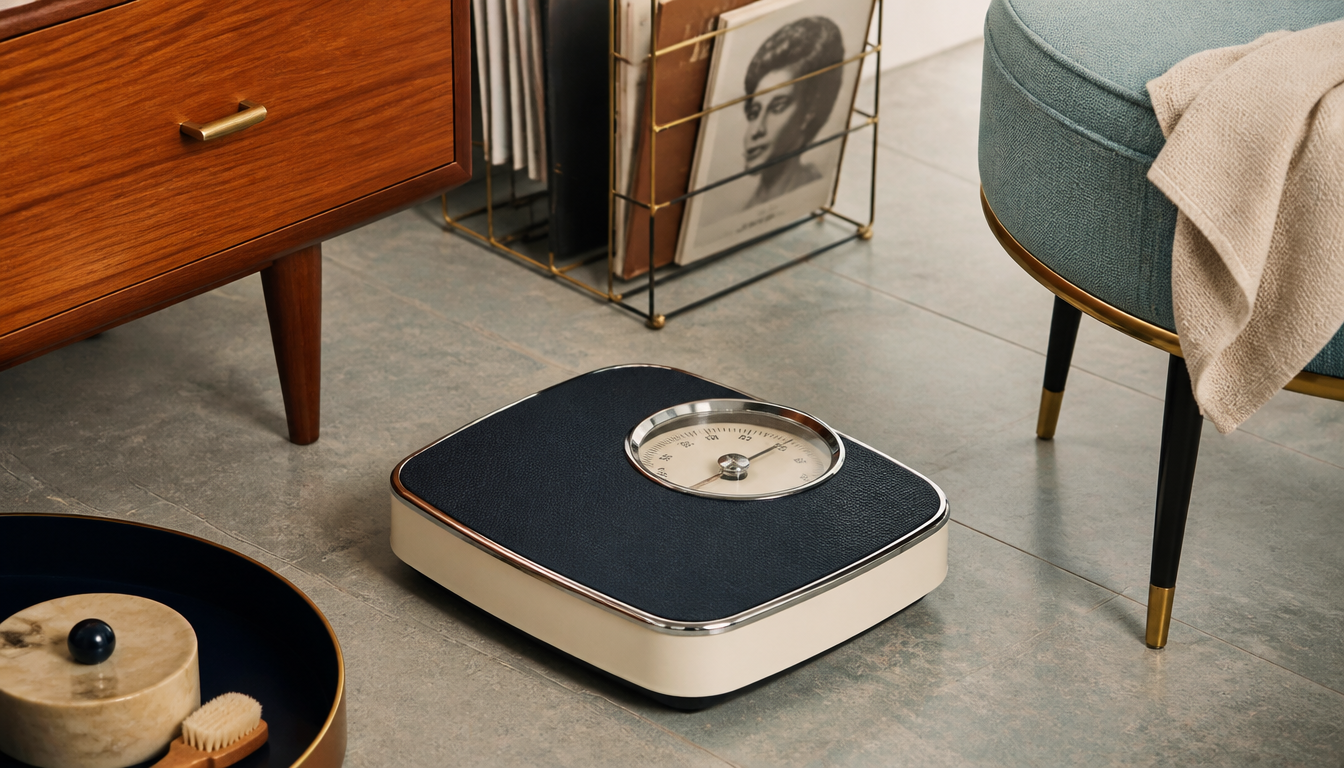
While other manufacturers in the 1970s were still relying on mechanical dials, Soehnle had already launched its first electronic bathroom scales, quietly making design history in the process. Bathroom scales are rarely the stars of industrial design museums, yet they have a lot to say. Soehnle’s early shift to electronics in the 70s shows how functionalist design language and technological progress went hand in hand: less dial nostalgia, cleaner lines, greater precision. For you as a vintage enthusiast, this means a Soehnle piece from that era is not just a bathroom accessory but a tangible document of West German industrial design that had the courage to go digital before everyone else.
Soehnle Bathroom Scales: How a Bathroom Scale Became an Icon of Functionalism
As early as the 1970s, Soehnle presented its first electronic bathroom scales while other manufacturers were still holding on to mechanical models. This technological head start was no coincidence, but the result of a design philosophy that consistently thought function and form together.
A Design Language Between Kitchen and Bauhaus
Anyone who picks up a Soehnle scale from the 1950s to the 1970s today is holding a small piece of applied functionalism. Clean lines, reduced scale markings, robust housings without unnecessary ornamentation: this was no aesthetic coincidence, but reflected the spirit of a design era that understood usability as beauty. You can see similar principles in the work of the Bauhaus movement, for example in the Bauhaus Exhibition Poster or the Bauhaus Sun Poster, which show how consistently this attitude shaped the visual thinking of an entire era.
4 Practical Implications for You as a Consumer
1. Analogue Scales Are Not Outdated – They Are a Design Choice
Soehnle’s current range still includes analogue bathroom scales such as the “Tempo White”, with a platform measuring 27 x 29 cm, a maximum capacity of 130 kg and an accuracy of 1,000 g. The generously sized full-view dial is deliberately designed for easy readability. Those who appreciate analogue measuring instruments get no compromise solution here, but a well-considered continuation of classic design principles.
2. Electronic Scales Had an Early Start
The first generation of electronic Soehnle scales came onto the market as early as the 1970s. Anyone who comes across an early electronic bathroom scale at a flea market or vintage dealer today may well be holding one of the earliest examples of this product category. That carries collector’s value, but also relevance for understanding the history of devices.
3. Body Analysis Scales Are the Logical Next Step
The current top model, the “Shape Sense Connect Lite”, combines BIA body analysis for muscle mass, body fat and water content with four electrodes and a Magic LED display that only becomes visible when you step on it. The measurement functions would have been science fiction in the 1970s. For those seeking orientation in the retro-tech cosmos, there is a direct line from the mechanical dial scale to the smart sensor.
4. Travel Scales Are a Practical Addition to the Range
Soehnle also offers a luggage scale called “Travel” with a 50 kg capacity, 100 g accuracy and a robust carrying strap with a metal hook. Again: no superfluous elements, clear purpose, classic handling. A direct legacy of the functionalist approach.
Why This Matters for Vintage Enthusiasts
Anyone who wants to experience design history not just in a museum will find in old Soehnle scales concrete everyday objects that make formal history tangible. The same applies to other artefacts from this era: patent drawings, for instance, document the aesthetics of technical objects in their own way. Take a look at the Patent Drawing Stethoscope or the Patent Drawing Coffee Roasting Drum, which display the same sober drawing style that Soehnle also used in its product communication during the post-war decades.
Anyone wishing to furnish their living space with a vintage design language will find a curated selection of posters, canvases and décor in the reetro Shop that captures exactly this spirit – including Bauhaus-style decorative cushions and Bauhaus Hexagon wall art.
Sources
- Soehnle Bathroom Scales: History of Electronic Scales
- Personal scales | Soehnle – Product overview at Leifheit
FAQ
When did Soehnle actually start making electronic bathroom scales?
Soehnle brought its first electronic bathroom scales to market as early as the 1970s. That was quite bold, as most other manufacturers were still firmly committed to their mechanical models at the time. Soehnle was a genuine pioneer – before the word ‘pioneer’ was worn out by marketing brochures.
What makes the design of Soehnle scales from the 1950s to 1970s so special?
The design language of those decades followed the principles of functionalism: clean lines, reduced forms, nothing superfluous. Analogue models such as the later ‘Tempo White’ illustrate this well: a clear full-view dial, a compact platform, no frills. Design as a direct response to the intended purpose.
Did Soehnle also make travel scales during that era?
Travel scales remain part of the Soehnle range to this day. Current models such as the ‘Luggage Scale Travel’, with its metal hook and sturdy carrying strap, carry forward the same no-nonsense philosophy that defined the brand’s early decades: robust, straightforward, to the point.
How large are typical Soehnle scale platforms, and why is that relevant to design?
Analogue Soehnle scales come with platform dimensions of around 27 x 29 cm and a capacity of up to 130 kg. These compact measurements are no coincidence: they reflect the ambition to create an everyday object that fits into the bathroom without dominating it. Minimum footprint, maximum function.
What came after the mechanical era, and how did Soehnle manage the transition?
Following the analogue models of the early decades, Soehnle gradually developed digital and body-analysis scales, such as the ‘Shape Sense Connect Lite’ with BIA technology for muscle mass, body fat and water content. The design thread remained intact throughout: clear displays that only light up when you step on the scale, and four electrodes for precise measurement. Function first, form follows.
This article was generated automatically by an AI system. Disclosure pursuant to Article 50 of the EU AI Act.