
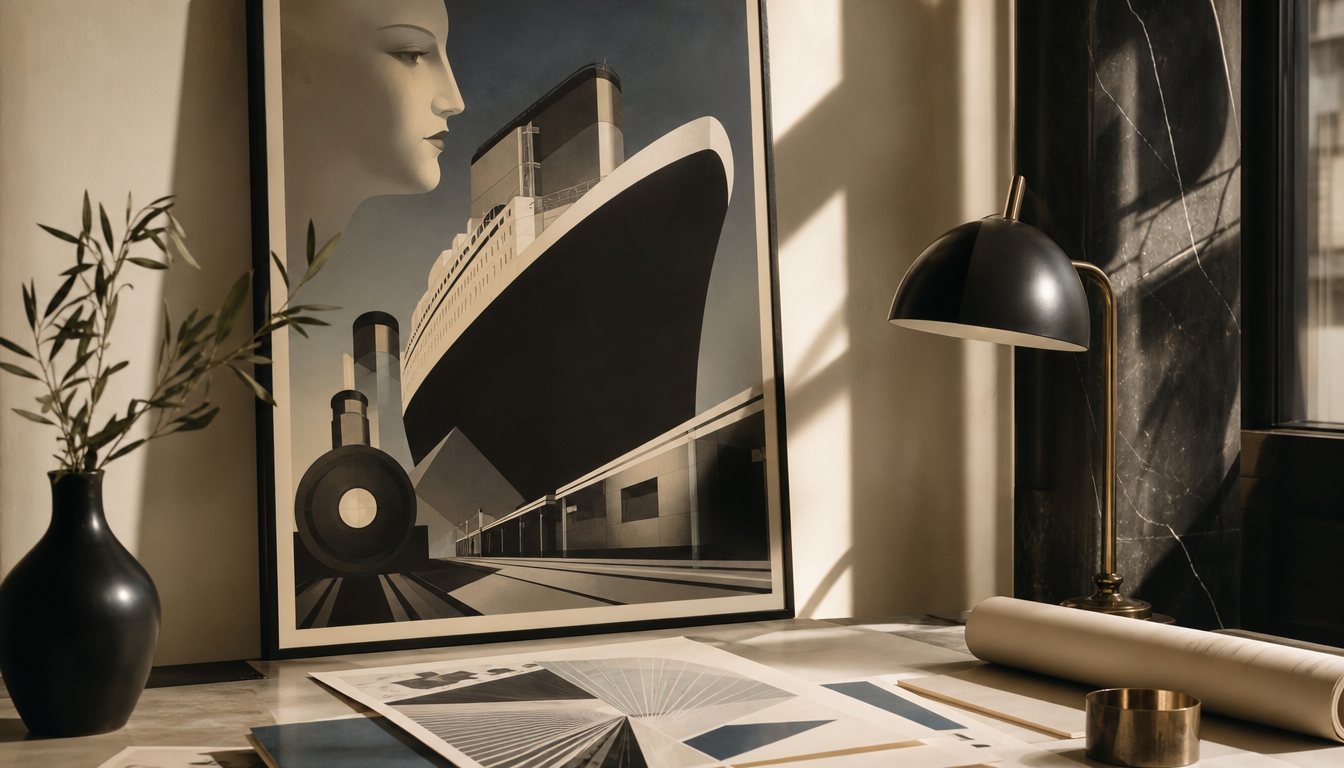
A.M. Cassandre created at least five iconic Art Deco posters between 1923 and 1935, won first prize at the 1925 Paris Exposition des Arts Décoratifs and the Grand Prix in 1937, thereby defining the visual language of the modern French advertising poster. Cassandre demonstrated that advertising graphics can be genuine art. His posters for Nord Express (1927) and the SS Normandie (1935) brought Cubism and geometry directly to the streets. Anyone who loves sneaker culture knows this principle: strong design makes an object timeless. Cassandre’s work lives on today in logos, typefaces and visual languages we encounter every day.
A.M. Cassandre: How a Poster Artist Brought Art Deco to the Streets
Between 1923 and 1935, a single graphic designer fundamentally transformed the face of European advertising. Adolphe Jean-Marie Mouron, who worked under the pseudonym Cassandre, created posters that carried Art Deco out of the salons and directly into everyday life.
Who Was Cassandre?
Cassandre was born on 24 January 1901 in Kharkiv (then part of the Russian Empire), the son of a French wine merchant. When the First World War broke out, the family returned to Paris. There he studied at the École des Beaux-Arts and the Académie Julian. As early as 1923 he was working commercially under his pseudonym, which he retained for the rest of his life.
His first major poster, Au Bûcheron (1923), immediately attracted attention. It was followed by works now regarded as icons: Étoile du Nord (1927), Nord Express (1927), the serial Dubonnet campaign (1932) and finally the poster for the ocean liner SS Normandie (1935).
In 1926 he co-founded the Alliance Graphique with Maurice Moyrand, one of France’s first modern advertising agencies. He won first prize for graphic design at the 1925 Paris exhibition, and in 1937 received a Grand Prix at the Exposition Internationale.
Geometry Meets Speed: The Technical Innovation
What set Cassandre’s work apart from the poster painting of his era was the consistent fusion of Cubist pictorial structures, clear geometric forms and a colour language that remained effective even at a distance. His train posters, for instance, depicted locomotives head-on and near-abstractly, conveying an immediate sense of speed and industrial power.
Alongside his poster work, he designed typefaces for the Parisian type foundry Deberny & Peignot: Bifur (1929), Acier Noir (1935) and Peignot (1937). These typefaces influenced graphic design practice far beyond his own career.
From 1939 onwards he turned primarily to stage design, working among others for the Comédie-Française and the Opéra de Paris. He died on 19 June 1968 in Paris.
What This Means for You: 4 Practical Implications
1. Vintage posters are not impulse buys — they are style decisions. Cassandre’s posters show that commercial graphics and fine art are not opposites. Anyone who hangs a travel poster or an advertising poster from the Art Deco era on their wall today is making a conscious design statement. In the reetro Poster Shop you’ll find motifs that draw on exactly this aesthetic — for example the Retro Travel Poster Hong Kong or the Acapulco Retro Travel Poster.
2. The visual language still works today. Geometry, clean colour fields, strong contrasts: these are not passing trends but principles that Cassandre developed systematically. Designs in the Bauhaus or Art Deco style tend to hold up particularly well in living spaces because they do not overwhelm. The Bauhaus Exhibition Poster or the Bauhaus Sun Poster show just how close that kinship still is today.
3. Travel motifs have their own design history. Cassandre’s ocean liner and train travel posters were no harmless tourism advertising — they were images of a new, mobile modernity. That legacy lives on in city map posters and travel motifs. Take a look, for example, at the City Map Paris Poster or the City Map Berlin Poster.
4. Take typography seriously as a design element. Cassandre’s typefaces such as Bifur and Peignot were not accompanying text but an integral part of the image. Anyone choosing wall décor should treat typography with similar respect: as form, not merely as information. The London Underground Advertising Poster or the Zenith Watches Advertising Poster make this approach visible.
Ready to bring some Cassandre energy to your walls? Browse the entire reetro Shop or head straight to the Poster category and Canvas category.
Sources
- Cassandre | Art Deco, Advertising, Posters | Britannica
- A.M. Cassandre – The Graphic Design School
- Cassandre’s posters helped art deco to “elbow its way in” | Dezeen
FAQ
Who was A.M. Cassandre, and why did he work under a pseudonym?
Cassandre was the artist name of Adolphe-Jean-Marie Mouron, born in 1901 in Kharkiv (then part of the Russian Empire) to a French wine merchant. When the First World War broke out, the family moved to Paris. He studied at the École des Beaux-Arts and the Académie Julian. From 1923 onwards he worked under the pseudonym Cassandre, which he retained until his death in 1968. He deliberately dropped his given name in order to position himself as an independent creative voice in the Parisian advertising market.
Which posters established Cassandre's reputation in the 1920s and 1930s?
Even his first commercial poster, Au Bûcheron (1923), attracted immediate attention. In the years that followed he designed a series of travel and product posters that defined the visual style of French Art Deco: Étoile du Nord (1927), Nord Express (1927), the serial Dubonnet campaign (1932) and the poster for the ocean liner SS Normandie (1935). The latter remains one of his best-known works to this day. The 1937 Paris Exposition Internationale honoured him with the Grand Prix.
What made Cassandre's poster style technically and visually so distinctive?
Cassandre combined the Art Deco visual vocabulary with influences from Cubism to create a clear, geometric pictorial language designed for impact across urban distances. He used strong perspectives and reduced colour fields to give subjects such as trains or ocean liners a monumental presence. His poster for Nord Express (1927), for instance, features a Cubism-inspired frontal view of the locomotive. This combination of precision and visual power elevated advertising posters for the first time to the level of independent works of art.
Did Cassandre influence areas of design beyond posters?
Yes. Cassandre also designed typefaces, including Bifur (1929), Acier Noir (1935) and Peignot (1937), all produced for the Parisian type foundry Deberny & Peignot. In 1926 he co-founded the Alliance Graphique with Maurice Moyrand, one of France’s first modern advertising agencies. He later turned to stage design, working among others for the Comédie-Française and the Opéra. The still-famous interlocking YSL logo for Yves Saint Laurent is also his work.
What role did Cassandre play in bringing Art Deco into everyday life?
Cassandre played a significant part in moving Art Deco out of galleries and into the public urban space. He viewed the poster not merely as an advertising medium but as a format capable of actively shaping the cityscape. Works such as the Normandie poster or the Dubonnet campaign made the style visible and accessible to a broad audience. The International Exhibition of Decorative and Industrial Arts in Paris in 1925, where he won first prize for graphic design, definitively established him as one of the central figures of the movement.