
Bauhaus Poster Prints
The Bauhaus school gave design its modern conscience. These prints distil the movement's core conviction — that geometry, colour and type are not ornament but structure — into works that remain as precise and compelling as they were a century ago.
Between 1919 and 1933, the Bauhaus school in Weimar, Dessau and Berlin reshaped the relationship between art, craft and industry. Walter Gropius founded the school with the belief that visual discipline and functional thinking were inseparable — that a poster, a chair, a typeface and a building should all obey the same fundamental principles. The poster became one of the school's most powerful documents: a flat surface on which composition, colour theory and typographic logic could be tested at scale. Today, Bauhaus posters remain some of the most intellectually rigorous graphic works ever made, and their authority has only deepened with time.
What makes the Bauhaus aesthetic so durable is precisely its refusal of the superfluous. Colour is never applied for atmosphere or mood — it is deployed as information. Red advances, blue recedes, yellow radiates. The primary triad, isolated from all mixing and graduation, forces the eye to read relationships rather than nuances. Geometric forms — the circle, the triangle, the square — carry the same logic. They are the irreducible vocabulary of visual communication, stripped of cultural association and personal gesture. A Bauhaus print placed on a wall does not merely decorate a room; it introduces a quiet visual argument into the space.
Reetro's Bauhaus collection is printed on heavyweight, fine-art matte paper using archival pigment inks. The decision to use matte rather than gloss is not incidental: it preserves the flat, poster-like character of the originals, where ink sat on the surface rather than beneath it. Colour accuracy is calibrated to the historical source material, and each print is printed to order by our production partner in the EU. The result is a reproduction that honours the original's intention without pretending to be a facsimile — an object of genuine quality for interiors that take design seriously.
Hanging a Bauhaus print is an exercise in the same compositional thinking the movement championed. A single large-format piece on a plain wall needs nothing else around it — the geometry is its own context. A triptych of smaller prints, evenly spaced, creates a horizontal rhythm that the Bauhaus masters would have found entirely natural. What these prints resist is the merely decorative arrangement: crowded gallery walls, competing patterns, ornate frames. A slim black or white metal frame, flush against the wall, allows the work to speak without interruption. The Bauhaus had a word for this kind of clarity — Sachlichkeit, objectivity — and it is the quality that makes these prints as relevant in a contemporary interior as in any other.
- 01 Strict geometric forms — circles, triangles and rectangles as the sole building blocks of composition.
- 02 Primary colour palette used with deliberate restraint, never decoratively but always structurally.
- 03 Typography as visual architecture — sans-serif letterforms carry the same weight as graphic elements.
- 04 Asymmetric grid layouts that create dynamic tension while preserving overall visual balance.
Bauhaus Poster Prints
The Bauhaus school gave design its modern conscience. These prints distil the movement's core conviction — that geometry, colour and type are not ornament but structure — into works that remain as precise and compelling as they were a century ago.
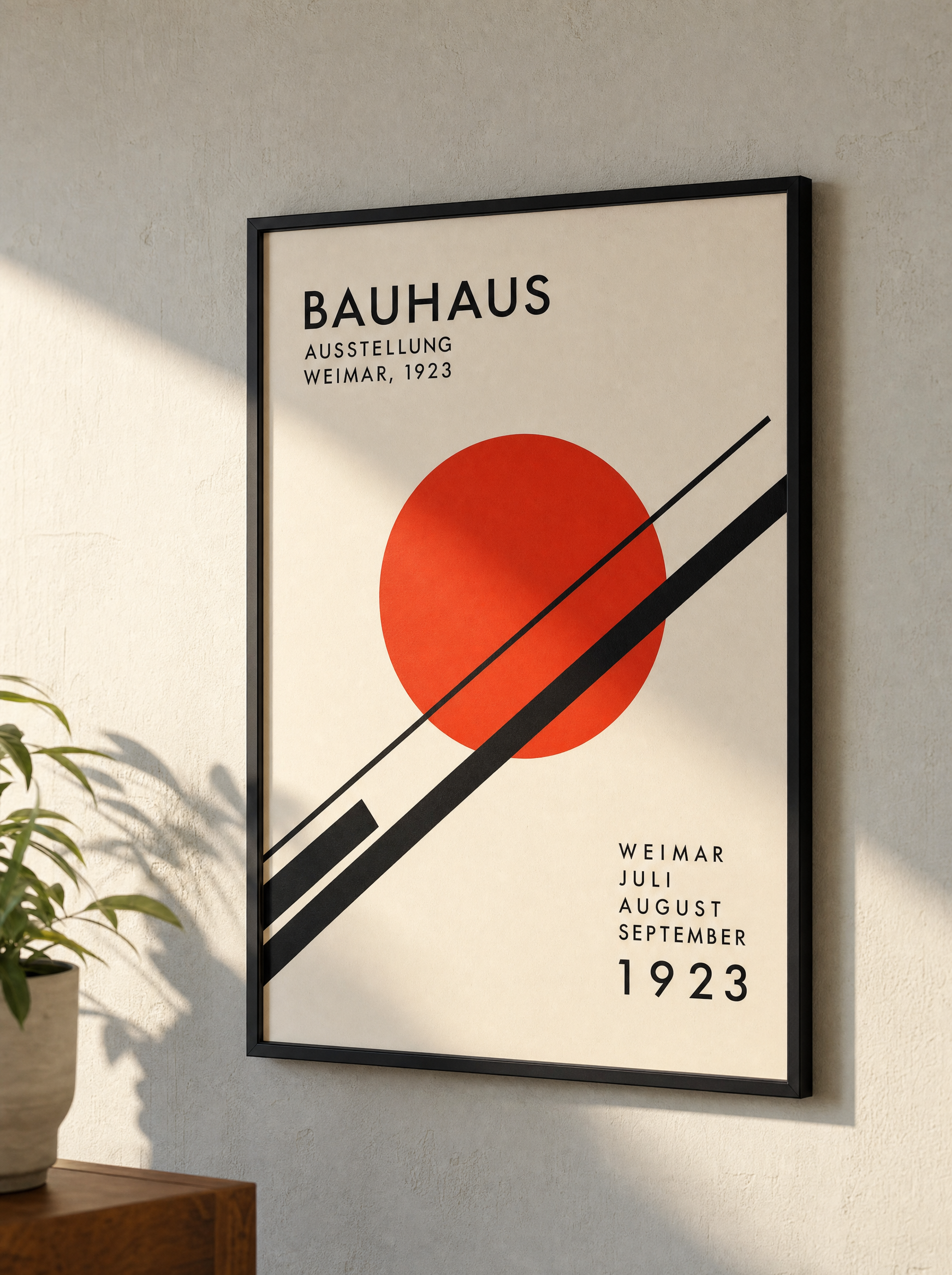
Form follows function — a single framed print redefines a wall
Form follows function — a single framed print redefines a wall.
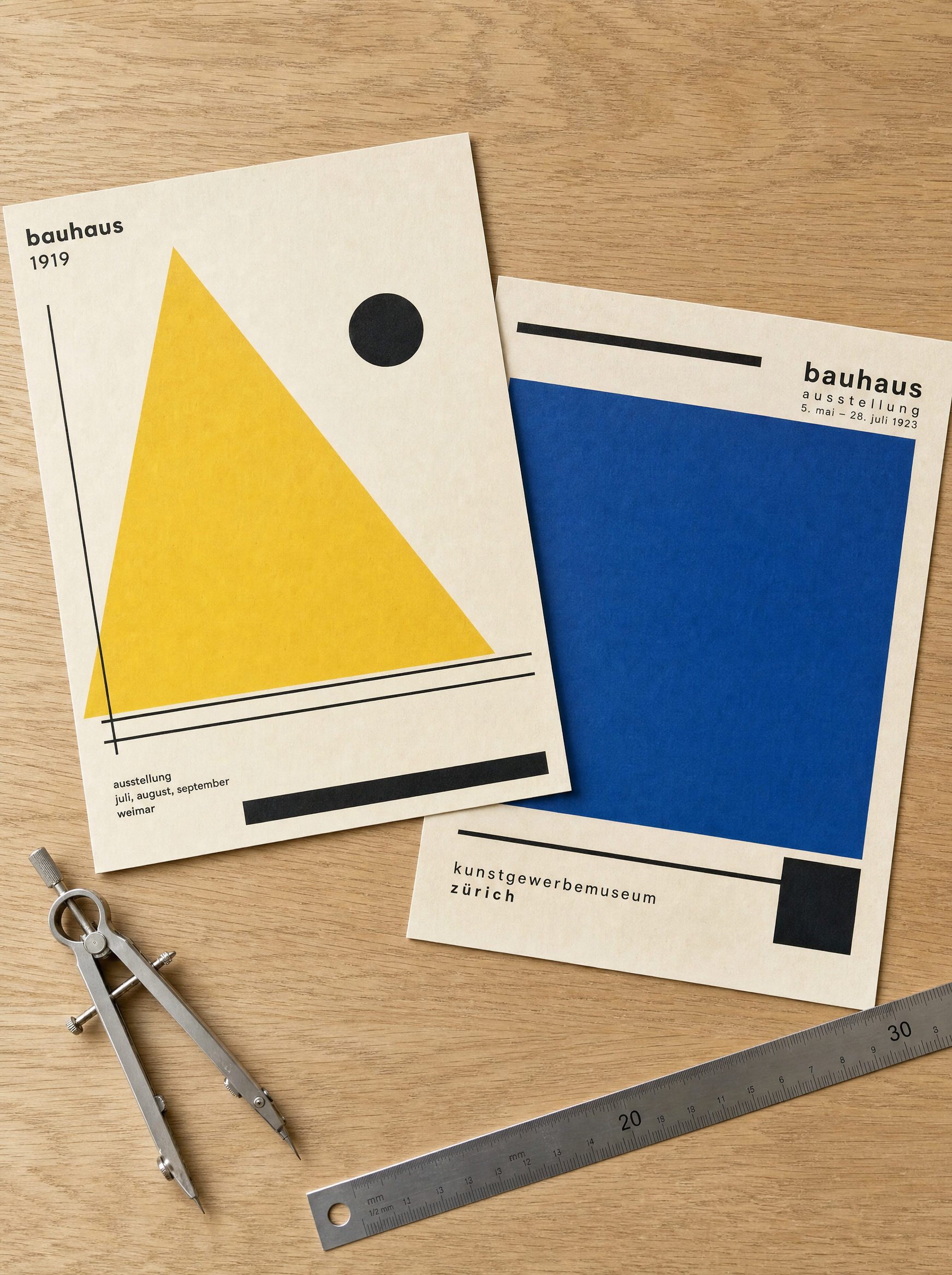
Geometry as language — the Bauhaus reduced design to its essential elements
Geometry as language — the Bauhaus reduced design to its essential elements.
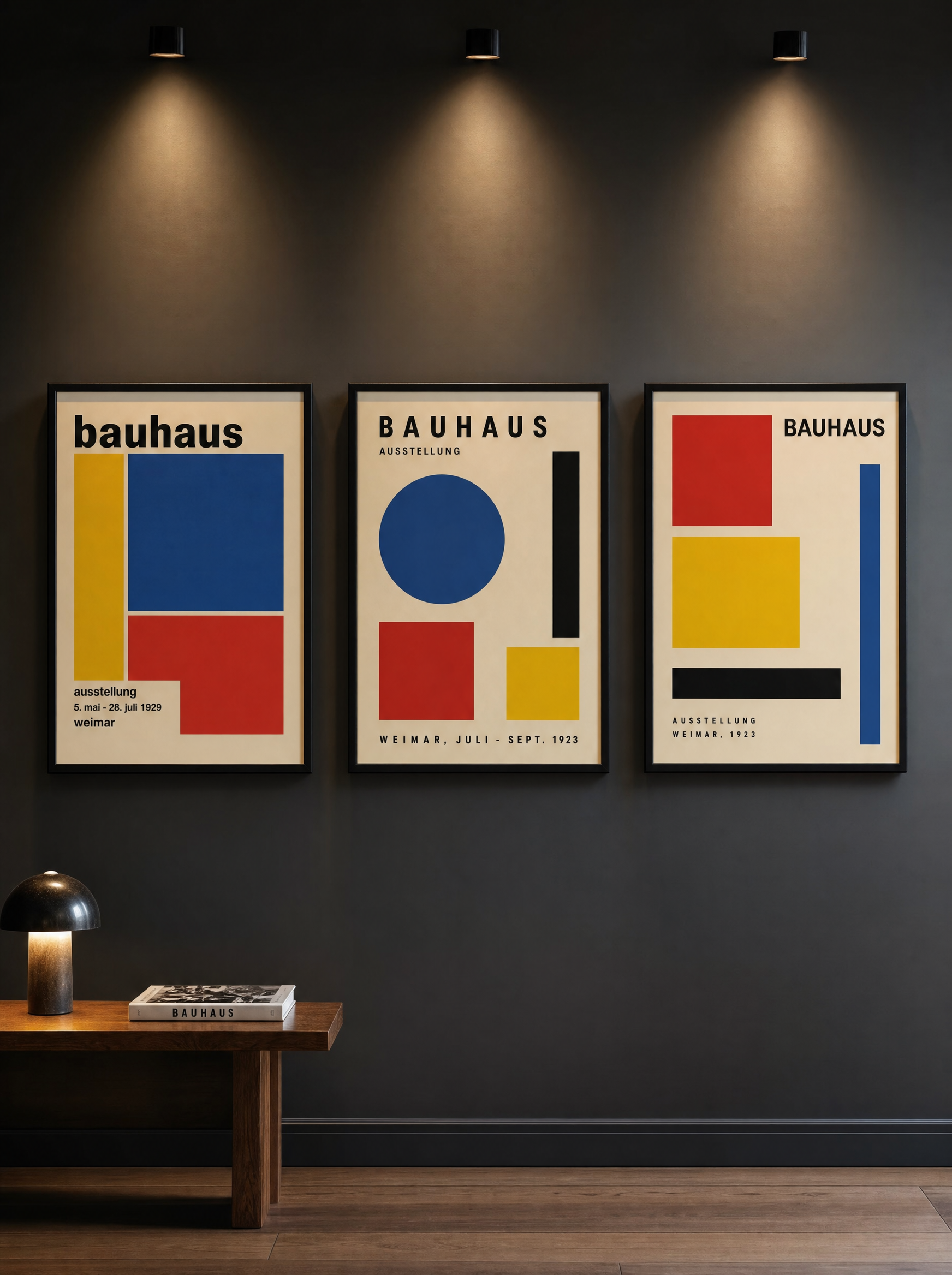
A considered arrangement of three prints brings gallery composure to any interior
A considered arrangement of three prints brings gallery composure to any interior.
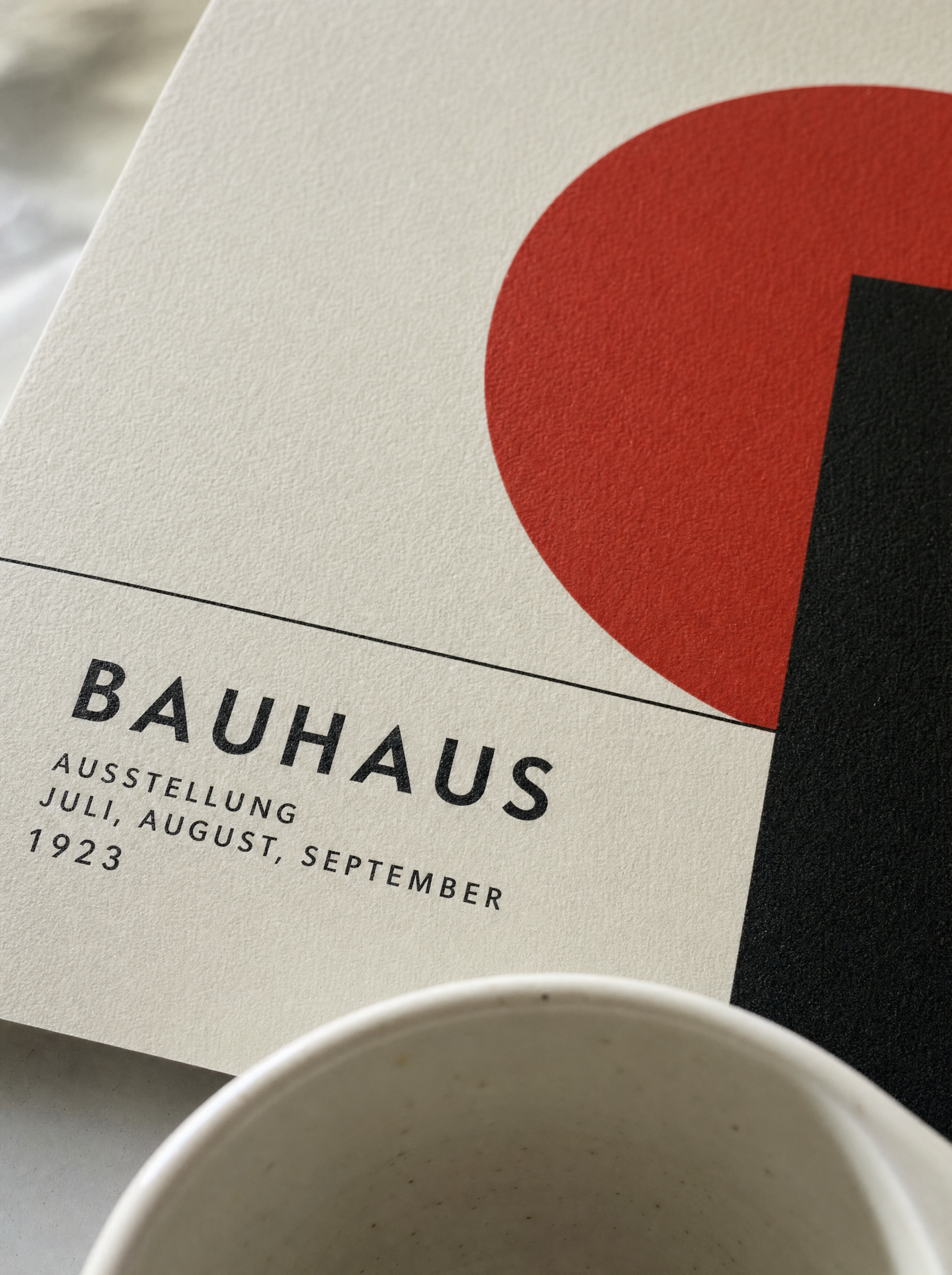
Printed on heavyweight matte paper — the material quality is as deliberate as the design itself
Printed on heavyweight matte paper — the material quality is as deliberate as the design itself.
The Bauhaus strives to bring together all creative effort into one whole, to reunify all the disciplines of practical art.