
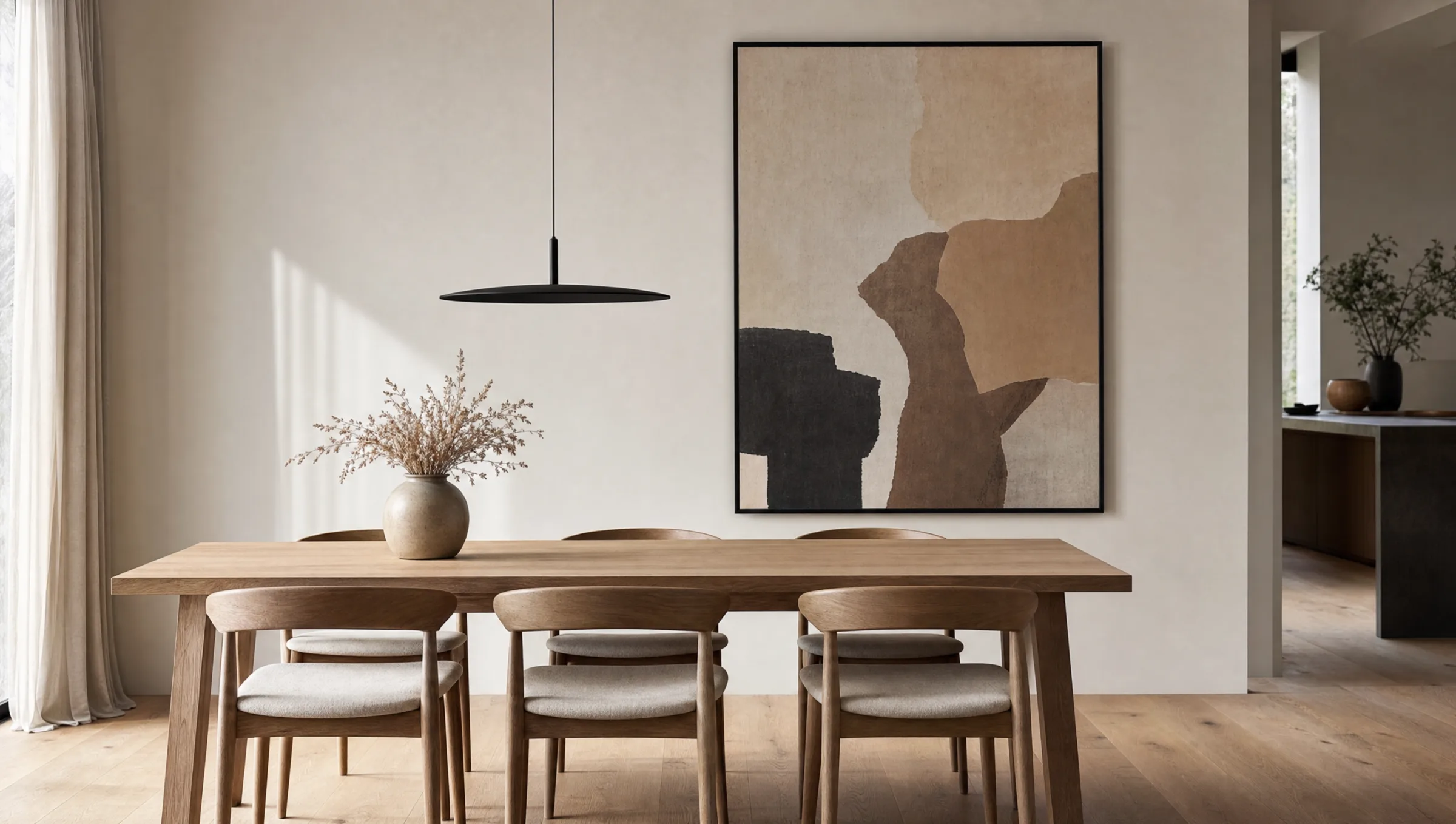
Modern Dining Room Wall Art: Ideas for a Calm, Contemporary Wall Display
The dining room is a space for lingering – and the wall behind it shapes its atmosphere more than any piece of furniture. Modern dining room wall art works with restrained formats, considered colour palettes, and materials that absorb light rather than reflecting it back.
What Defines Modern Dining Room Wall Art
Modern dining room wall art is not driven by effects, but by clear decisions. Rather than many small decorative elements, a larger single motif, a quiet colour plane, or a restrained gallery wall with a few curated works tends to take centre stage. The relationship between image size, table width and wall height matters: as a rule of thumb, a central work should span roughly two thirds of the table's width.
The colour climate also plays a role. Modern dining rooms often favour muted tones such as greige, sage, warm off-white or matte anthracite. Art is chosen to echo this underlying mood rather than compete with it. Black-and-white photography, abstract line work and reduced still lifes work particularly reliably in this context.
Finally, lighting is decisive. Pendant lamps above the dining table direct their light downward, so wall art in the background is best presented through indirect daylight or dedicated wall-wash spotlights. Matte surface finishes are more forgiving than high-gloss ones, because they do not pick up reflections from the pendants.
Four Concepts for Modern Dining Room Wall Art
Four recurring design principles that have proven themselves in modern dining rooms – each with a note on which spatial situation they suit best.
Large Format Solo
A single XXL poster or canvas in a 100×140 cm format behind the dining table reads like an architectural element. Well suited to high walls and understated table arrangements.
Diptych in Equal Measure
Two equally sized works side by side with a narrow gap. The principle works well above wide sideboards and gives the wall rhythm without making it restless.
Curated Trio
Three motifs in different formats but sharing a common colour or thematic thread. Ideal when the room already has calm furniture and little pattern.
Material as Accent
Instead of multiple prints, a hexagonal aluminium wall panel or a high-quality canvas object. The materiality takes the lead role; the motif remains graphically reduced.
Formats, Materials and Hanging Height
For modern dining room wall art, three print materials have established themselves: high-quality FSC-certified paper from 200 g/m² behind matte glass, premium canvas on stretcher bars, and aluminium wall panels. Paper brings a reserved, almost painterly quality; canvas feels more classical and echoes the textiles at the table; aluminium remains graphic and cool – well suited to concrete, glass and steel interiors. All Reetro prints are printed to order by our production partner in the EU to ensure consistent quality across all three substrates.
Hanging height is guided not by standing eye level but by the seated position. The standard distance between the table top or sideboard surface and the lower edge of the frame is 25 to 40 centimetres. This keeps the centre of the image comfortably visible while seated, without pendant lamps cutting across the motif.
For gallery walls, it helps to lay out the arrangement on the floor first and test positions with paper templates on the wall. Consistent gaps of four to six centimetres between frames produce the calmest result.
A modern wall in the dining room does not need to be loud – it should carry the room, not explain it.
Reetro editorial team
Motifs That Work Long-Term in the Dining Room
Not every motif holds up in the daily life of a dining room. Art that hangs here is seen multiple times a day – at breakfast, at dinner, during conversation. It should therefore have depth without being intrusive. Abstract colour fields in earth tones, architectural lines, botanical studies, and quiet landscape photography with expansive sky or water have proven themselves over time.
Those aiming for distinctly modern dining room wall art can work with minimalist typography or line-illustration prints. These motifs read graphically clean and harmonise with the straight edges of contemporary dining tables. Text-based motifs are best used sparingly – a single typographic work has more presence than several placed side by side.
In terms of colour, it pays to align the work with one element in the room: the wood grain of the table, the upholstery of the chairs or the tone of the rug. This creates visual coherence without making the space feel monothematic.
Care and Longevity
Because cooking and eating take place in the dining room, fine aerosols settle on the walls over time. Matte-coated prints and canvases can be wiped with a dry microfibre cloth; cleaning products should be avoided. Aluminium wall panels are the most straightforward to maintain in this regard and remain stable over the long term even in open-plan kitchen-dining spaces.
Prolonged direct sunlight each day shortens the colour stability of any print. Where possible, art should not hang in direct midday sun, or should be printed with UV-stable pigment inks to preserve colour fidelity over many years.
Häufige Fragen
-
01
What formats work best for modern dining room wall art?
For modern dining room wall art, large single works from 70×100 cm upward and diptychs of two equally sized pieces have proven most effective. Above narrow sideboards, portrait formats work well; behind long dining tables, landscape formats that span roughly two thirds of the table's width are usually preferable. Square formats read particularly calmly and are a strong option when the room already contains many different lines and shapes.
-
02
Which colours suit a modern dining room?
Modern dining rooms typically work with muted, largely matte tones: greige, sage, sand, warm off-white, matte anthracite and broken earth colours. Art is ideally chosen to echo this underlying mood rather than compete with it. A single accent tone – rust, olive green or a deep blue, for example – can run through the motif and connect with upholstery, a vase or the rug.
-
03
How high should modern dining room wall art be hung?
The gap between the table top or sideboard surface and the lower edge of the frame is typically 25 to 40 centimetres. This keeps the centre of the image clearly visible while seated, and prevents pendant lamps from cutting across the motif. When hanging a piece above a sideboard, erring slightly lower rather than higher helps maintain the visual connection to the furniture below.
-
04
Gallery wall or single piece – which looks more contemporary?
Both can look contemporary, but they follow different principles. A large single work emphasises calm and architecture and is often favoured in pared-back interiors. A curated gallery wall of three to five pieces allows more narrative, but needs a clear unifying thread in colour, frame or subject matter. As a general rule, fewer works printed larger and at higher quality read as more current than many small individual pieces.
-
05
Which material is easiest to care for in the dining room?
Fine aerosols from cooking and eating are unavoidable in the dining room. Aluminium wall panels – including hexagonal formats – are the most straightforward: they can simply be wiped clean. Matte premium canvases and framed prints on FSC paper from 200 g/m² are also durable long-term but should only be cleaned dry with a microfibre cloth. All Reetro prints are printed to order by our production partner in the EU with UV-stable pigment inks, which preserves colour accuracy over many years.