
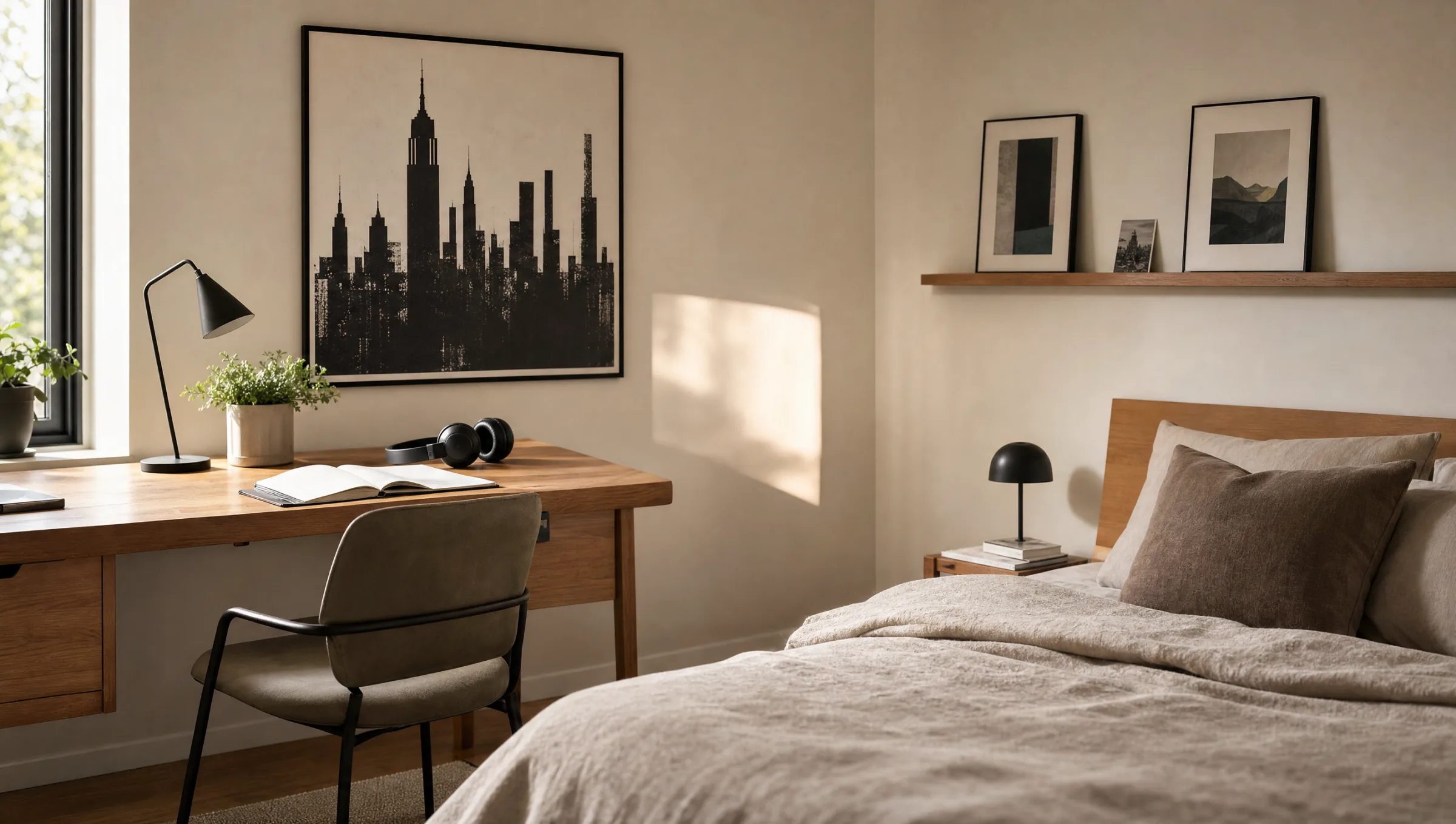
Choosing the Right Wall Art for Teenage Rooms
A teenager's room changes fast — interests, music taste and aesthetic preferences can shift within a matter of months. Good wall art for teenage rooms needs to do more than fill a blank space: it should express personality without cluttering the room, and ideally remain relevant as tastes evolve over time.
Why Wall Art for Teenage Rooms Is More Than Decoration
In the years between a childhood bedroom and a first home of one's own, a teenager's room becomes a retreat, a workspace and a space for self-expression all at once. The wall above the desk or the bed is often the first surface where identity becomes visually tangible. Unlike furniture, wall art for teenage rooms can be swapped, added to or reframed without much effort.
This makes prints and posters a flexible design element. Parents who help plan a room should look less for whatever motif is currently popular and more for images with staying power: graphic works, photographic cityscapes, abstract compositions or understated nature scenes. These categories survive several taste phases without feeling childish or generic.
The overall tone of the room matters too. A quiet wall colour can carry a bolder, more expressive motif. In rooms already busy with open shelving, posters and pinboards, a more restrained main print tends to hold the composition together better.
Popular Motif Categories for Wall Art for Teenage Rooms
Four motif directions that work well in teenage rooms across different age groups — from 12 to 18 and beyond.
Skylines and travel motifs
Tokyo at night, New York street scenes or Parisian rooftops: city motifs work particularly well for older teens because they convey wanderlust and ambition without feeling juvenile.
Sport and movement
Surfers in backlight, skaters, basketball scenes or mountain sport imagery: sports prints bridge the gap between hobby and style. In black and white they sit more quietly in the room and outlast changes in taste.
Music, film and pop culture
Typographic lyrics, abstracted album artwork or film-poster prints in an editorial style replace the classic band poster while integrating into the room's design rather than competing with it.
Abstract and graphic art
Flat colour compositions, line-based works and mid-century graphics offer a calmer alternative. They give the room a more grown-up feel and leave room for rotating posters alongside them.
Format, Size and Hanging in a Teenage Room
Teenage bedrooms are rarely large, yet wall art for teenage rooms does not have to be small. A single larger format above the bed — around 70 × 100 cm or 80 × 120 cm — often looks tidier than many small pieces that accumulate over time. The bottom edge of the frame should sit roughly 15 to 25 centimetres above the top of the bed frame, so that pillows and the frame do not crowd each other.
Above a desk, a small gallery wall of two to four prints in mixed portrait and square formats works well. Anyone wanting flexibility can mount picture ledges: prints, postcards and photos can be rearranged at any time without marking the wall.
For framing, slim, simple profiles in black, oak or aluminium are a reliable choice. They give structure to the motif without competing with the content. For very busy motifs, a mat board is worth considering — it adds visual calm and makes the print feel more considered overall.
Good wall art for teenage rooms is not decided by the motif alone, but by whether it will still feel right two years from now.
Reetro Editorial
Materials and Print Quality That Hold Up Day to Day
Teenage rooms are lived in: things get moved around, projects happen on the floor, layouts change. The chosen material needs to cope with that. Classic poster prints on matte FSC-certified paper from 200 g/m² upwards look quality and reflect very little light — which matters when a desk sits directly opposite a window.
Premium canvas is a strong option for larger formats above the bed: it requires no glass, is resistant to knocks, and sits quietly in the room. Hexagonal aluminium wall panels suit modern, graphic concepts and can be expanded module by module without disrupting the overall composition. Printed to order by our production partner in the EU, Reetro's prints are produced on FSC-certified papers with a matte coating throughout.
When choosing a print, it is worth checking colour depth and lightfastness. Pigment-based prints retain their colours over many years even in direct daylight — relevant in south-facing teenage rooms where a piece of wall art for teenage rooms may hang through several summers.
Choosing Wall Art for Teenage Rooms Together
The most important advice last: wall art for teenage rooms should not be bought over the head of whoever lives there. Even when parents set the format and the budget, the choice of motif belongs to the young person. A practical approach is to prepare a shortlist of three to five options and make the final decision together.
Anyone wanting to preserve the element of surprise as a gift can combine a voucher with a curated selection of motifs. This avoids a misspent purchase, and the print gains a personal story that goes beyond the object itself.
Häufige Fragen
-
01
What wall art for teenage rooms works for 12- to 14-year-olds?
In this age group, motifs that sit between a children's room and early teen style tend to work best. Popular choices include sports themes such as surfing, skateboarding or basketball, as well as graphic animal illustrations, world maps and space imagery. The key is to choose wall art for teenage rooms that does not look too playful — otherwise it may need replacing within a year. Slim black or light wood frames give the motifs a more grown-up quality. One larger main print above the bed, paired with a picture ledge holding smaller pieces, is a flexible arrangement for this phase.
-
02
How large should wall art for teenage rooms be?
Above the bed, a main format of around 70 × 100 cm or 80 × 120 cm works well. It fills the wall without feeling oppressive. Above a desk, smaller formats such as 30 × 40 cm or 40 × 50 cm make sense, ideally arranged as a pair or group of three. A useful rule of thumb: the print should span roughly two-thirds of the width of the furniture below it. In very small rooms under twelve square metres, it is generally better to choose one larger piece of wall art and a few supporting items rather than scattering many small prints around the space.
-
03
Poster or canvas — which is better for a teenage room?
Both have their place. Posters on matte paper are affordable, easy to swap out and suit teenagers who like to change their motifs frequently. Premium canvas is more robust, requires no glass and looks particularly composed in larger formats above the bed. If a print is intended to stay up for a long time — a photographic cityscape or an abstract composition, for example — canvas or an aluminium panel is a sound long-term choice. For gallery walls made up of several smaller formats, framed paper is usually preferable because it creates clean, defined edges.
-
04
How should wall art for teenage rooms be hung?
The centre of the print should sit at roughly eye level, around 145 to 155 centimetres from the floor. Above furniture such as a bed or desk, use the top edge of the furniture as a reference: 15 to 25 centimetres of clearance between furniture and frame tends to look balanced. Heavier pieces need wall plugs; lighter posters can be hung with adhesive hooks or placed on picture ledges. Anyone who wants flexibility can mount one or two ledges — prints can then be rearranged without drilling new holes. A spirit level and pencil marks prevent crooked results.
-
05
What should you look for in print quality?
The key factors are paper weight, surface finish and lightfastness. From 200 g/m² upwards, a print feels substantial and will not bow inside the frame. A matte coating reduces reflections, which is practical in a teenage room where a desk lamp or window can otherwise cause glare. Pigment-based inks keep colours stable for many years, even with regular exposure to sunlight. Reetro prints posters and canvases to order through its production partner in the EU on FSC-certified papers from 200 g/m² with a matte finish — a useful benchmark for the quality criteria worth looking for when buying wall art generally.