
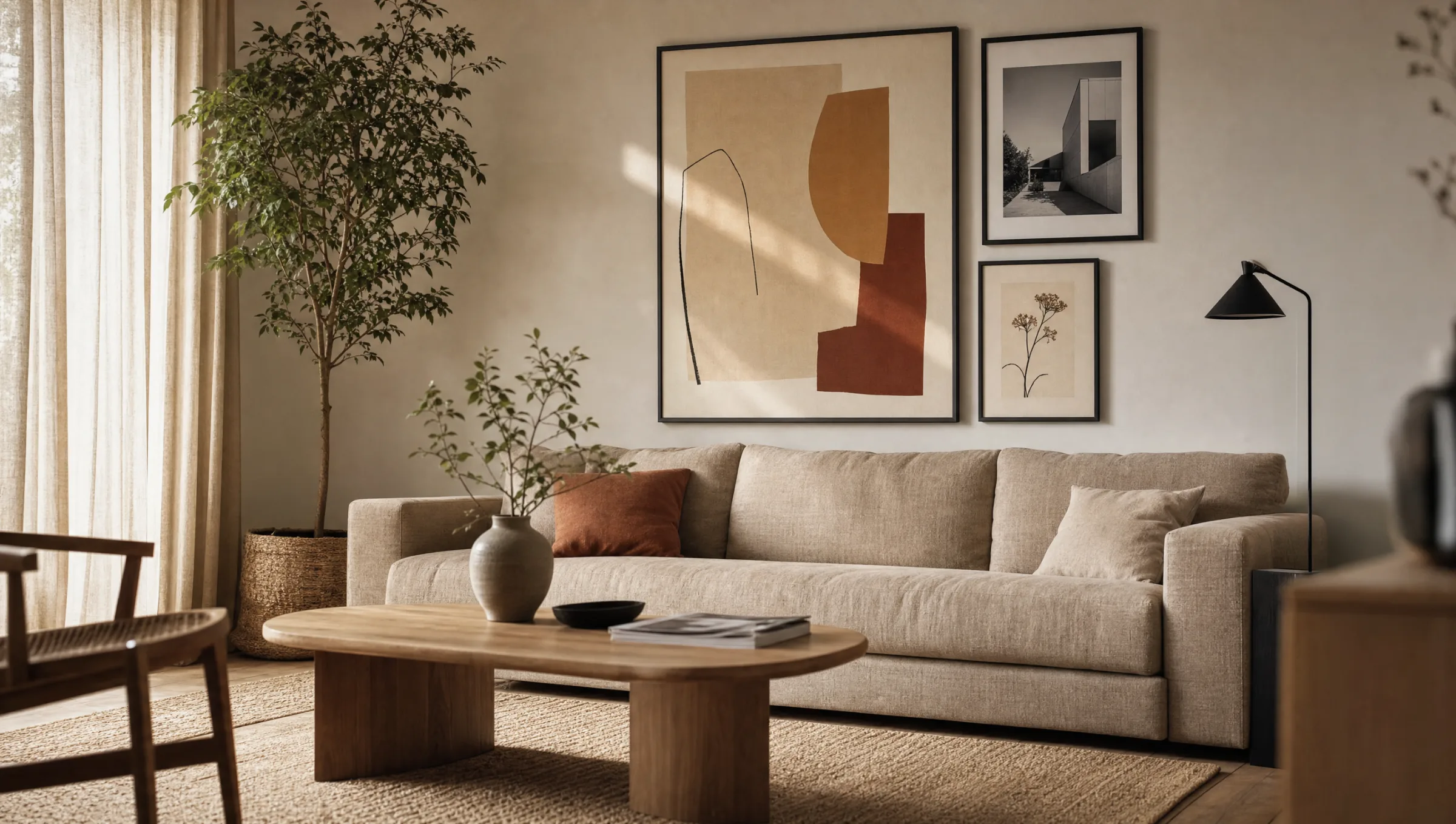
Beautiful Living Room Wall Art – Curated Selection, Formats and Hanging
A living room only feels calm and considered when the walls don't look arbitrary. Anyone searching for beautiful living room wall art faces choices across subject matter, formats and materials. This overview organises the key decisions editorially — from style direction through to hanging above the sofa.
Why Beautiful Living Room Wall Art Is More Than Decoration
The living room is where everyday life, guests and retreat all converge. Wall art structures this space, defines sightlines and shapes atmosphere more powerfully than any piece of furniture. A single large-format work above the sofa can bring calm to a room, while a closely grouped gallery wall generates energy — both approaches work when the selection is consistent.
When looking for the right motifs, it pays to consider the existing interior first: wood tones, textiles, light conditions. Beautiful living room wall art should neither compete with the room nor disappear into it, but instead function as a quiet counterpoint or a considered colour accent. Deciding too quickly often means rehashing the arrangement a few months later.
Four Subject Worlds for Beautiful Living Room Wall Art
The following style directions have proved their worth in editorial selections and can also be combined, provided the colour palette remains coordinated across all pieces.
Abstract Compositions
Colour fields, loose brushwork or graphic forms feel restrained and suit both modern and classical living rooms. They bring a sense of calm without imposing a specific theme.
Botanicals and Still Lifes
Pressed leaves, floral studies or understated still lifes bring nature indoors. In rooms with plenty of wood or linen they feel organic and warm.
Black-and-White Photography
Architecture, landscapes or documentary shots in black and white structure the room graphically. They continue to work even if the wall colour changes later.
Line Art and Minimalism
Reduced line drawings on a pale ground suit Scandinavian-influenced interiors. They make no loud statement and sit comfortably within almost any colour scheme.
Format and Hanging Above the Sofa
The most common position for beautiful living room wall art is the wall above the sofa. A useful rule of thumb: the picture or arrangement should occupy roughly two-thirds of the sofa's width. If it reads narrower, a visual gap appears; if it reads wider, the proportions tip out of balance.
The gap between the sofa's back and the bottom edge of the frame ideally sits between 20 and 30 centimetres. This keeps the visual connection intact without the piece feeling too close to the upholstery. With high ceilings the hanging can sit a little higher; in rooms with lower ceilings, a little lower.
For gallery walls it is worth laying all frames out on the floor first. A mix of two or three formats reads more quietly than five different sizes. Those who prefer symmetry choose identical frames; those who want a little tension deliberately combine portrait and landscape orientations.
A good living room piece doesn't have to impress at first glance — it has to still feel right after three months.
From the Reetro editorial team
Materials: Poster, Canvas or Aluminium
Classic art poster prints on FSC-certified paper from 200 g/m² with a matte coating look restrained and produce little glare — ideal for bright living rooms with natural daylight. In a simple wood or aluminium frame they can be swapped out easily if the style changes, and are printed to order by our production partner in the EU to consistent quality standards.
Canvases bring depth and a textile quality. They work especially well for abstract and painterly motifs because the surface emphasises brushwork and texture. Hexagonal aluminium wall panels, by contrast, make a clear, contemporary statement and suit motifs with high levels of detail, such as photographs or graphic works.
When mixing materials, it pays to keep the framing concept calm. A wall combining three different print mediums can feel very coherent as long as the motifs share a common colour language.
Coordinating Colour with Sofa, Rug and Light
Before buying, it is worth identifying the dominant colours in the room. A sand-toned sofa works well with warm earth tones, off-white and soft greens; a dark blue upholstered piece carries stronger contrasts such as ochre, terracotta or black-and-white motifs. Beautiful living room wall art does not emerge in isolation — it develops in dialogue with these surfaces.
Light plays an equally decisive role. North-facing rooms read cooler — warmer motifs help to balance this. In south- or west-facing living rooms, art can be cooler and more graphic. Anyone working with warm artificial light in the evenings should check prints under similar conditions beforehand, as colours can shift noticeably.
Häufige Fragen
-
01
How large should beautiful living room wall art above the sofa be?
As a guide, the picture or the overall arrangement should occupy roughly two-thirds of the sofa's width. With a 220 cm wide sofa, that equates to a picture width of around 140 to 160 cm — either as a single large-format piece or as a combination of several frames. The gap between the sofa back and the lower edge of the frame ideally sits between 20 and 30 cm. If the piece reads too narrow, a visual gap appears; if it reads too wide, the proportions tip and the room can start to feel crowded.
-
02
Which motifs work best for beautiful living room wall art in smaller rooms?
In smaller living rooms, reduced motifs read more quietly than detailed compositions. Line art, minimalist graphics, single-colour fields or black-and-white photography give the room structure without making it feel visually smaller. Pale backgrounds in the motifs connect with light walls and allow the space to breathe. Anyone wanting to introduce colour should limit themselves to two or three coordinated tones. A single landscape-format piece above the sofa often works more harmoniously in a narrow room than a busy gallery wall.
-
03
Poster, canvas or aluminium — which material fits best?
Art poster prints on matte paper are the most flexible option because they are easy to swap out and suit almost every interior style. Canvases work well for painterly and abstract motifs, bringing depth and a textile quality. Hexagonal aluminium panels are best suited to detailed photographs and graphic works, as the smooth surface renders fine detail sharply. The choice depends on the room's style and the motif itself — more important than the material is a consistent visual language across all the pieces on a single wall.
-
04
How do I combine several pieces into a gallery wall?
Start with an anchor piece — usually the largest or most colour-forward work — and group smaller formats around it. A shared colour palette or a recurring element such as similar frames creates coherence. Lay all pictures out on the floor before drilling. Keep an even gap of around five to seven centimetres between frames. Two or three formats generally read more quietly than five different sizes, particularly in living rooms with a clean, linear aesthetic.
-
05
How do I care for living room wall art over the long term?
Direct sunlight should be avoided, as UV light can cause print colours to fade over time. Art poster prints behind glass or acrylic remain the most stable; canvases can be dusted occasionally with a soft, dry cloth. Reetro prints on FSC-certified paper from 200 g/m² with a matte coating, printed to order by our production partner in the EU — the surface reflects little light and remains colour-stable for many years under normal living conditions. Avoid damp cleaning cloths and do not hang pieces directly above radiators, as temperature fluctuations can place stress on both paper and frames.