
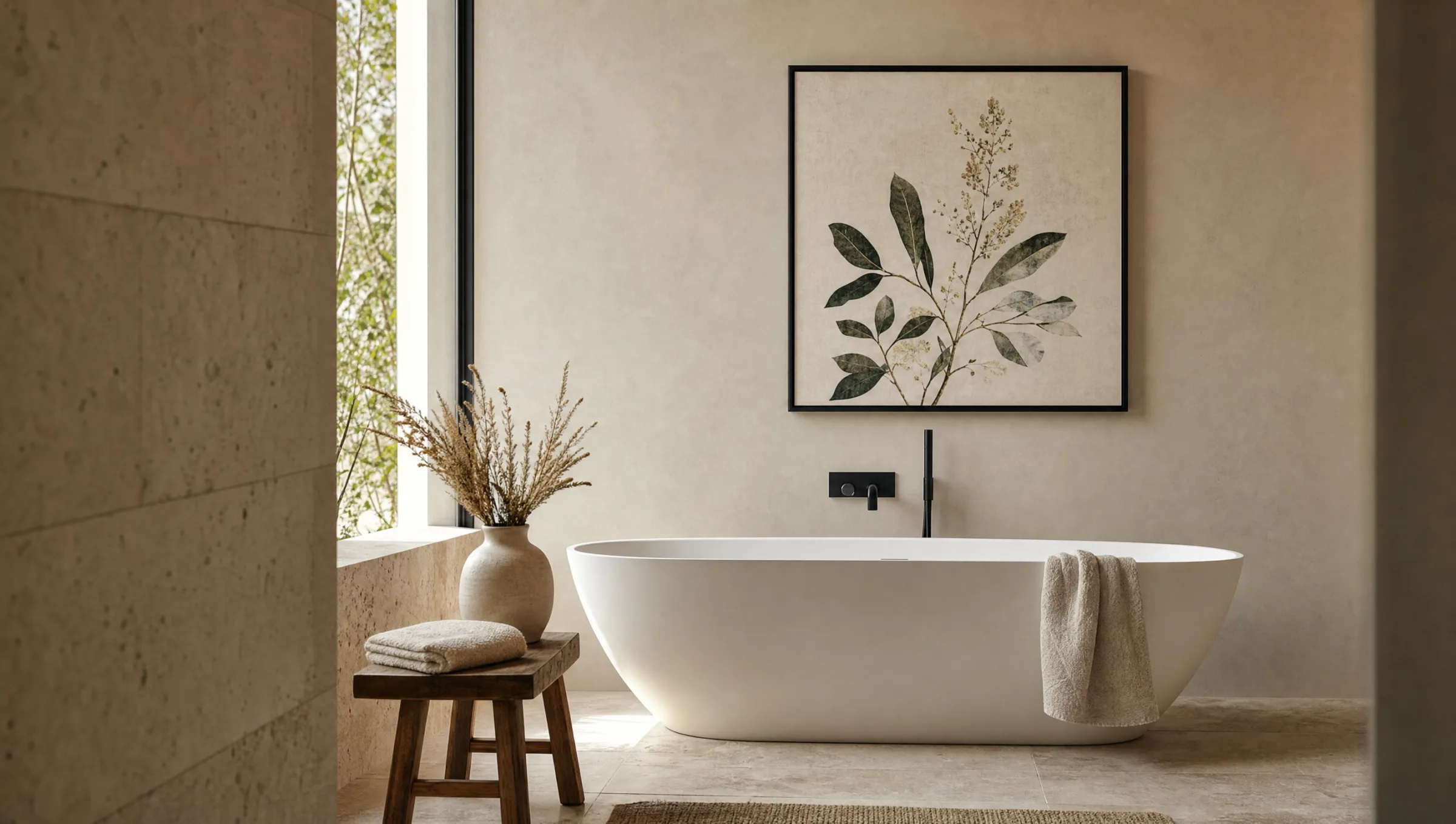
Bathroom wall art: calm motifs for an often overlooked room
The bathroom is frequently overlooked when it comes to wall decoration — yet it is a room we spend time in every day, and a considered choice of art can make a real difference. This overview covers which motifs, materials and formats suit bathroom wall art, and what to keep in mind regarding humidity and lighting conditions.
What bathroom wall art needs to handle
Bathroom wall art faces particular challenges: fluctuating humidity, temperature changes from the shower or bath, and often artificial light rather than natural daylight. That does not mean art is off-limits in a bathroom — far from it. With the right choice of materials and a well-considered hanging position, even small bathrooms can be dressed without the artwork suffering over time.
Functionally, a piece of wall art in the bathroom serves several purposes: it breaks up the visual hardness of tiled surfaces, creates a calm focal point away from mirrors and fixtures, and can alter the perceived size of the room. Vertical compositions draw the eye upward and make low-ceilinged rooms feel taller; horizontal formats settle the eye and suit narrow floor plans.
What matters most is distance from the water source. Directly above the shower or immediately beside the basin, classic paper prints are rarely the right call. With a little distance — above the toilet, on the end wall behind the bath, or in an entrance vestibule — almost all common print substrates perform reliably.
Materials for bathroom wall art: what actually works
Not every substrate handles bathroom conditions equally well. Four options have proven themselves in practice, each with its own strengths.
Aluminium print
Aluminium Dibond or hexagonal aluminium panels are unaffected by moisture and can be wiped down easily with a damp cloth. This makes them suitable even on walls closer to the shower or washbasin.
Premium canvas
Canvas stretched on a wooden frame handles ambient humidity well in adequately ventilated bathrooms. A safe clearance from direct splash water is important, as is regular airing after showering.
Framed poster
A poster behind glass or acrylic is a reliable option in the bathroom because the frame protects the paper from moisture. Look for a mount construction that is sealed on the reverse side.
Unframed paper print
Open FSC paper prints are only conditionally suitable in bathrooms. In well-ventilated guest WCs or entrance areas without a shower they can work, but they should not hang directly opposite a damp wall.
Motifs: which visual language suits bathroom wall art
The bathroom is a room for slowing down. Motifs with quiet composition, a reduced colour palette and natural references tend to work more convincingly here than graphically loud or text-heavy pieces. Botanical illustrations, abstract water and wave studies, minimalist black-and-white photography and delicate watercolours are all well-established choices.
Architectural and landscape motifs work well too, provided they use a restrained tonality. A misty coastal stretch, a Japanese bamboo scene or a calm marble texture all suit the contemplative atmosphere that most bathrooms naturally aim for.
In terms of colour, successful choices tend to echo the existing materials: warm beige and sand tones harmonise with travertine and timber surfaces, while muted greens and blues pick up classic tile colours. Heavily saturated primary colours can work, but should be placed deliberately as a considered contrast to the rest of the interior.
A piece of bathroom wall art is not a decorative object — it is a quiet reference point for a room where we want to unwind each day.
Reetro Editorial
Format, hanging and care
The right format follows from the available wall space and the viewing distance. In small bathrooms, a single medium-sized piece between 40×60 cm and 50×70 cm usually feels more settled than a multi-part gallery wall. In larger bathrooms, two or three prints can be arranged as a calm sequence above the bath or a double vanity.
A good rule of thumb for hanging is to position the centre of the artwork at roughly eye level for a standing person — around 145 to 155 cm from the floor. Above furniture, the piece may sit a little lower, ideally with 15 to 25 cm of clearance from the top edge of the furniture. For fixing in damp rooms, stainless steel screws and wall plugs are advisable; adhesive hooks often lose their hold reliably over time in higher humidity.
Care depends on the substrate. Aluminium prints can be cleaned with a soft, lightly dampened cloth; canvas prints need only a dry dusting. For framed posters, keeping the glass clean and occasionally checking the frame for moisture marks is sufficient. Airing the room after every shower noticeably extends the lifespan of all print substrates.
Bathroom wall art in a wider interior context
A well-chosen piece of wall art connects the bathroom to the rest of the home. If botanical prints feature in the living room, the same theme can be carried through into the bathroom in a more reduced form. A consistent frame colour — such as matte black or natural oak — also creates continuity between rooms without requiring identical motifs in every space.
Häufige Fragen
-
01
Is bathroom wall art actually a good idea?
Yes, provided the material and hanging position suit the room. Bathroom wall art breaks up large expanses of tile, creates a calm focal point and connects the bathroom visually with the rest of the home. The key is choosing a substrate that can handle humidity and hanging it away from direct splash zones. In a modern bathroom with adequate ventilation — particularly if you air the room after showering — art on the walls causes very few problems in practice.
-
02
Which material is best for bathroom wall art?
Aluminium prints are the most resilient option: they can be wiped down with a damp cloth, do not yellow and are unaffected by changes in humidity. Framed posters behind glass are also well suited because the frame protects the paper. Canvas prints work fine in adequately ventilated bathrooms but benefit from a little distance from the shower. Unframed paper prints are only advisable in drier areas such as a guest WC.
-
03
Which motifs work well as bathroom wall art?
Calm, reduced motifs perform particularly well in the bathroom. These include botanical illustrations, abstract water studies, minimalist black-and-white photography, Japanese landscapes and marble or stone textures. Heavily saturated or graphically busy images can work too, but are best used as a deliberate contrast to an otherwise restrained interior. It generally helps to align the colour palette of the artwork with the existing materials — tiles, timber and sanitaryware — already present in the room.
-
04
How high should bathroom wall art be hung?
A good rule of thumb is to position the centre of the piece at around 145 to 155 centimetres from the floor — roughly eye level for a standing person. Above furniture such as a vanity unit or sideboard, the artwork may sit a little lower, with an ideal gap of 15 to 25 centimetres between the bottom of the frame and the top of the furniture. For art hung above the bath, it is worth considering the typical seated or reclined position so that the motif sits comfortably in the sightline from the tub.
-
05
What format is suitable for bathroom wall art in a small bathroom?
In a small bathroom, a single print in 40×60 cm or 50×70 cm tends to feel more considered than a multi-piece gallery arrangement. Vertical formats lengthen the perceived height of low-ceilinged rooms; horizontal formats calm the eye in narrow floor plans. Anyone wishing to hang multiple pieces should choose consistent frame colours and leave sufficient space between works so the room does not feel cluttered. Larger bathrooms can accommodate formats from 70×100 cm upwards or carefully composed groupings.
-
06
How do you care for bathroom wall art?
Care depends on the material. Aluminium prints can be wiped down with a soft, lightly dampened cloth; canvas prints need only a dry dusting; and framed posters mainly require a clean glass surface. Airing the room after every shower is the single most effective measure for removing moisture from the air and protecting all substrates. Reetro prints its wall art to order through its production partner in the EU on FSC-certified papers of at least 200 g/m² with a matte coating — a combination that makes the prints more resistant to light reflections and everyday ambient humidity.