
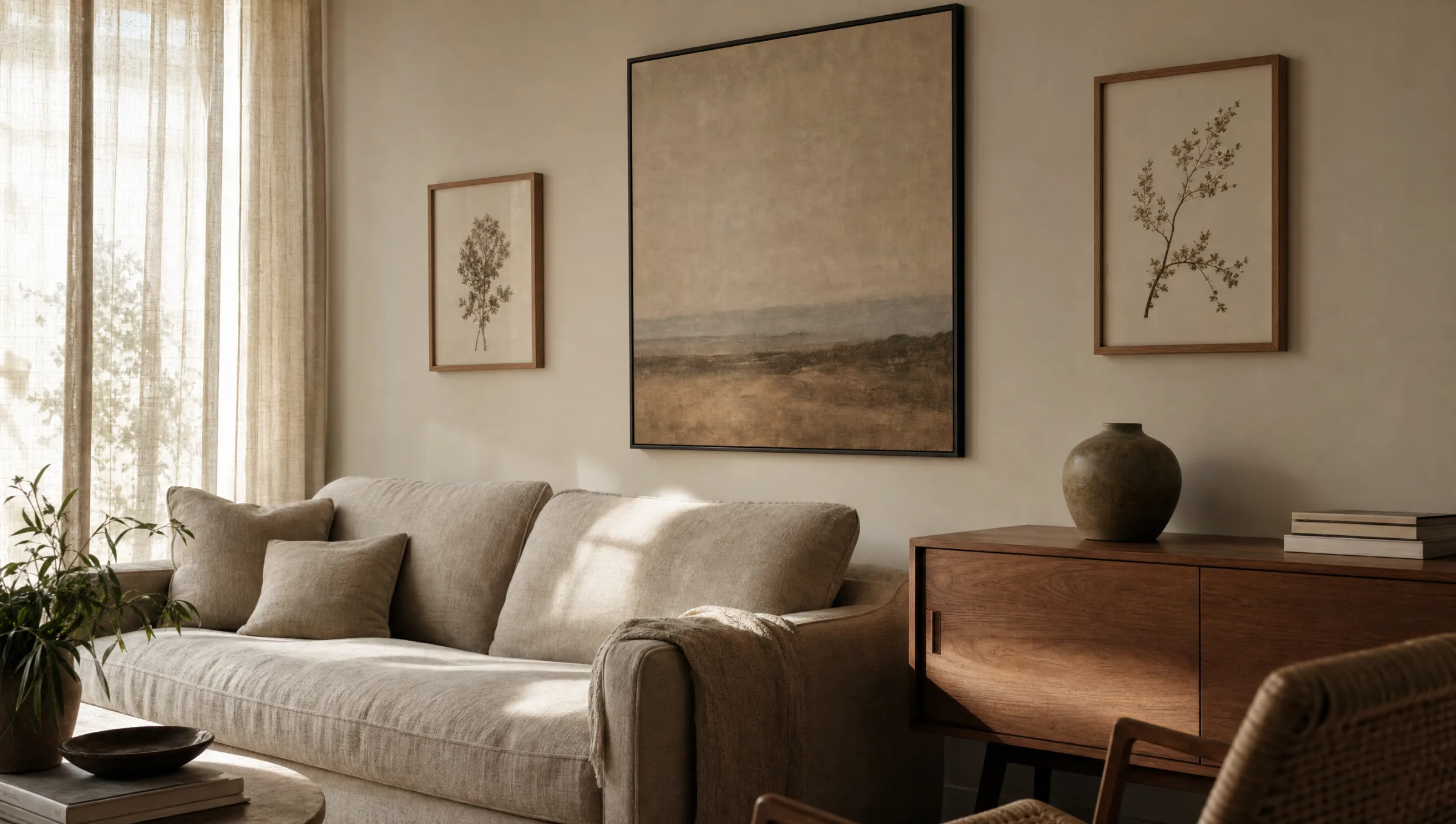
Living Room Wall Art: Selection, Formats and Hanging at a Glance
Choosing living room wall art means shaping the atmosphere of the most-used room in the home. This guide takes an editorial look at formats, materials and subject categories, and outlines what to consider when selecting, hanging and caring for prints – without trend promises, but with reliable criteria.
Living Room Wall Art: What Shapes Your Choice
The living room serves as lounge, reception space and retreat all at once. Wall art takes on several roles within it: structuring wall surfaces, creating focal points above the sofa or sideboard, and connecting the furniture with the chosen colour palette. Before buying, it is worth taking a sober look at wall dimensions, lighting conditions and furniture heights.
A useful rule of thumb: a piece of art above a sofa should span roughly two-thirds of the sofa's width. For a 220 cm wide couch, that translates to a single print of around 140–150 cm, or a three-part grouping of the same total width. Anyone buying living room wall art should also factor in the gap between the top of the sofa and the bottom of the frame – 20 to 30 cm reads as balanced in most rooms.
Lighting conditions also determine the right material. In rooms with direct sunlight, matte-coated papers or anti-reflective canvases are advantageous, as they reduce glare and preserve the detail within the image.
Formats and Materials for Living Room Wall Art
Which format suits which living room depends on wall size, furniture arrangement and the visual effect desired. The four options below cover the most common scenarios.
XXL Poster on FSC Paper
Large-format prints from 70 × 100 cm serve as calm visual anchors above sofas or sideboards. FSC-certified papers from 200 g/m² with a matte surface render colours accurately and avoid distracting reflections.
Premium Canvas on Stretcher Frame
Canvases bring depth to a room and require no glass. They suit classically and warmly furnished living rooms, as well as subjects with a painterly character – landscapes or abstract compositions, for instance.
Hexagon Wall Art in Aluminium
Hexagonal aluminium formats can be combined into modular groupings. They work well in restrained interiors where the arrangement of the pieces itself becomes part of the overall design.
Triptychs and Print Series
Three- or five-part series visually widen narrow walls and fill broad surfaces without imposing a single dominant motif. Gaps between the individual panels are typically 3–5 cm.
Subject Selection: Which Living Room Wall Art Stands the Test of Time
A piece of art in the living room is seen every day – often for years. The selection should be correspondingly considered. Understated landscapes, botanical studies, quiet architectural photography and abstract compositions in muted colour palettes age visually more slowly than highly graphic or poster-bold subjects.
Anyone looking to buy living room wall art should ideally check which colours dominate the room beforehand. A wall in warm white is compatible with almost any palette; with coloured walls, it helps to echo at least one hue from the furniture or textiles in the artwork. This creates a coherent overall picture without the subject competing with the interior.
For groupings, the principle of a shared visual thread has proven effective: a uniform frame style, a consistent visual language or a recurring colour. The individual subjects can vary – the formal thread holds the wall together.
Good living room art does not need to be loud. It needs to carry the hours between morning and evening without imposing itself.
From the Reetro editorial team
Hanging and Care: Buying Living Room Wall Art with a Plan
The eye level of a standing person is approximately 145–155 cm. This height serves as a reliable reference point for the centre of a picture – even when the piece hangs above a piece of furniture. Above very low sofas, the centre may sit slightly lower, so that the visual connection to the seating surface is maintained.
For fixing, the right approach depends on the wall type and the weight of the piece. Options include traditional picture hooks, cavity wall anchors, or adhesive systems for lighter posters. Heavier canvases and aluminium prints hang more level with two fixing points rather than one.
For care, a dry microfibre cloth is sufficient in most cases. Matte papers and coated aluminium surfaces should not be cleaned with aggressive glass cleaners; a lightly dampened cloth is enough. Direct sunlight should be avoided for high-quality prints to minimise colour shift over the years.
Buying Living Room Wall Art Online: What to Check Before Ordering
With online purchases, preparation determines the outcome. A useful first step is to mark out the planned picture area on the wall using kraft paper or painter's tape. This makes the real-world impact of the format tangible before placing an order.
The resolution of the image file – or the resolution specification given by the supplier – also matters: large formats require high-resolution source files, otherwise details become blurred. Reputable suppliers state the print material, paper weight and finish transparently, as well as the origin of production.
Reetro prints to order through a production partner in the EU on FSC-certified papers from 200 g/m², as well as on premium canvas and aluminium. The range is curated editorially, with a focus on long-lasting subjects and consistent material quality – an aspect that counts when buying living room wall art for the long term.
Häufige Fragen
-
01
What size should living room wall art be?
A practical starting point is the width of the furniture below: a single piece or a grouping should span roughly two-thirds of the sofa or sideboard width. For a 200 cm wide sofa, that means an artwork around 130–140 cm wide. Above narrow consoles, formats from 50 × 70 cm are sufficient. The gap between the top of the furniture and the bottom of the frame also matters – 20 to 30 cm reads as balanced in most rooms, keeping the artwork and furniture visually connected without merging.
-
02
What should I look for when buying living room wall art?
When buying living room wall art, it is worth checking four things: wall dimensions and furniture height, the dominant colours in the room, the lighting conditions and the material of the print. In rooms with a lot of natural light, matte surfaces are preferable as they reflect less. It is also worth examining the paper weight, printing process and country of production – these details indicate the long-term quality of the piece.
-
03
Which subjects work particularly well in the living room?
Subjects that hold up well over daily viewing tend to work best: understated landscapes, abstract compositions in muted tones, botanical studies or quiet architectural photography. Very graphic or colour-intense subjects can make an immediate impression but tend to feel tiring more quickly in everyday life. With coloured walls, it helps to echo at least one shade from the interior in the artwork, so that the subject and the room share a common thread.
-
04
At what height should living room wall art be hung?
The eye level of a standing person – approximately 145–155 cm – serves as the reference point for the centre of the artwork. When hanging a piece above a sofa, there should be a gap of 20–30 cm between the top of the furniture and the bottom of the frame, so a visual relationship is established. For multi-part arrangements, the centre of the entire grouping is used as the reference rather than any individual panel.
-
05
Is it worth buying living room wall art online?
Buying living room wall art online offers the advantage of a wide range and transparent information on materials and formats. It is important to mark out the planned picture area on the wall beforehand – using painter's tape, for example – and to look for specific details on paper type, weight and print origin. Reputable suppliers state these key facts clearly.
-
06
What materials does Reetro offer for living room wall art?
Reetro produces to order through a production partner in the EU on FSC-certified papers from 200 g/m² with a matte coating, on premium canvases with a stable stretcher frame, and on hexagonal aluminium wall art for modular arrangements. Subjects are curated editorially, so that format and material complement the visual language of the image – a foundation designed to hold up in the living room for years to come.