
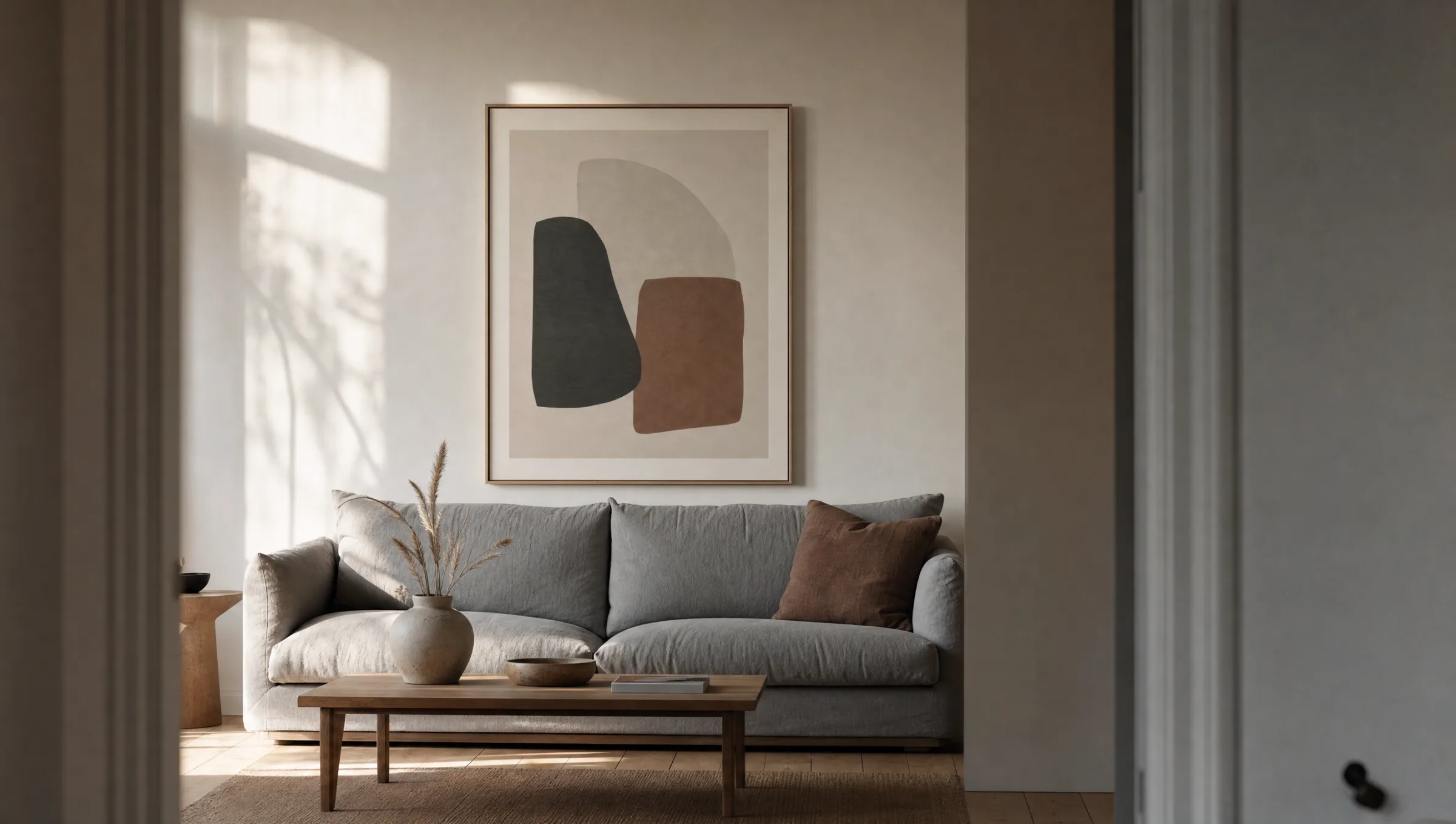
Wall Poster Living Room – Motifs, Formats and Styles at a Glance
A wall poster in the living room changes the mood of a space without much effort. Whether a single statement format or a curated gallery wall – the choice of motif, paper and hanging position determines whether the result feels coherent or arbitrary. This page provides a straightforward overview.
What a Wall Poster in the Living Room Can Do
A large-format wall poster in the living room serves primarily as a compositional anchor. It gives the wall a direction and connects furniture, textiles and light sources into a coherent overall picture. Unlike wallpaper or paint, a poster can be swapped out at any time – making it a flexible tool for anyone who wants to develop their living space gradually.
The visual language plays just as important a role as the format. A quiet, monochrome motif – such as an architectural photograph or an abstract line composition – has a calming effect and creates visual stillness. Stronger colour fields or organic forms from the world of botanical illustration, on the other hand, bring warmth to an otherwise neutral room. Neither is inherently better; what matters is how well the choice aligns with the existing interior concept.
The material also influences the effect considerably. Matte paper from 200 g/m² absorbs scattered light and feels less commercial than high-gloss surfaces. Reetro uses exclusively matte coatings and FSC-certified papers for its art prints, which gives the finished print a calm, almost tactile quality – printed to order by our production partner in the EU to consistent production standards.
Formats for a Wall Poster in the Living Room
The choice of format depends on the available wall space, ceiling height and the desired visual weight of the motif. Four formats have proven particularly practical for living rooms.
50 × 70 cm – The Classic
The best-selling poster format works above desks, beside shelving units or grouped together on larger walls. It feels present without dominating, and is straightforward to frame.
70 × 100 cm – Statement Format
Suited to wide sofa walls or empty hallway walls. A single motif at this size needs no accompanying images; it carries the wall on its own.
XXL from 100 × 140 cm – Room-Defining
XXL posters noticeably alter the proportions of a room. They work especially well in living rooms with high ceilings and a clear, pared-back furniture arrangement.
Landscape / Panorama
Panorama posters are ideal above elongated sideboard or sofa arrangements. They emphasise the horizontal and make rooms appear optically wider.
Styles and Motif Selection
When selecting a motif, it is worth identifying the dominant tones of the room first. Wall posters for the living room that draw from the same colour spectrum as the sofa, rug or curtains integrate harmoniously. High-contrast motifs, by contrast, set a deliberate accent and draw the eye.
Abstract art prints – including colour-field compositions, geometric patterns or expressive brushwork – are stylistically adaptable and rarely date quickly. Photographic motifs, such as cityscapes or nature images, bring a narrative quality that abstract work lacks. Which category fits better ultimately depends on how the space is used: is the living room a place of quiet or of social exchange?
Botanical prints and vintage illustrations have seen sustained demand over recent years. Their warm, organic graphic language harmonises well with natural materials such as wood, linen and rattan. Those who inhabit a cooler, more minimalist space more often reach for typographic posters or black-and-white architectural photography.
A well-chosen wall poster needs no explanation – it answers a question the room had not yet thought to ask.
Reetro Editorial
Hanging, Arranging and Caring for Your Wall Poster
The ideal hanging height for a wall poster in the living room is generally 145–155 cm from floor to image centre – this corresponds roughly to the average eye level of a standing person and is equally comfortable when seated. If the poster is placed above a sofa, the lower edge of the image should begin approximately 20–25 cm above the top of the backrest.
Gallery walls made up of several posters require a little more planning. It is advisable to lay out the arrangement on the floor first and test it on the wall with paper templates before any nails go in. A consistent frame style or uniform spacing between images creates visual order without making the composition feel rigid.
For maintenance, dry dusting is sufficient. Matte paper is sensitive to moisture, so posters in humid areas should be framed and hung behind glass. Under normal living-room conditions, frameless prints on heavy paper are long-lasting and dimensionally stable.
Wall Poster Living Room – The Reetro Range
The Reetro range includes art prints in a wide variety of formats – from the classic A2 poster to the XXL print, as well as canvases and hexagonal aluminium wall art for particular wall situations. All prints are printed to order by our production partner in the EU on FSC-certified paper with a matte finish. The result is a print that holds its place in the living room over the long term, without looking worn after a few years.
Curation at Reetro means that every motif undergoes an editorial review – not every submitted image makes it into the range. This distinguishes the brand from anonymous marketplaces and ensures the catalogue remains manageable and internally consistent. Anyone searching for a wall poster living room does not need to work through thousands of listings but will find an editorially filtered selection with a clear, considered aesthetic.
Häufige Fragen
-
01
What format works best for a wall poster in the living room above a sofa?
The format should not exceed roughly two-thirds of the sofa's width. For a standard sofa of around 200 cm, a poster in 70 × 100 cm or a landscape format around 90 × 60 cm is well proportioned. Those who want a stronger visual focal point can opt for an XXL format, but should then avoid additional wall decoration in the immediate vicinity to prevent visual noise.
-
02
How high should a wall poster in the living room be hung?
A reliable rule of thumb: position the image centre at around 145–155 cm from the floor. This corresponds to average eye level and works equally well for both standing and seated viewing. When the poster hangs above a piece of furniture such as a sideboard or sofa, the lower edge of the image should sit approximately 20–25 cm above the top of that furniture.
-
03
Which motifs work particularly well as a wall poster living room print?
This depends strongly on the existing interior style. In warm, naturally toned rooms, botanical illustrations and organic abstractions work well. For minimal, light-filled spaces, monochromatic photography or geometric compositions tend to suit better. What matters less is following trends and more is aligning with the room's colour palette: the poster does not need to match exactly, but should draw from the same tonal range.
-
04
Can a wall poster be hung without a frame?
Yes – on sufficiently heavy paper, from 200 g/m² upwards, posters hang flat and stable without a frame. Wooden or metal poster rails that clamp the top and bottom edges are a practical option, giving the print both support and a clean finish. Washi tape strips are a frameless alternative for temporary hanging without wall damage. In humid rooms or with direct sunlight, a frame with glass is the more durable solution.
-
05
How do I care for a wall poster in the living room?
Matte paper is best dusted with a dry, lint-free cloth. Avoid moisture and cleaning products entirely – both can lift the surface or cause waviness. Direct sunlight fades colours over time; for permanent display, UV-protective glazing in the frame is recommended.
-
06
What distinguishes a high-quality art print from a standard poster?
The main differences lie in paper weight, printing technique and colour accuracy. High-quality art prints – such as those printed to order by Reetro's production partner in the EU – are printed on FSC-certified paper from 200 g/m² with a matte finish. The result is colour-true, long-lasting and looks considerably less commercial in a living room than thinner gloss paper. Print resolution and colour management also matter: Reetro produces all motifs to an editorially verified colour profile, ensuring consistent reproduction across all formats.