
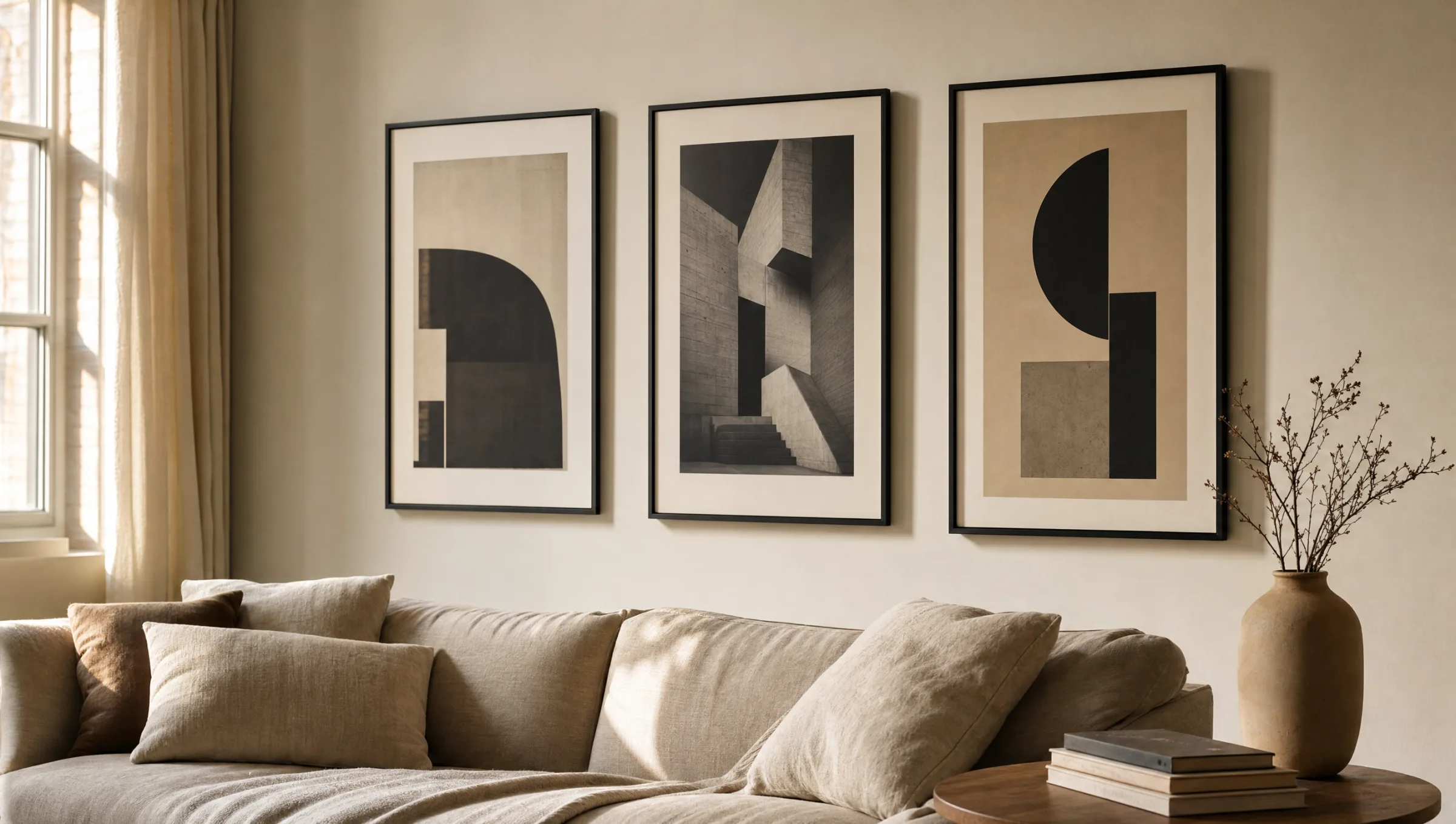
Art Posters for Walls – Prints That Define a Space
A well-chosen poster changes the mood of a room in a fundamental way. Art posters for walls are not simply a decorating trend – they are a considered design decision that brings together format, subject matter and context. This guide covers what matters when selecting, combining and hanging art prints on your walls.
What Makes an Art Poster Suitable for a Wall?
Not every print works equally well on a wall. Three factors are decisive: print quality, paper weight and surface finish. Art posters intended to hang long-term benefit from papers of at least 200 g/m², as these are more dimensionally stable and less prone to warping – particularly in rooms where humidity fluctuates, such as kitchens or bathrooms.
Subject choice is closely linked to the function of the room. In home offices, abstract and less narrative compositions tend to support concentration better than detailed illustrations. In living areas, large-format landscape or architectural prints can optically extend the sense of depth. For bedrooms, calm colour palettes with low contrast are a sound choice.
On format, a straightforward rule of thumb applies: the poster surface should occupy between 60 and 80 per cent of the available wall space above a piece of furniture. Formats that are too small look lost; formats that are too large can feel overwhelming. XXL posters from 100 × 140 cm upwards make a clear statement without needing any accompaniment.
Art Posters for Walls – Three Display Approaches at a Glance
Art posters for walls can be arranged in quite different ways. The three most common approaches differ in composition, effort and visual effect.
The Single Statement
One large-format poster – from 70 × 100 cm upwards – hangs alone on a clearly defined wall. No competing accessories, no shelving alongside. This works particularly well in minimalist interiors and with strong motifs that have a calm, uncluttered background.
The Gallery Wall
Multiple posters in varying formats are arranged along a shared axis or a grid. Recommended: the same frame colour or the same paper finish for visual cohesion. The spacing between pieces should be consistent, between 5 and 8 cm.
Diptych and Triptych
Two or three thematically related posters are hung side by side in identical formats. This arrangement reads especially well above long pieces of furniture such as sofas or sideboards, creating a calm, rhythmic visual language.
Styles and Subject Worlds for Art Posters for Walls
The range of art posters for walls can be broadly divided into four style categories: abstraction, typography, photography and illustration. Each category follows its own design logic and suits different living contexts.
Abstract motifs – from geometric forms to expressive colour fields – are the most adaptable category. They integrate into almost any colour scheme without competing with existing furnishings. Earth tones, monochromatic grey scales and muted pastels are particularly popular choices within this group.
Photographic art prints, whether architectural, nature or street photography, introduce a documentary quality that adds a narrative layer to a room. High-quality prints are recognisable by their sharp edges, even coverage and faithful colour reproduction – all properties that depend directly on the printing technology and the paper used.
A poster is not a filler – it is a curatorial statement about what you want to encounter in a room every day.
Reetro Editorial
Materials and Printing Methods for Art Posters for Walls
The durability and visual quality of an art print depend substantially on the material used. FSC-certified fine-art papers from 200 g/m² provide a sufficiently rigid base for both framed and frameless hanging. Matte coatings reduce light reflections and ensure the image remains clearly legible even under indirect artificial lighting.
As alternatives to paper posters, direct prints on aluminium composite (Alu-Dibond) and canvas prints have established themselves as lasting options. Alu-Dibond panels are rigid, moisture-resistant and require neither a frame nor a mount. Canvas prints, by contrast, produce a tactile quality through the fabric texture that is reminiscent of traditional oil paintings. Both formats are well suited to humid spaces where paper prints may deteriorate over time.
On framing: slim aluminium or wood frames in black, white or natural wood are the most versatile options, as they support the motif without drawing attention to themselves. Wide museum frames suit individual statement pieces but are less appropriate for gallery-wall arrangements with multiple works.
Care and Longevity of Art Posters for Walls
Art posters for walls require little maintenance when hung correctly. Direct sunlight is the greatest threat to fine-art prints: UV radiation bleaches pigments over time. Anyone not using UV-protective glazing should position posters away from direct sunlight, or choose a wall area with indirect natural light.
Framed prints protect the paper from dust and physical damage. When cleaning the glass, a lightly dampened microfibre cloth is recommended – spray cleaners can seep under the frame if the seal is imperfect. Unframed paper prints can be dusted with a dry microfibre cloth, but should never be touched with damp materials.
Häufige Fragen
-
01
Which formats work best for art posters for walls?
The ideal format depends on the available wall space and the display concept. For a single statement, formats from 70 × 100 cm upwards are a good starting point, as they carry enough visual presence. For gallery walls, combinations of 30 × 40 cm, 50 × 70 cm and 70 × 100 cm work well because they create rhythmic variety without feeling busy. As a general rule, the poster surface should cover approximately 60–80 per cent of the visible wall space above a piece of furniture.
-
02
How do I hang art posters for walls without drilling?
For lighter paper prints up to around 2 kg, self-adhesive hanging strips designed for smooth walls are a practical option – they can be removed without leaving residue. Heavier Alu-Dibond panels or framed canvases typically require wall fixings with plugs and screws. It is important that the fixings are rated for the relevant weight and wall type – whether plasterboard or solid masonry. Temporary adhesive solutions should be checked regularly to ensure they remain secure.
-
03
How do I combine different art posters for walls into a cohesive gallery arrangement?
The simplest route to cohesion is to limit variation to one shared element: the same frame colour, the same paper finish or a shared colour palette across the motifs. Varying all three at once risks a restless overall impression. Before hanging, it helps to lay out the intended arrangement on the floor and measure spacing with a tape measure. Consistent gaps of 5–8 cm between pieces give the display a clean, considered feel.
-
04
Which rooms suit large-format art posters for walls?
Large-format art posters – from 100 × 140 cm upwards – work best in rooms where the viewer can step back a few metres. Living rooms and open-plan kitchen-dining spaces are ideal. Hallways and stairwells are better suited to upright formats in slimmer sizes. In compact rooms, very large formats can feel confining; here, sizes up to 50 × 70 cm are generally the more considered choice.
-
05
How do I protect art posters for walls from fading and damage?
The most effective protection against fading is avoiding direct sunlight. UV-filtering frame glazing or acrylic glass blocks a large proportion of harmful radiation and significantly extends the lifespan of the print. In humid rooms, Alu-Dibond prints or laminated canvas are preferable to paper prints. For cleaning: use dry microfibre cloths on unframed prints and a lightly damp cloth on glass panes – never solvents or abrasive cleaners.
-
06
What should I look for when buying art posters for walls in terms of print quality?
Look for stated information on paper weight, printing method and colour profile. High-quality art prints use papers of at least 200 g/m² and are produced using giclée or pigment-ink processes, which offer particularly high colour fidelity and longevity. FSC-certified papers are an additional quality indicator, guaranteeing responsibly sourced wood fibre. Reetro has all posters printed to order by its production partner in the EU on FSC papers from 200 g/m² with a matte finish – with no compromise on sharpness or colour accuracy.