
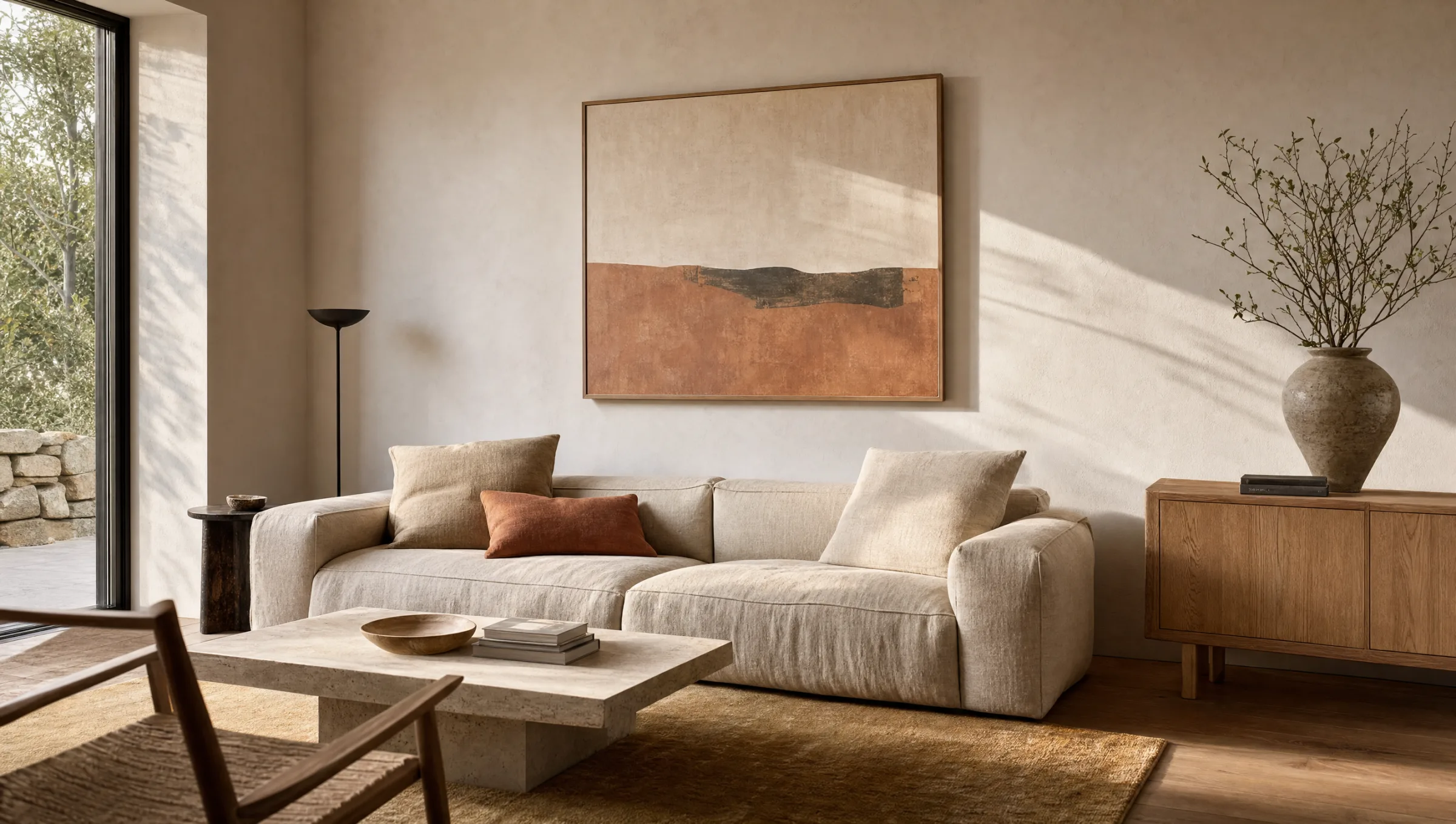
Room Wall Art: Designing Walls with Intention
A piece of room wall art changes more than just an empty surface – it defines the focal axis, atmosphere and daily rhythm of a space. This overview explains what matters when choosing a motif, format and hanging position, so that wall and furnishings work together as a quiet, cohesive whole.
Room Wall Art: Understanding Effect and Function
Room wall art is rarely pure decoration. It marks the visual anchor point of a wall, balances proportions and gives a space its atmospheric direction. When selecting wall art for a room, the question should extend beyond motif to function: should the wall calm, structure or carry a memory?
In the living room, the artwork often takes on the role of a central anchor above the sofa or sideboard. In the bedroom it works more subtly, typically in muted tones, because the eye needs to settle. In a home office or children's room, the image content may be clearer, more graphic and more stimulating – without visually overloading the space.
This distinction is worth making because the same motif can read very differently in two rooms. A botanical print above the dining table brings freshness; in the bedroom, that same print can feel restless if the density of foliage is too high.
Choosing Room Wall Art by Space Type
Each room has its own requirements for motif, format and light behaviour. The four room types below illustrate typical decision patterns when selecting wall art.
Living Room
Large formats from 70 × 100 cm read calmly and proportionally above a sofa or sideboard. Landscape orientations emphasise the horizontal; a single XXL poster often replaces an entire gallery wall.
Bedroom
Muted colour palettes, abstract landscapes or black-and-white photography support rest. Portrait formats above the bed feel framing without dominating the space.
Home Office
Clean lines, typography or reduced architectural motifs keep the eye focused. Mid-range formats around 50 × 70 cm are usually sufficient, as the gaze moves frequently between screen and wall.
Children's Room
Friendly illustrations or animal motifs with a matte coating are less sensitive to raking light. Several small formats can be added to and rearranged over time.
Format, Height and Spacing for Room Wall Art
The most common uncertainty when hanging room wall art concerns the hanging height. As an editorial guideline: the centre of the artwork should sit at around 145 to 150 cm – this corresponds to average eye level when standing. Above furniture, that figure is adjusted downward so that roughly 15 to 25 cm remain between the top of the piece and the lower edge of the frame.
The format should suit the wall, not just the sofa alone. A rough rule of thumb: the artwork occupies two-thirds of the furniture's width. Above a 220 cm sofa, a single piece from around 120 cm wide reads well. Smaller prints belong in groups or on narrow wall sections, such as alongside doors or above console tables.
With multiple pieces, a shared imaginary centre line and an even gap of 5 to 8 cm between frames is recommended. This creates a composed gallery rather than a randomly distributed collection.
Good room wall art does not impose itself – it orders the space and lets it breathe at the same time.
Reetro Editorial
Material and Print: What Holds Up Over Time
Beyond motif and dimensions, material determines how room wall art ages. Matte FSC papers from 200 g/m² reflect very little light and remain calm even in side-lit rooms. Premium canvases absorb colour depth well and suit painterly motifs, while aluminium wall art panels show their strengths with graphic work and crisp edges.
For room wall art in spaces with strong sunlight, UV-stable inks and matte coatings make practical sense. Direct heat sources such as radiators or fireplaces are best avoided – not because of print quality, but due to long-term stress on the substrate material.
Reetro has its motifs printed to order by our production partner in the EU on FSC-certified papers and offers formats from the classic 30 × 40 cm to XXL posters beyond 100 cm. This means the same motif can be used consistently across different rooms without changing the overall style.
Style Directions for Different Living Situations
Anyone looking for room wall art rarely faces a stylistically blank space. Furniture, textiles and flooring already set a direction. In Scandinavian-influenced rooms with light oak and muted textiles, botanical prints, line drawings or calm landscape photography work well. Industrial spaces with exposed concrete or metal can carry high-contrast black-and-white work and architectural motifs.
Classically furnished rooms benefit from framed prints with a mount, as the white border settles the motif and creates measured visual distance. In modern minimalist spaces, frameless large formats or aluminium wall art panels feel more consistent, because they continue the wall rather than interrupting it.
Häufige Fragen
-
01
How large should room wall art above a sofa be?
As a guideline, room wall art above a sofa should span roughly two-thirds of the furniture's width. Above a 220 cm sofa, a single piece from around 120 cm wide reads in proportion. Smaller formats work better in groups – for example a set of three or four with consistent frame spacing. The key is that the artwork reads as a unit with the furniture beneath it, rather than floating in isolation above the wall.
-
02
At what height should room wall art be hung?
The centre of the artwork should sit at approximately eye level for a standing person – around 145 to 150 cm. Above furniture, adjust this downward: ideally 15 to 25 cm should remain between the top of the piece and the lower edge of the frame. This creates a visual connection between artwork and furniture without the two elements feeling cramped together.
-
03
Which room wall art suits which room?
In the living room, large-format, calm motifs above the sofa or sideboard work well. The bedroom calls for muted colours and abstract or landscape subjects. In a home office, clear graphic work keeps focus; in a children's room, friendly illustrations with a matte coating are a practical choice. A general principle: the longer you spend in a room, the more restrained the motif should be.
-
04
What material is best for room wall art in a sunny space?
For sun-filled rooms, matte coatings and UV-stable inks are the sensible choice: they reduce reflections and keep colours accurate over the long term. Matte FSC paper from 200 g/m² or premium canvas are more resilient here than glossy surfaces. Direct heat sources such as radiators or open fires are best avoided, as they can stress the substrate material over time.
-
05
How many pieces of wall art belong in one room?
There is no fixed number, but a reliable guideline is one main work per wall, supplemented by at most one or two smaller pieces on secondary walls. Too many prints fragment the eye. A deliberately curated gallery wall is perfectly valid, but should be contained to a single wall so the remaining surfaces can convey a sense of calm.
-
06
What does Reetro focus on when producing room wall art?
Reetro has prints printed to order by our production partner in the EU on FSC-certified papers from 200 g/m² with matte coatings, alongside premium canvases and hexagon aluminium wall panels. Formats range from the classic 30 × 40 cm through to XXL posters beyond 100 cm. The focus is on durable materials, colour-stable pigments and an editorially curated motif selection – so that room wall art continues to sit quietly in a space for years to come.