
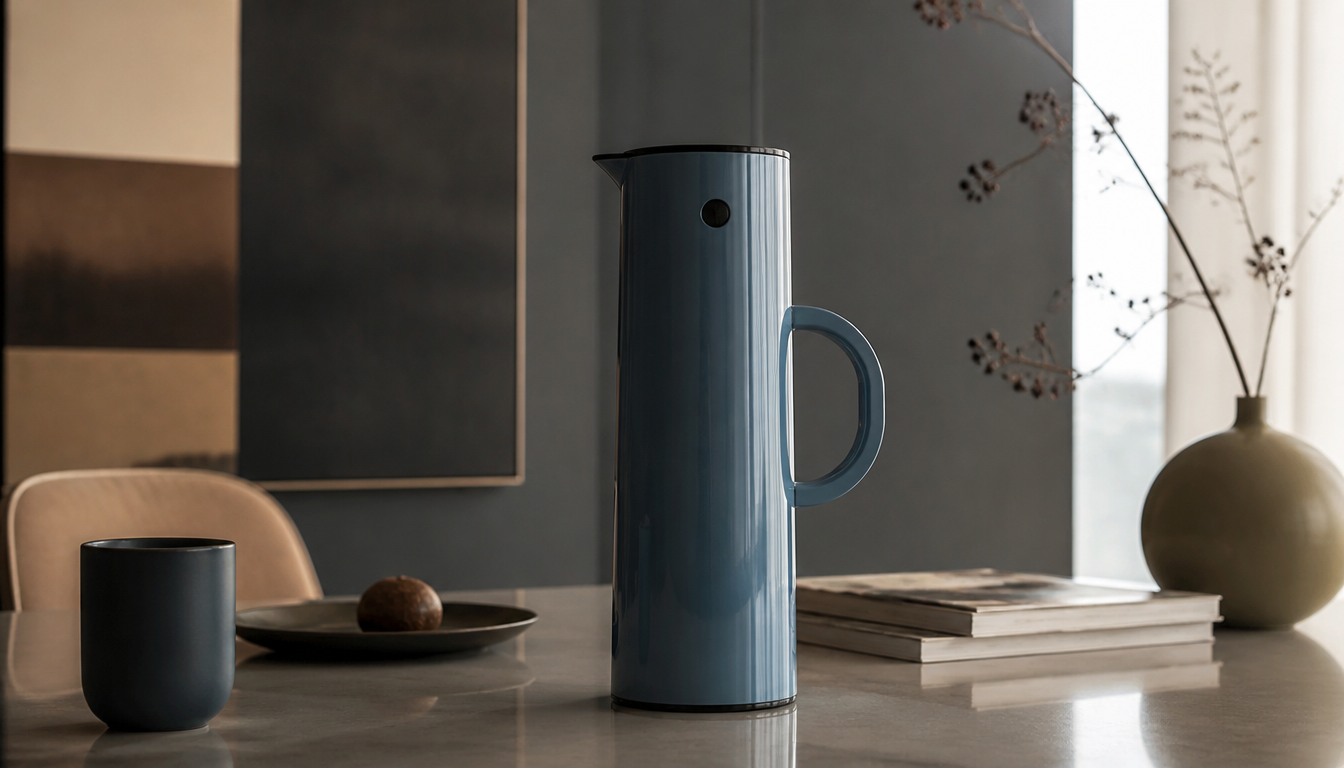
Arne Jacobsen (1902–1971) designed the Cylinda-line for Stelton in 1967, which won the ID Prize from the Danish Society of Industrial Design in the same year and the International Design Award from the American Institute of Interior Designers in 1968. When you pick up a thermos carafe today and wonder why it feels so damn right, the answer often lies in this era. Jacobsen brought his architectural eye for proportion directly to the breakfast table: clean cylinders, no superfluous edges, only the essentials. Stelton has never let go of this design DNA and continues to build on it to this day. For those who understand vintage not as nostalgia but as an attitude, the Cylinda-line is proof that good form simply has no expiration date.
Stelton, Jacobsen and the Cylinda-line: How a Thermos Carafe Became a Design Icon
Arne Jacobsen designed the Cylinda-line for Stelton in 1967, and it was recognised immediately: the Danish industrial design ID Prize 1967 and the International Design Award 1968 from the American Institute of Interior Designers brought the series to international prominence. What began as cocktail and tableware shaped the design DNA of an entire company.
The Man Behind the Cylinder
Arne Jacobsen (1902–1971) began studying architecture at the Royal Danish Academy of Fine Arts in 1924, where he studied under Kaare Klint, among others. Even as a student, he won a silver medal at the 1925 Paris World Exhibition for a chair design. His later work — from “The Ant” to “The Swan” and the “7 Series” — was mostly created as part of larger architectural projects. This holistic way of thinking brought Jacobsen to the Cylinda-line as well: proportion and detail were not opposites for him, but one and the same.
Stelton itself describes the partnership with Jacobsen as one of the defining moments in its design history, alongside collaborations with Erik Magnussen and Peter Holmblad.
What Makes the Cylinda-line So Special
The series lives by the cylinder. No elaborate ornamentation, no curved handles to draw attention away from the form. The insulated carafe from this line follows the same principles: clear geometry, cylindrical body, reduced stainless steel surface. For the early 1960s and 1970s, this was radical. Functionality and aesthetics were not played off against each other, but conceived as a unity.
It is precisely this thinking that Stelton continues to this day — for example with the Brus carbonator, which combines sustainability and minimalist design on the kitchen counter.
4 Practical Tips for Consumers
1. Pay attention to price history. The original Cylinda-line from 1967 is a collected object. Anyone buying a thermos carafe from this period should check manufacturer markings and the year of production. Stelton has reissued the series several times, and the price differences between early originals and later editions are considerable.
2. Material says a lot about the year of manufacture. Early pieces of the Cylinda-line are made of polished stainless steel with no plastic elements on exposed surfaces. Later versions increasingly incorporate plastic components. Those looking for authentic pieces from the founding period should pay attention to the degree of material purity.
3. Use design awards as a guide. The ID Prize 1967 and the International Design Award 1968 are documented distinctions. Sellers who advertise with these awards are referring to verifiable facts. This makes it easier to assess whether an offer is credible.
4. Consider the overall concept. Jacobsen designed the Cylinda-line as a series, not as individual pieces. The carafe, sugar bowl, creamer and tray all follow the same design language. A single piece already makes a strong statement, but the full expression emerges in the interplay of all elements.
Taking Vintage Aesthetics Further
Anyone with a passion for the design thinking of the 1960s and 1970s will find further motifs from this era at reetro. The Bauhaus exhibition poster and the Kandinsky print in Yellow, Blue, Red show how consistently these decades brought aesthetics and function together — just as Jacobsen did. Those wishing to combine colour and geometry will find a harmonious companion in the Bauhaus cushion. And for walls that call for clear structure, it is worth browsing the hexagon range or the entire shop.
Sources
FAQ
Who designed the famous Cylinda-line for Stelton?
The Danish architect and designer Arne Jacobsen (1902–1971) designed the Cylinda-line for Stelton in 1967. Jacobsen is considered one of the most significant Danish designers in the world and played a pivotal role in shaping modernism. His precise understanding of proportions, developed during his architecture studies at the Royal Danish Academy of Fine Arts, fed directly into the cylindrical cocktail and tableware.
What design awards has the Cylinda-line won?
The Cylinda-line received a double distinction: in 1967 it was awarded the ID Prize from the Danish Society of Industrial Design, and in 1968 it received the International Design Award from the American Institute of Interior Designers. This made Jacobsen’s design for Stelton a recognised design statement not only nationally, but internationally as well.
What makes the Stelton insulated carafe a design classic to this day?
Stelton has always been committed to the principle of integrating beautiful details into everyday life and making special moments unforgettable. The iconic thermal carafes are at the heart of this design vision. The Cylinda-line is considered the centrepiece of Stelton’s design DNA: timeless cylindrical forms, clean lines and an attention to detail that Jacobsen brought from his architectural projects, in which he always conceived all interior design elements together.
What was Arne Jacobsen's educational background before he worked for Stelton?
Jacobsen first graduated from the Copenhagen Polytechnic in 1924 and was admitted in the same year to the Royal Danish Academy of Fine Arts, where he studied under Kaare Klint, among others. Even as a student, he won a silver medal at the 1925 World Exhibition in Paris for a chair design. He graduated in 1927. This deep academic foundation explains why his later designs, such as the Cylinda-line, display such an extraordinary sense of proportion.
Which other designers have shaped Stelton's design language alongside Jacobsen?
Alongside Arne Jacobsen, Erik Magnussen and Peter Holmblad have helped shape Stelton’s design style over the years. These collaborations reflect Stelton’s commitment to creating timeless yet practical everyday products in which every detail counts. The thermal carafes and tableware of this era are the most visible result of this collective design thinking.
This article was generated automatically by an AI system. Disclosure pursuant to Article 50 of the EU AI Act.