
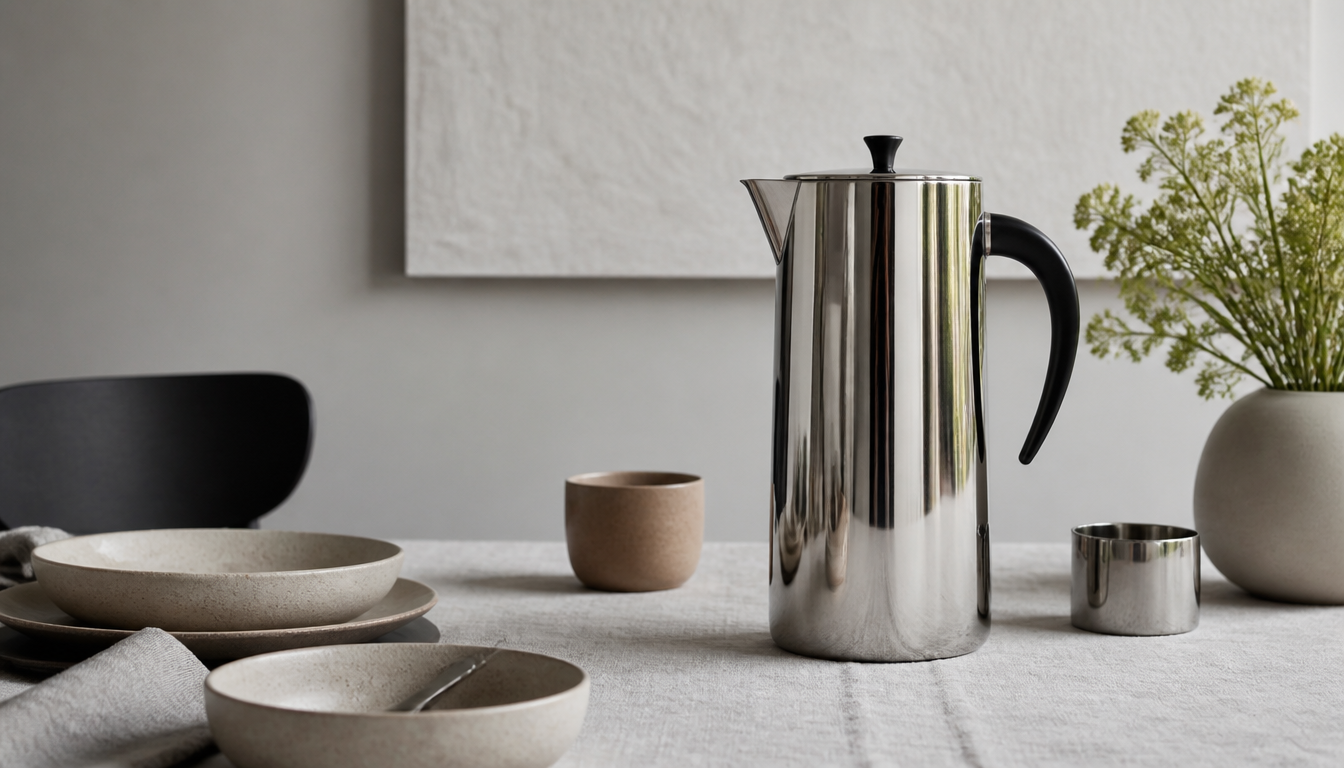
Arne Jacobsen’s Cylinda-Line for Stelton, designed in 1967 in stainless steel, won the ID Prize of the Danish Society of Industrial Design in its very year of release and the International Design Award of the American Institute of Interior Designers in 1968. Anyone searching for timeless tableware design today will inevitably encounter cylindrical forms and brushed steel. The Cylinda-Line was a direct statement against the high-gloss polished silverware of its time: Jacobsen used standardised steel tubes as the formal basis and turned industrial precision into a stylistic principle. Both design awards immediately after launch show that this attitude was instantly understood. And because Jacobsen mastered proportions like no one else, the collection feels just as fresh today as it did in its debut year.
Stelton Cylinda-Line: How Arne Jacobsen Reinvented Table Design in 1967
Arne Jacobsen designed the Cylinda-Line in 1967 for the Danish manufacturer Stelton. In its very year of release, the collection was awarded the ID Prize of the Danish Society of Industrial Design; the International Design Award of the American Institute of Interior Designers followed in 1968. These are no minor footnotes – this is design history in fast forward.
What makes the Cylinda-Line special?
The starting point was as clear as could be: standardised steel tubes. Jacobsen took industrial semi-finished products and turned them into a collection that still graces laid tables today. The cylindrical basic forms with their matte steel surfaces stood in deliberate contrast in 1967 to the high-gloss polished, curved objects that dominated at the time. Steel instead of silver, geometry instead of ornament.
Yet Jacobsen was not a trained product designer. He studied architecture at the Royal Danish Academy of Fine Arts in Copenhagen. This way of thinking in terms of complete spaces and proportions ran through his entire body of work: from “The Ant” and “The Swan” to the “7 Series” chair programme and on to the Cylinda-Line. He developed the collection for Stelton in close collaboration with the manufacturer, which benefits the precision of each individual piece.
4 practical points you should know as a consumer
1. A material with a long-term promise The Cylinda-Line is made of stainless steel and plastic. Stainless steel does not rust, is easy to clean and ages without patina. Invest once and you have a collection that does not need replacing after just a few years.
2. Geometric basic form as a design principle The cylindrical form is not a stylistic device for aesthetics’ sake. It emerged directly from the logic of industrial production. This means: consistent repetition of form, uniform wall thicknesses, precisely defined proportions. This is exactly what makes the individual pieces – including the teapot – instantly recognisable objects with a strong sense of belonging together.
3. Not a single piece, but a system The Cylinda-Line is conceived as a series, not as a single decorative object. Pot, jug, sugar bowl and further elements combine seamlessly. Once you start, you can add pieces gradually without fear of stylistic breaks.
4. Contemporary interiors meet functional classics Jacobsen’s formal vocabulary of the 1960s had, according to sources, consciously moved away from the organic forms of his 1950s furniture and turned towards repetition and geometric basic forms. This makes the Cylinda-Line compatible with interior styles that favour clean lines. Those wishing to complement their living space with similarly uncompromising designs will find kindred aesthetic attitudes in the reetro shop, for example in the Bauhaus-style cushion or the Bauhaus Exhibition Poster. The Bauhaus Sun Poster and the Bauhaus Hexagon Picture strike a similar chord: reduced, precise, timeless.
Jacobsen and the Gesamtkunstwerk
Arne Jacobsen (1902–1971) is, according to Stelton, one of the most internationally recognised Danish architects and designers. His designs frequently emerged in the context of larger architectural projects, for which he simultaneously conceived the interior furnishings and objects. The Cylinda-Line is therefore no outlier, but the consistent continuation of a way of thinking that always understands form in context.
The teapot from the Cylinda-Line is today regarded as a Danish design icon. The term “icon” is often used inflationary in design journalism, but here it is simply historically documented: two international accolades in its year of release and decades of uninterrupted production speak for themselves.
Anyone interested in vintage design and formal consistency will find further objects and prints in the reetro shop that reflect similar design attitudes – for example posters in vintage style or canvases with retro aesthetics.
Sources
- Cylinda line, stainless steel tableware by Arne Jacobsen – Scandinavian Objects
- Arne Jacobsen – Stelton
- Cylinda Line Teapot by Arne Jacobsen for Stelton – Hive Modern
FAQ
Who designed the Cylinda-Line for Stelton and when?
Arne Jacobsen (1902–1971) designed the Cylinda-Line in 1967 for the Danish manufacturer Stelton. Jacobsen is considered one of the most significant Danish architects and designers worldwide and his work fundamentally shaped modernism and Danish design history.
What material is the Cylinda-Line made of and what makes its form special?
The Cylinda-Line is made of brushed stainless steel and plastic. Its forms are based on standardised steel tubes, giving it a clearly geometric, cylindrical silhouette. In 1967, this reduced formal vocabulary stood in deliberate contrast to the high-gloss polished and curved tableware that was common at the time.
Has the Cylinda-Line won any design awards?
Yes, immediately after its market launch the series was honoured with two prestigious accolades: the ID Prize 1967 of the Danish Society of Industrial Design and the International Design Award 1968 of the American Institute of Interior Designers.
How does the Cylinda-Line differ from Jacobsen's other well-known design works?
While Jacobsen’s furniture classics such as “The Ant”, “The Swan” or the “7 Series” from the 1950s are characterised by free, organic forms, the Cylinda-Line is built on repetition and strict geometric basic forms. This development reflects his stylistic shift in the 1960s towards an aesthetic of industrial precision.
Why is the Cylinda-Line still considered a design icon today?
The Cylinda-Line combines consistent functionalism with timeless aesthetics. Conceived as a modern alternative to classic silverware, it was recognised as iconic industrial design immediately upon its introduction. Its minimalist, cylindrical formal vocabulary has lost none of its relevance, which is why the series continues to be produced to this day and shapes Stelton’s design DNA.
This article was generated automatically by an AI system. Disclosure pursuant to Article 50 of the EU AI Act.