
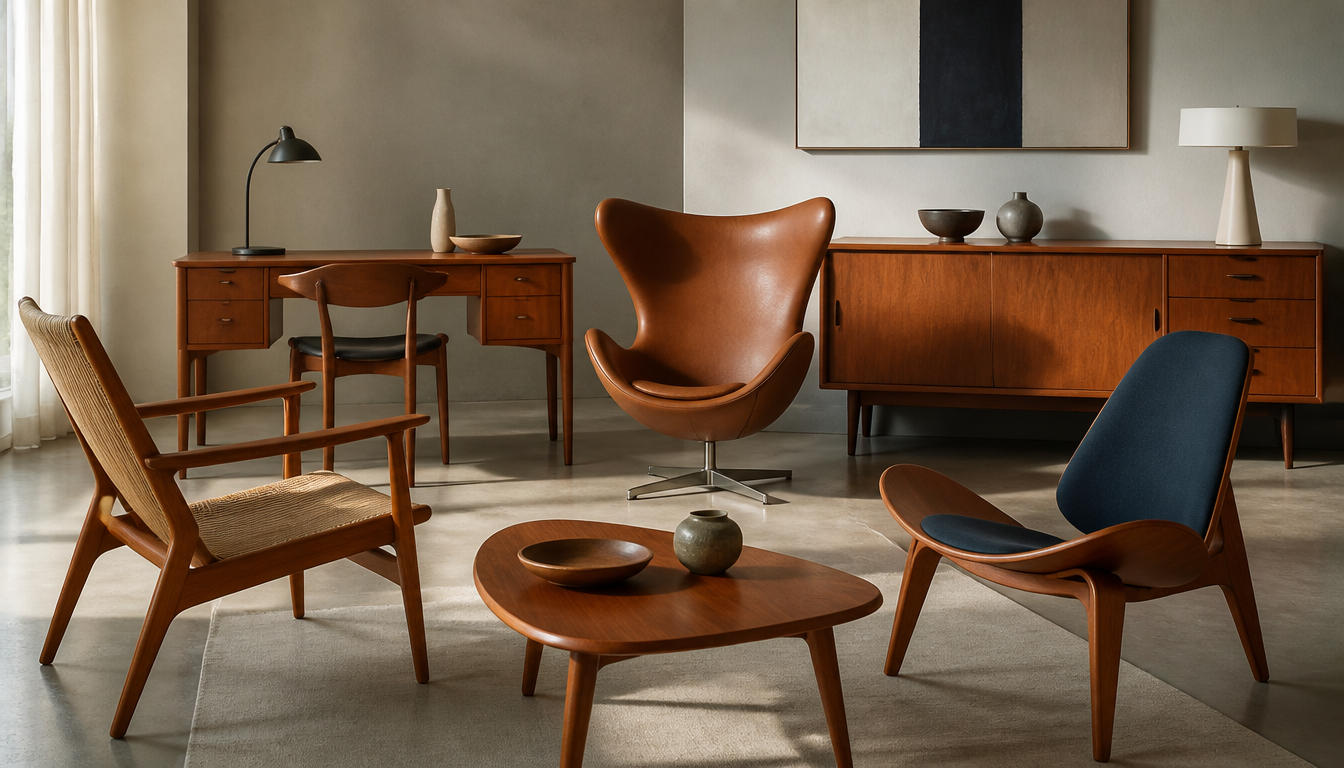
Hans Wegner designed over 500 different wooden chairs, shaping Danish furniture functionalism worldwide from the 1950s onwards alongside Arne Jacobsen and Finn Juhl. Scandinavian design emerged around the turn of the century and experienced its breakthrough from the 1950s onwards in Denmark, Norway, Sweden and Finland. The principle was as simple as it was revolutionary: form follows function, minimalism meets organic elegance. Pieces from this era — roughly from the 1930s through to the 1970s — are considered classic vintage Scandinavian with genuine original production. So if you track down a Wegner chair or a teak sideboard from that period, you’re holding a piece of design history that hasn’t gathered dust to this day.
Scandinavian Furniture Design 1950 to 1970: Why Teak, Functionalism and Three Danes Changed the World of Interiors
Hans Wegner designed more than 500 different chairs, according to Christie’s. That single fact says just about everything about the energy driving Scandinavian design between 1950 and 1970.
The Key Fact: Form Follows Function, Without Compromise
Scandinavian design emerged around the turn of the 20th century and experienced its heyday from the 1950s in Denmark, Norway, Sweden and Finland, according to Galerie Møbler. The guiding principle was always the same: elegance through simplicity, minimalism and functionality. No ornamentation for ornamentation’s sake. Only what is truly needed.
Teak as a material was a perfect fit for this concept: warm, durable, easy to work with and honest in its texture.
The Three Names You Should Know
Hans Wegner is the most prolific of the three. The Danish master furniture maker trained in carpentry and architecture, and initially worked in the office of Arne Jacobsen and Erik Møller when they were designing the furniture for Aarhus City Hall. In 1943, Wegner opened his own studio. His most famous designs — including the Papa Bear Chair, the Peacock Chair and the Wishbone Chair — were almost all made from wood, combining craftsmanship with practical purpose, as Incollect describes. Christie’s confirms: over 500 chairs, predominantly crafted in wood.
Arne Jacobsen was both architect and designer. His influence extended from spatial planning down to the individual piece of furniture.
Finn Juhl completes the trio. His approach was more organic and sculptural, without sacrificing functionality.
All three operated within the same set of coordinates: clean lines, honest materials, practical utility.
4 Practical Tips for Consumers
1. Verify authenticity — don’t trust blindly Vintage pieces from Scandinavian design date, according to Galerie Møbler, from the period 1930 to 1970. Original pieces from this era come with manufacturer’s marks, serial numbers and documented provenance. Anyone buying should look carefully.
2. Read the material as a quality indicator Wegner’s pieces consist primarily of wood, according to Christie’s, worked with carpentry precision. Teak, oak and walnut were the preferred timbers of the era. The joints and surfaces reveal a great deal about a piece’s age and origin.
3. Reproductions have their own value Not every piece needs to be an original. The Scandinavian mid-century modern style is widely appreciated today. Those who want to bring the look into their home can also work with prints and decorative elements that capture the aesthetics of the period. A Bauhaus hexagon picture or a Scandinavian pattern as a hexagon wall picture fit stylistically well in rooms inspired by the Nordic design language.
4. Think in proportions and space Scandinavian design works best in uncluttered rooms. A few well-chosen pieces rather than many small details. Wall décor should follow the same principle. A Sweden pattern as a hexagon wall picture or an MCM alu hexagon as a nod to mid-century modern sets an accent without overloading the space. Those who want to complement the style with further prints will find a good selection in the reetro poster shop.
Why This Style Still Holds Up Today
Galerie Møbler sums it up this way: Scandinavian design combines discreet aesthetics with pragmatic functionality, and in doing so transcends eras and borders. Incollect adds that the craftsmanship of these designers conveys elegance, simplicity and organic modernism — a combination that remains highly valued to this day.
This is no coincidence. Pieces that forgo short-lived trends simply age better.
Sources
- About Scandinavian design | Galerie Møbler
- 11 Scandinavian Mid-Century Modern Furniture Design Pioneers | Incollect, Laurel M. Fay
- Five mid-century modern Nordic furniture designers to know | Christie’s
FAQ
What makes Scandinavian furniture design of the 1950s to 1970s so special?
Scandinavian design of this era follows a clear principle: form and function belong together. The furniture appears simple, yet is crafted with considerable skill. Clean lines, natural materials such as teak and wood, and a consistent suitability for everyday use define the style. This design language emerged in Denmark, Norway, Sweden and Finland from the turn of the century, with the style reaching its peak from the 1950s onwards.
How many chairs did Hans Wegner actually design?
Hans Wegner was a true chair obsessive: depending on the source, the Danish master furniture maker designed more than 200 elegant seats, with other accounts citing over 500 different chairs. Made predominantly from wood, his works stand for masterful craftsmanship and the typically Danish combination of functionality and aesthetics. His Wishbone Chair, Papa Bear Chair and Peacock Chair remain among the most iconic seats of the 20th century to this day.
What connects Arne Jacobsen and Hans Wegner in their careers?
Before Hans Wegner opened his own studio in 1943, he worked in the office of Arne Jacobsen and Erik Møller. Together they designed the furniture for Aarhus City Hall in Denmark. Both designers are exemplary of the Scandinavian approach to crafting everyday objects at the highest aesthetic and artisanal level.
What distinguishes 'vintage Scandinavian' from later productions?
Classic vintage Scandinavian refers to original pieces from the period spanning the 1930s to the 1970s. Items from this period are characterised by authentic production methods and materials of their time. From the 1970s onwards, production and influences changed increasingly, which is why collectors and connoisseurs place particular value on original pieces from the style’s golden age.
What materials are typical of Scandinavian furniture design of this era?
Wood is clearly at the centre — teak in particular was the preferred material of Scandinavian furniture designers during the 1950s to 1970s. Wood was complemented by textiles, ceramics and glass, as Scandinavian designers specialised in everyday objects of all kinds. The combination of natural materials and functional form is the unmistakable hallmark of this design period.
This article was generated automatically by an AI system. Disclosure pursuant to Article 50 of the EU AI Act.