
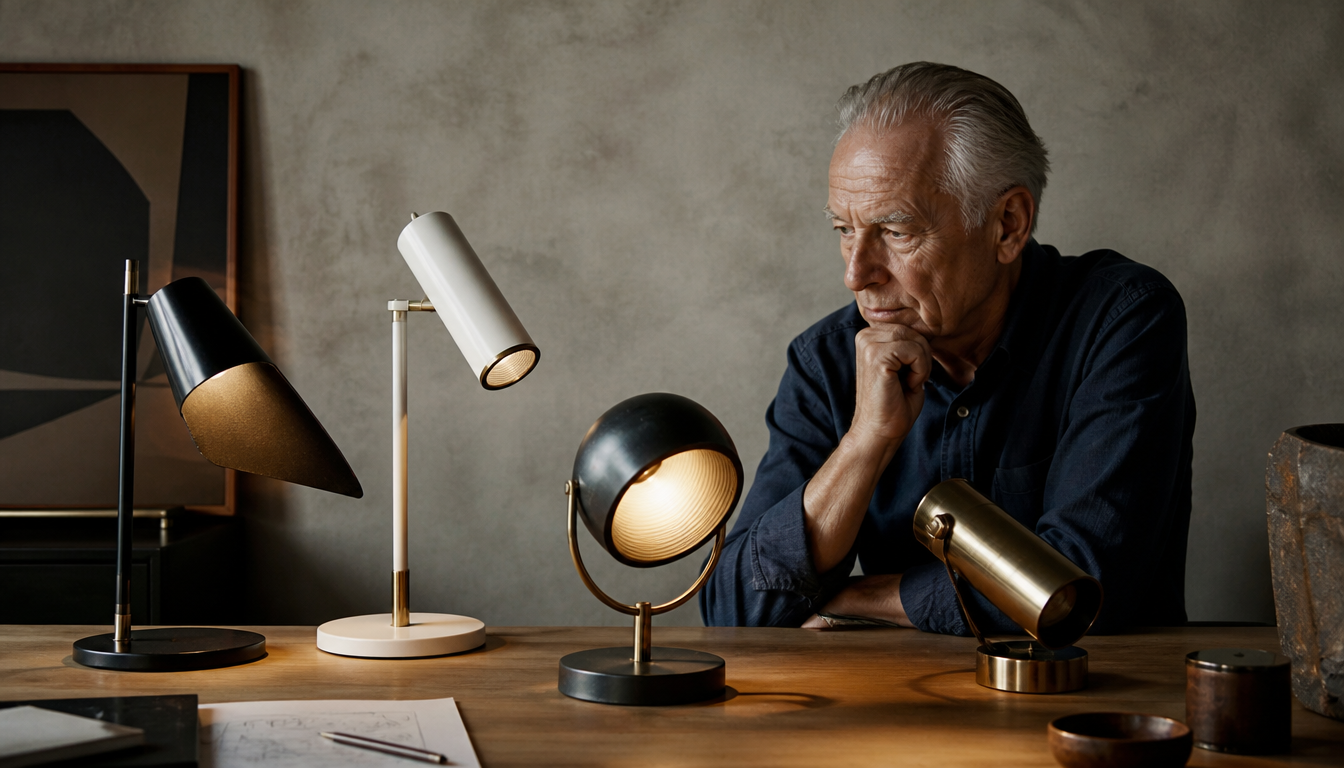
Paavo Tynell’s “Snowflake” chandeliers fetch up to half a million dollars at auction: Scandinavian luminaires from the 1950s to 1970s are now considered the most expensive design objects of their era. What was once designed as functional everyday lighting is today museum-worthy cultural heritage. Companies like the Swedish ASEA deliberately collaborated with designers in the 1950s to unite technical production with aesthetic elegance. The result: luminaires that, decades later, not only grace collectors’ living rooms but have shaped the entire design history of the North. Anyone familiar with Scandinavian vintage lighting of this era understands why minimalism and materials research continue to influence the global design language to this day.
Scandinavian Luminaires of the 1950s to 1970s: Minimalism, Materials Research and the Spotlight Concept
Key fact: According to the art market magazine Incollect, Finnish designer Paavo Tynell ranks among the world’s most renowned and admired Mid-Century Modern creators of luminaires and lamps. His “Snowflake” chandeliers achieve auction prices of up to half a million US dollars — and even higher sums on the gallery market.
Scandinavia as a Design Laboratory for Light
Anyone familiar with the design history of Northern Europe knows: light was never mere function there. In the 1950s, Swedish and Finnish manufacturers combined industrial production expertise with a deep sense of elegance and everyday usability. A particularly striking example is ASEA, the Swedish industrial conglomerate, which according to Jelmar Hufen, owner of H Gallery in Utrecht, was not only an industrial heavyweight during that decade but also a significant patron of modern home lighting. ASEA worked with designers “who understood how to bring softness and elegance into functional objects,” says Hufen. Its influence on design history, particularly in the field of luminaires, was enormous.
Hans Bergström designed ceiling luminaires for ASEA in the mid-20th century that are still regarded today as reference objects of Scandinavian modernism. The combination of innovative design and technical production expertise made such pieces into collector’s items that H Gallery continues to exhibit to this day.
The Spotlight Concept and the Question of Materials Research
What sets Scandinavian luminaire design apart from other schools is the consistent use of new materials and the reduction to essentials. Shades made of brass, perforated metal or mouth-blown glass were constructed so that light is directed, diffused or filtered with precision. The “spotlight concept” of the 1960s and 1970s — the directed, often swivelling light source — was more than an aesthetic trend: it was a response to the long, dark winter months of Northern Europe.
The Scandinavian Journal of Design History has documented these developments over several decades. Volume 14 (2004) of the journal, for example, asked under the title “Is the aim still the same?” about the role of arts and crafts museums in the 21st century, demonstrating that academic engagement with Scandinavian design remains very much alive today. Volume 15 (2005) was dedicated, among other things, to the legacy of the Ulm School of Design from a Finnish perspective as well as design education in Norway between 1919 and 1952.
4 Practical Implications for Consumers
1. Identifying originals, avoiding fakes Scandinavian luminaires from the post-war period usually bear manufacturer or designer markings. For Tynell luminaires that achieve six- to seven-figure sums at auction, a thorough provenance check before purchase is well worthwhile. Catalogues from galleries such as H Gallery are valuable references in this regard.
2. Material quality as a purchasing criterion Brass ages differently from aluminium or plastic. Anyone buying or reproducing Scandinavian luminaires from the 1950s to 1970s should pay attention to the original alloy: many pieces patinate over decades to a distinctive golden tone that modern replicas often fail to achieve.
3. Combining with wall art and textile décor The directed light of Scandinavian spotlights showcases wall art to particularly striking effect. Those wishing to take the Mid-Century look further at home will find fitting complements in the reetro shop: for instance a Bauhaus hexagon picture or a Scandinavian pattern hexagon as a wall element. The Bauhaus classic as a poster also fits stylistically into this setting.
4. Decorative cushions as an easily changeable style element Anyone who doesn’t want to commit permanently to the minimalist Northern European look can turn to textiles. A decorative cushion in the Bauhaus style or a cushion with an abstract retro pattern can be swapped quickly yet still makes a clear statement. Our complete cushion collection offers further options for the Northern European look.
Why the Topic Is Relevant Again Today
Interest in Mid-Century Scandinavian Design has grown noticeably in recent years — not only at auctions, but also in everyday life. The clean lines, the longevity of the objects and the idea that good design needs no decoration strike a chord at a time when spaces are once again being designed more consciously. For those who want to explore further: the Scandinavian Journal of Design History is one of the few academic sources that systematically examines these developments and is freely accessible.
For wall and room design in a similar spirit, it is worth browsing our poster collection and the hexagon wall pictures, which combine geometric reduction with a warm interplay of colour.
Sources
- Northern Lights: Scandinavian Modern Lighting & Designers | Benjamin Genocchio
- Scandinavian Journal of Design History, Vol. 1–15 | SDU Nordic Forum for Design History
FAQ
Who was Sievert Lindblad and what role did he play in Scandinavian luminaire design of the post-war period?
Sievert Lindblad was a Swedish designer who worked during the height of Scandinavian modernism. In the 1950s to 1970s, Swedish manufacturers such as ASEA played a decisive role in shaping luminaire design by engaging designers who combined functional objects with elegance and softness. According to gallerist Jelmar Hufen, ASEA was regarded as an “industrial powerhouse” and at the same time an important patron of contemporary home lighting, whose influence on design history can still be felt to this day.
What makes Scandinavian luminaires from the 1950s to 1970s so special?
The strength of this era lay in the combination of technical expertise and design sensibility. Companies such as ASEA in Sweden paired innovative designs with their production capabilities, resulting in unique and inventive luminaires. Designers understood how to transform everyday objects into genuine design pieces without sacrificing functionality — that is the essence of the Scandinavian approach.
Who is considered the most famous Scandinavian luminaire maker of the 20th century?
Finnish designer Paavo Tynell ranks among the world’s most renowned and admired creators of Mid-Century Modern luminaires and lamps. His spectacular ‘Snowflake’ chandeliers achieve auction prices of up to half a million dollars — and even higher prices on the gallery market.
How has design history research addressed Scandinavian luminaires and their designers?
The Scandinavian Journal of Design History has systematically documented the design history of Scandinavia across 15 volumes. Topics such as the influence of international schools, national design traditions and materials research played a central role throughout. This academic work has helped to bring lesser-known designers and manufacturers out of the shadow of the major names.
What distinguishes the spotlight concept of Scandinavian designers from other European design schools of the same era?
While many European design schools — such as the Ulm School of Design — relied heavily on purist reduction, Scandinavian designers like Hans Bergström for ASEA pursued an approach that combined functionality with organic warmth. According to H Gallery in Utrecht, these collaborations brought “softness and elegance into functional objects” — a characteristic that clearly sets the Scandinavian spotlight and ceiling luminaire concept apart from purely rationalist designs.
This article was generated automatically by an AI system. Disclosure pursuant to Article 50 of the EU AI Act.