
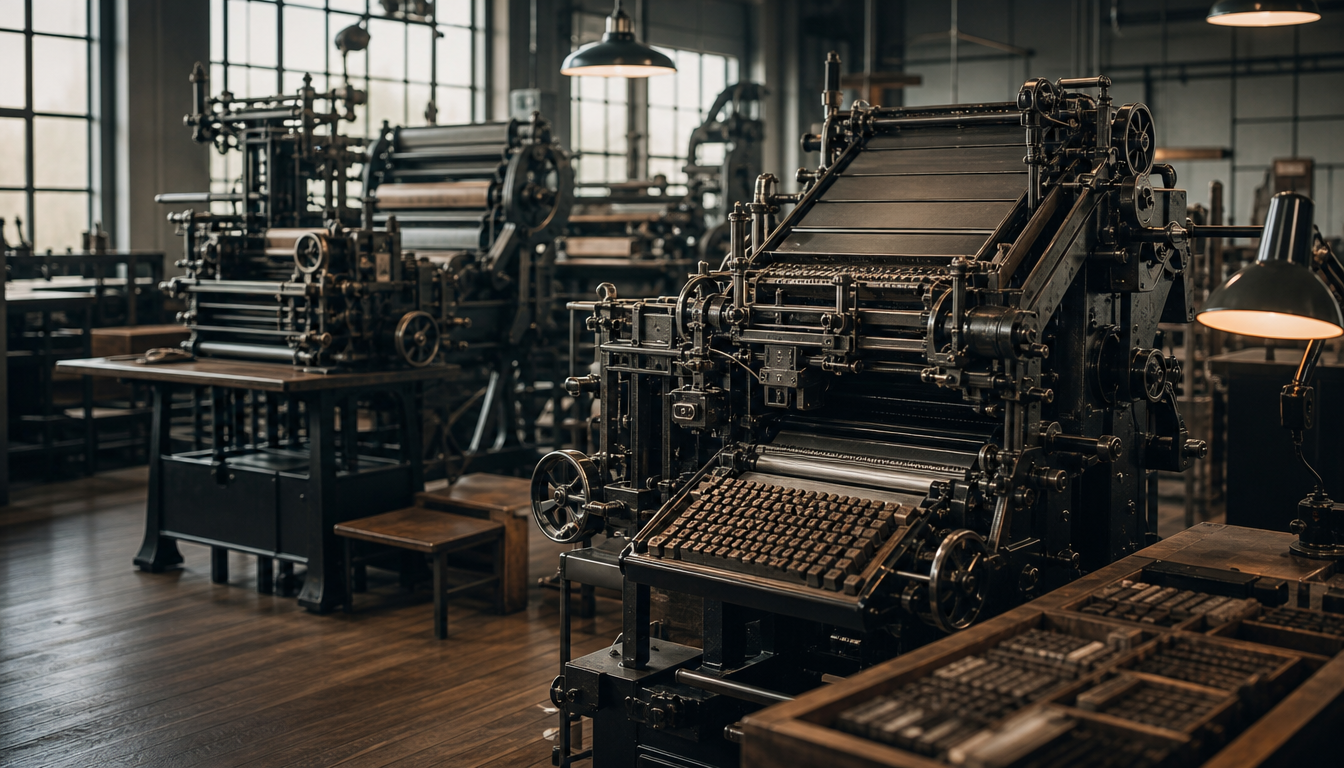
A single Linotype machine replaced six hand compositors at once: Ottmar Mergenthaler’s 1884 invention allowed newspapers and magazines to be produced faster and more cheaply than ever before from the late 19th century onward. Before the Linotype conquered pressrooms, nobody simply typed out a text. Every single letter had to be placed by hand into a composing stick. With the Linotype, a single operator typed on a 90-character keyboard and the machine cast a complete line of metal in one piece. That was what truly made the mass production of books, newspapers and magazines possible. No Gutenberg, no Mergenthaler, no reetro journal block. The machine remained the industry standard well into the 1970s and 1980s, before phototypesetting and digital composition replaced hot metal.
Line by Line: How the Linotype Machine Changed Printing Forever
Imagine a single machine replacing six compositors at once. That is exactly what the Linotype achieved, invented by German watchmaker Ottmar Mergenthaler around 1884. The Mergenthaler Linotype Company sold it worldwide, making it the most widely used typecasting machine of its era. From the late 19th century through the 1970s and 1980s, the system remained the standard in newspaper and magazine printing, before phototypesetting and digital composition replaced it. The American Society of Mechanical Engineers (ASME) recognised the Linotype in 2005 as a Historic Mechanical Engineering Landmark.
What was the technology behind it?
The Linotype was a hot-metal typesetting process. The operator typed on a 90-character keyboard; the machine assembled matrices — moulds of individual letters — into a complete line, which was then cast as a single piece of metal known as a “slug”. The name explains itself: “line-o’-type”, one line at a time. Previously, compositors set letter by letter by hand using a composing stick and flat, partitioned type cases. This was slow and space-intensive. The Linotype accomplished the same work faster, in less space, and with far fewer staff.
What does this mean for you today?
1. Mass-produced type shaped the visual world we now call “vintage”. Newspapers, advertising posters and magazine pages from the Linotype era carry a characteristic typography that still serves as a reference for retro design today. If you collect or commission reprints of posters from the early decades of the 20th century, you are immersed in the aesthetic that the Linotype made possible. A great example is the Bauhaus Ausstellung Poster or the Klassisches Retro Kinoposter.
2. Printing speed made content affordable. Because one person took over the work of six, production costs for books, newspapers and advertising materials fell considerably. Mass-market books and inexpensive daily papers only became a matter of course thanks to the Linotype. That same cost logic resonates today when retro prints are accessible for living rooms everywhere, not just for galleries.
3. Typography became an art for the people. The visual language of this era landed directly on cinema posters, travel advertisements and exhibition posters. Anyone interested in vintage wall décor today will find genuine historical context in reprints of this imagery. Take a look, for example, at the Bauhaus Werbeplakat Kunsthochschule or the Retro Reiseposter Hong Kong — both breathe the spirit of the typesetting-machine era.
4. Vintage print as an interior design idea. The Linotype turned printed matter into everyday culture. Its echo lives on today in framed reprints that work as wall art or posters. In the reetro Poster Shop you will find a wide selection — from historic advertising posters to city maps such as the Stadtplan Berlin Poster, which captures the charm of the printmaking tradition.
Sources
- Linotype machine – Wikipedia
- A Landmark in Typecasting – ASME
- What is a Linotype machine? – Exploring Trafford’s Heritage
FAQ
What exactly is a Linotype machine, and why was it such a big deal?
The Linotype is a line-casting machine invented by Ottmar Mergenthaler that cast complete lines of text in metal all at once. Before it, every printer set letter by letter by hand. A single Linotype machine replaced the work of up to six hand compositors. This dramatically accelerated the production of newspapers, magazines and books, and made printed matter affordable to a mass audience. No wonder the ASME recognised it in 2005 as a historic masterwork of mechanical engineering.
Who invented the Linotype, and exactly when did it happen?
Behind the Linotype stands German watchmaker Ottmar Mergenthaler. He developed the machine in the 1880s, with 1884 or 1886 cited as the date of origin depending on the source. It was marketed by the Mergenthaler Linotype Company in New York. Mergenthaler is far less well known today than Johannes Gutenberg, yet he mechanised typesetting in a way that made Gutenberg’s foundational work truly viable for the masses.
How did the Linotype's keyboard principle work technically?
The machine operator typed on a keyboard with 90 characters. The machine collected matrices — moulds of individual letters — into a complete line. That line was then produced in a single casting operation as one piece of metal, the so-called slug. Afterwards, the matrices automatically returned to their home positions. This was a huge leap over the old system of hand compositing with a composing stick and flat type cases.
How long did the Linotype dominate the printing industry?
From the late peak of the 19th century through to the 1970s and 1980s, the Linotype was the standard composition method for newspapers, magazines and advertising. Especially for smaller bodies of text, there was no serious alternative for a long time. Only phototypesetting and, subsequently, digital computer composition displaced the hot-metal technology after nearly a century of dominance.
Why does almost nobody know Ottmar Mergenthaler, even though his invention was so significant?
Good question. Gutenberg gets all the glory for the printing press, but Mergenthaler took the next revolutionary step. He mechanised what Gutenberg had conceived by hand, thereby enabling the golden age of daily newspapers and mass publishing. The Linotype became the world’s best-selling typesetting machine. Perhaps the reason is that machines from the 19th century sound less glamorous than Gutenberg’s Bible. Unjustly so.
This article was generated automatically by an AI system. Disclosure pursuant to Article 50 of the EU AI Act.