
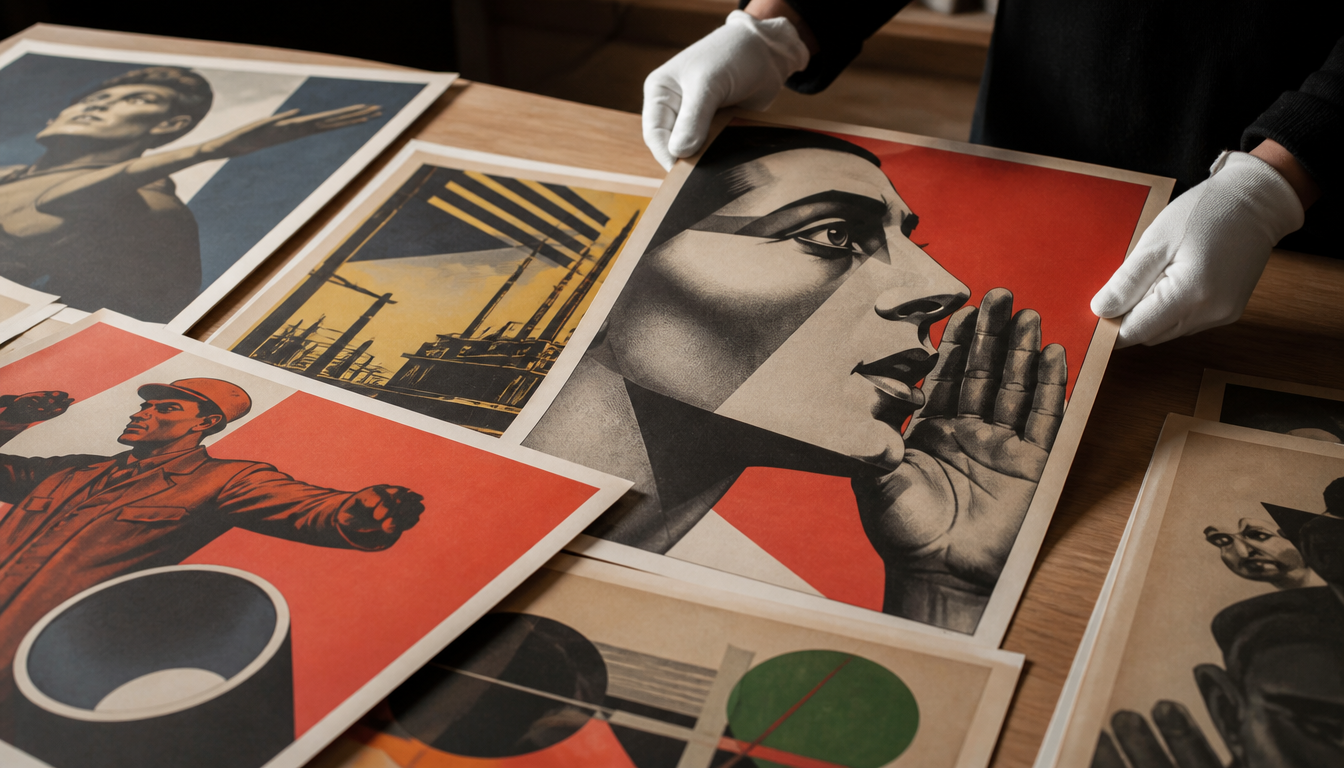
Over 100 surviving political posters from the Weimar Republic (1919–1933) document the poster war between the NSDAP, Social Democrats, and other parties – the German Federal Archives alone hold more than 1,000 copies. These posters show you how visual communication functioned within a fracturing democracy. Early NSDAP posters from 1920 onwards deliberately relied on bold reds and radical slogans, while Rainer Schoch’s seminal work Politische Plakate der Weimarer Republik (1980) captures the full spectrum from the Sachplakat to the avant-garde. Anyone who takes design history seriously cannot overlook this era.
Poster Art of the Weimar Republic 1918–1933: Propaganda, Sachplakat and Avant-Garde
Between 1918 and 1933, Germany produced one of the most diverse and contradictory poster landscapes in art history. More than 100 political posters from the Weimar party system alone are documented and archived today, including works from nearly every political camp, from Social Democracy to the NSDAP. The Federal Archives in Germany holds over a thousand of these original posters in digital form, while the University of California Library preserves around 300 more.
Between Agitation and Aesthetics: What Defines the Posters of This Era
The Weimar Republic was a laboratory for visual communication. On one side stood political campaign posters aimed directly at street-level voters. On the other, designers from the Bauhaus and related movements experimented with clean forms, geometric reduction, and new printing techniques. Both strands continue to shape what we understand as “classic” poster design today.
The early NSDAP posters from 1920 onwards deliberately employed bold signal colours, above all red, according to records held in the Calvin College Archive. A documented poster from May 1920 advertises a meeting in Munich with Hitler as speaker. The tone of the text was emotionally charged and explicitly opposed the parliamentary system. This design principle – vivid colour plus a short appeal – was no accident, but strategy.
In contrast stood the so-called Sachplakat: sober, typography-driven, favouring information over emotion. Rainer Schoch’s standard reference work Politische Plakate der Weimarer Republik, 1918–1933 (published in 1980, today accessible in the Rene Wanner Research Library at Poster House) systematically categorises these currents by party and era, making the study of their visual language easier to this day.
What You as a Design Enthusiast Can Take Away
1. Clear geometry and strong colour work together. That was the central promise of both the Sachplakat and the Bauhaus tradition. Anyone planning wall décor today intuitively draws on the same principles. Our Bauhaus Ausstellung Poster or the Kandinsky Poster Gelb Blau Rot make exactly that visible – no museum entrance ticket required.
2. The Bauhaus hexagon as a spatial design element. The visual language of the Weimar avant-garde lives on in modern wall formats. The Bauhaus Hexagon Bild translates this aesthetic directly into three-dimensional wall décor that can be combined with other vintage pieces.
3. Historical poster styles are a reliable anchor for interior design. The advertising posters of the Weimar years relied on instantly recognisable imagery: strong silhouettes, few colours, no distractions. Anyone wishing to work in a similar vein will find direct period references in the Bauhaus Werbeplakat Kunsthochschule or the Hohlwein Poster Zoologischer Garten.
4. Collecting and comparing pays off. The sheer number of surviving Weimar posters – over a thousand in the Federal Archives alone – demonstrates how systematically this era produced visual material. For your own wall, this means: thematic series work better than individual pieces. In the Poster Shop you will find a curated selection that can be assembled into groups.
Sources
- Politische Plakate der Weimarer Republik, 1918–1933 – Rene Wanner Research Library (Poster House)
- Over 100 Weimar Germany Propaganda Posters arranged by party and era, 1919–1933 – Reddit r/PropagandaPosters
- Nazi Posters: 1920–1933 – German Propaganda Archive, Calvin University
FAQ
Which political parties used posters as a means of propaganda during the Weimar Republic (1918–1933)?
Virtually all major parties of the time relied on the poster as a political communication tool. Posters are documented from parties across the entire political spectrum of the Weimar Republic. The NSDAP began a systematic poster campaign as early as 1920, as evidenced by collections held at the German Federal Archives and the University of California. Over 100 party posters from the period 1919 to 1933 have survived and are archived, organised by party and era.
What did the early Nazi posters look like, and what made them so striking?
The first NSDAP posters from 1920 onwards used bold red colours to attract attention. An early example from Munich, dated May 1920, announced a party meeting at which Hitler spoke on the topic ‘What do we want?’ These early posters combined provocative language with strong use of colour. Many were photographically documented by Dr. Robert D. Brooks at the German Federal Archives, which today makes over a thousand poster templates accessible online.
Where can I study original political posters from the Weimar Republic today?
There are several important resources: the German Federal Archives holds the most extensive collection, with more than a thousand digitised posters. The University of California Library has made nearly 300 posters available online, and the University of Minnesota Library also possesses a significant collection. For book research, the Rene Wanner Research Library is worth consulting – it holds, among other works, Rainer Schoch’s standard reference Politische Plakate der Weimarer Republik, 1918–1933 from 1980 as an in-house copy.
What distinguishes political propaganda posters of the Weimar era from the contemporaneous Sachplakat?
Political propaganda posters of the Weimar Republic aimed directly at emotional mobilisation: they employed enemy images, strong contrasts, and pointed messages, often with explicit party identification. The Sachplakat, which also flourished in this era, stood for clear imagery, reduced typography, and matter-of-fact product communication. Both genres can be traced side by side in the period from 1918 to 1933, as collections such as Politische Plakate, 1914–1945 by Ruth Malhotra or Hans Bohrmann’s Politische Plakate from 1984 illustrate.
Were there also posters in the Weimar Republic directed against the NSDAP?
Yes, definitely. Alongside Nazi propaganda, a vibrant counter-poster art existed. Documented collections explicitly include ‘Anti-Nazi Propaganda of the Weimar Republic’ from the period 1918 to 1933 – that is, posters specifically directed against National Socialism. These posters came from various democratic and left-wing parties and are today part of archival collections that make over 100 such examples accessible, categorised by party and year of production.
This article was generated automatically by an AI system. Disclosure pursuant to Article 50 of the EU AI Act.