
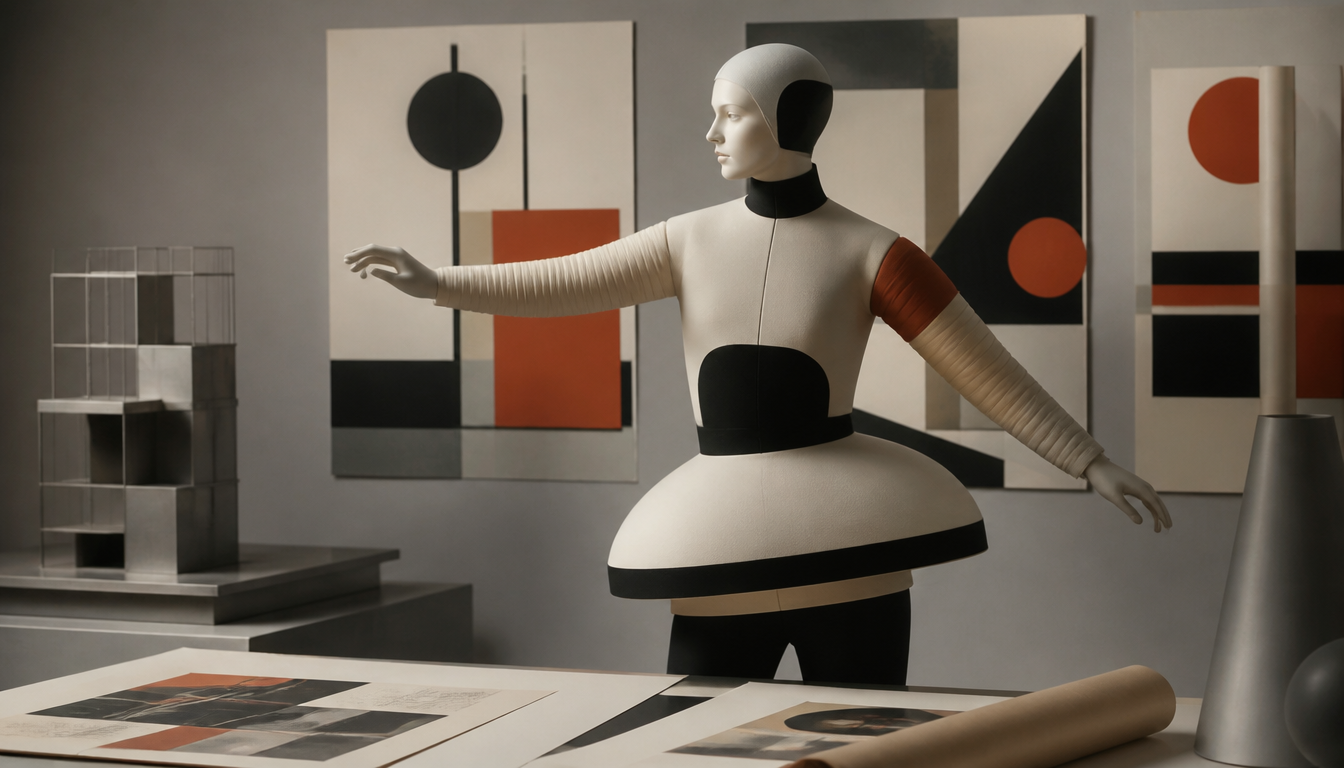
Between 1919 and 1923, Oskar Schlemmer developed around 12 reliefs, two sculptures in the round, and 20 figurines for the Triadic Ballet, establishing the geometric formal repertoire of the Bauhaus as a living design language. Anyone designing sneaker silhouettes, shoe boxes, or campaign graphics with clean lines and geometric forms today is working with a language that Schlemmer codified at the Bauhaus over 100 years ago. His approach of translating the human body into cylinders, spheres, and cone shapes — making both precision and movement visible — continues to resonate in visual culture to this day. As someone interested in design, it’s worth exploring these roots, because they show how hands-on experimentation gave rise to a formal logic that remains relevant today.
Oskar Schlemmer and the Bauhaus Poster: Geometry and Movement as Design Language, 1923 to 1933
The key fact upfront: Oskar Schlemmer (1888 to 1943) took on the role of Master of Form at the Bauhaus Theatre Workshop in Weimar in 1923. That same year saw the creation of his most famous work, the Triadic Ballet, in which costumed dancers were transformed into geometric forms. What Schlemmer described at the time as a “party of form and colour” was simultaneously the visual programme of an entire design era.
Geometry Instead of Ornament: What the Bauhaus Really Wanted
The Bauhaus was not a stylistic trait — it was an attitude. Schlemmer put it himself: whoever loves machines, technology, and precision rejects chaos and seeks a form that fits its own time. This idea ran through his entire body of work, from sculpture to stage poster.
Schlemmer created the bulk of his sculptures between 1919 and 1923. Karin von Maur documents in her book Oskar Schlemmer Sculpture (Harry N. Abrams, Inc., New York) around 12 reliefs, two sculptures in the round, and the 20 figurines of the Triadic Ballet from this period. In addition, there was a mural — half painting, half sculpture — for the workshop building of the Weimar Bauhaus. From the very beginning, Schlemmer moved between disciplines and made this crossing of boundaries his guiding principle.
Bauhaus posters from this era followed the same rules: clear surfaces, strong primary colours, typography as a design element, the human body as geometric cipher. This was no coincidence, but the programme of a school that understood art and craft as inseparable.
4 Practical Implications for You as an Interior Designer
1. Less really is more — when the form is right. Schlemmer reduced the body to circle, triangle, and rectangle, and gained expressive power in doing so. This translates directly to wall design: a single, formally strong poster needs no company. The Bauhaus exhibition poster and the Bauhaus advertising poster Kunsthochschule are built on exactly this principle and work just as well as a standalone piece as they do in an ensemble.
2. Geometry needs the right medium. The Bauhaus formal language lives on precise edges and high-contrast surfaces. On canvas it feels soft and painterly; on paper or aluminium it looks sharp and graphic. The Bauhaus Hexagon image uses the hexagonal form itself as a design element, making the format part of the statement. If you prefer the classic version, take a look at the poster range as well.
3. The Bauhaus cushion as a colour anchor in the room. Schlemmer worked with primary colours as carriers of meaning — red, yellow, and blue became a grammar of seeing. The decorative cushion in Bauhaus style translates exactly that into an everyday format. Those who want to take the look further will find geometric patterns in the cushion shop such as the monochrome 3D cube pattern cushion or the retro cushion in abstract style, both breathing the same formal spirit.
4. Bringing movement as a design principle into the living room. The Triadic Ballet was kinetic sculpture. The figurines moved, and the form changed with the viewing angle. You can recreate this effect with varying formats in the room: combine a large wall image with smaller objects in a similar colour language. The Bauhaus sun poster and the Kandinsky poster in yellow, blue, red together generate exactly the kind of visual tension that Schlemmer staged on the theatre floor.
Sources
- The Bauhaus style of Oskar Schlemmer, ArtWizard, 10.02.2020
- Oskar Schlemmer Sculpture, Artforum (Karin von Maur, Harry N. Abrams, Inc., New York)
- Object Checklist: History of the Bauhaus, Getty Research Institute
FAQ
Who was Oskar Schlemmer and what is his connection to the Bauhaus?
Oskar Schlemmer was born in Stuttgart in 1888 and was a painter, sculptor, designer, and choreographer. In 1923, the Bauhaus brought him in as Master of Form in the Theatre Workshop, having already worked in the sculpture workshop beforehand. He is therefore one of the central figures of this legendary school, which united art, craft, and technology under one roof.
What did Schlemmer mean when he spoke of 'the form of our time'?
Schlemmer put it in his own words: the art of his time loved machines, technology, and organisation, strived for precision, and rejected everything vague and dreamy. For him, this was not cold mechanism, but a conscious revolt against chaos and a search for a formal language that truly belonged to the present. This attitude ran like a thread through his posters, stage designs, and sculptures.
What is behind the Triadic Ballet that appears on so many Bauhaus posters?
The Triadic Ballet of 1923 is Schlemmer’s most famous work. In it, costumed dancers were transformed into geometric figures — the human body consistently translated into circles, cylinders, and spheres. Schlemmer himself called it a ‘party of form and colour’. Art historians even classify the 20 figurines of the ballet as kinetic sculptures, because they moved through space, thus combining sculpture and performance into a single concept.
How many sculptures did Schlemmer actually create during his time at the Bauhaus?
The bulk of his sculptural work was created between 1919 and 1923 — in just four years. During this period he produced around 12 reliefs and two sculptures in the round, along with a series of preparatory drawings for works that were never realised. Added to these are the mural on the workshop building of the Weimar Bauhaus — half painting, half sculpture — and the 20 figurines of the Triadic Ballet.
Which artists influenced Schlemmer's design language?
Schlemmer himself cited Wilhelm Lehmbruck and Alexander Archipenko as pioneering sculptors, as well as the Cubists in painting. For him, these were precisely the positions that pointed the way towards architecture, because they built within their works. These influences fed directly into his geometrically precise formal language, which continues to shape the visual identity of the Bauhaus to this day.
This article was generated automatically by an AI system. Disclosure pursuant to Article 50 of the EU AI Act.