
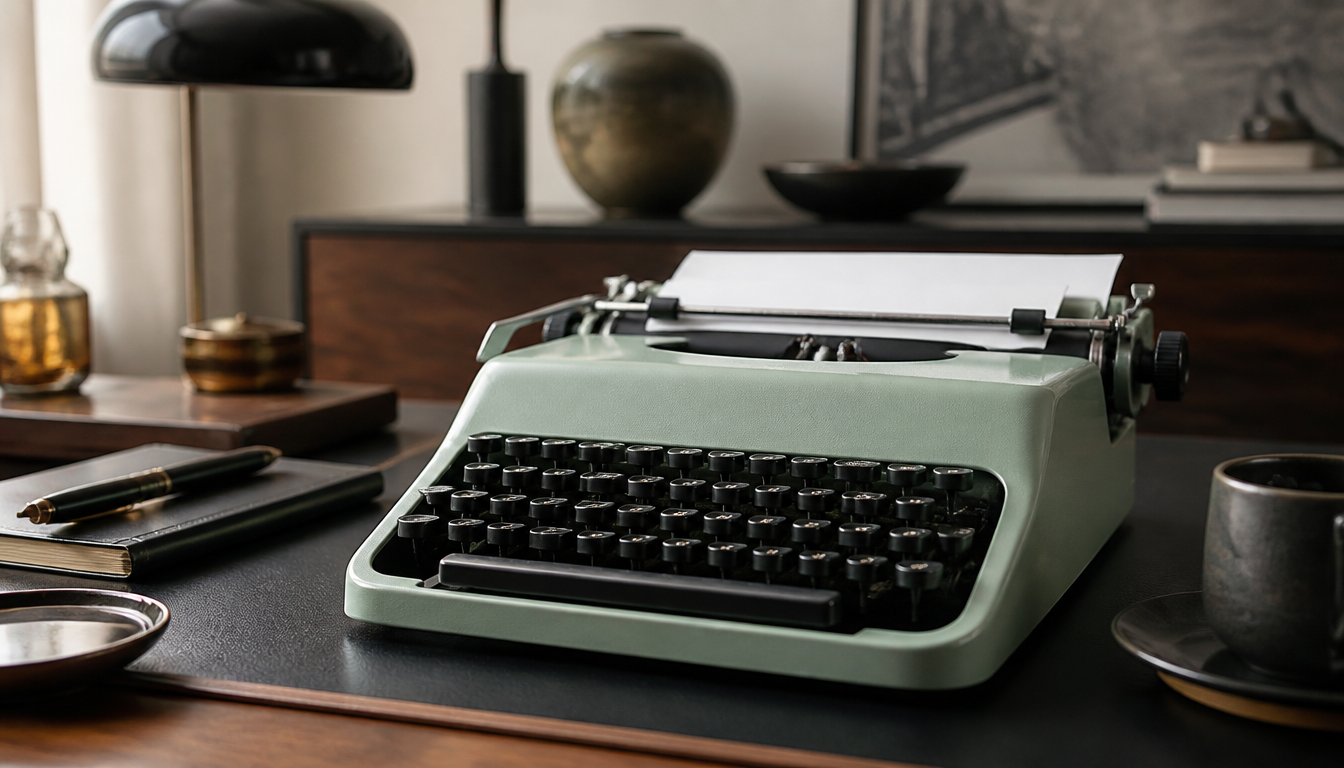
The Olivetti Lettera 32, designed in 1963 by Marcello Nizzoli, typed more than 5 million words into the world by Cormac McCarthy’s own estimate, and ultimately found its place as a design object in the SFMOMA collection. When a typewriter enters a museum and goes under the hammer at Christie’s, it has long since become more than an office device. The Lettera 32 shows how consistent design using metal, plastic, and color can produce an object that captivated generations of writers such as Sylvia Plath, Bob Dylan, and Francis Ford Coppola. For you as a vintage fan, this means: whoever tracks down a Lettera 32 holds a piece of design history in their hands — one that comes with the Compasso d’oro pedigree of its predecessor the Lettera 22 and genuine cult stories.
Olivetti Lettera 32: When a Typewriter Enters a Museum
In 1963, Marcello Nizzoli presented the Lettera 32 for Ing. C. Olivetti & C. — a portable typewriter made of metal, plastic, and lacquer that today belongs to the design history of the 20th century. One example is held in the collection of the San Francisco Museum of Modern Art (SFMOMA), classified there as a design object, with dimensions of 10.4 × 34.5 × 35.1 cm. This is no coincidence: the Lettera 32 was the direct successor to the Lettera 22, which won the Compasso d’oro in 1954 and was named the best design product of the last 100 years by the Illinois Institute of Technology in 1959.
One Machine, Many Hands
Marcello Nizzoli had already designed the Lettera 22 in 1950. Thirteen years later, the Lettera 32 followed as a more geometric, angular interpretation of the same basic concept: maximum portability, clear form, high manufacturing quality. The machine quickly became the choice of writers worldwide. Cormac McCarthy reportedly wrote nearly his entire literary output on it — including novels, screenplays, and correspondence — totaling an estimated more than five million words. His personal Lettera 32, purchased in 1963, was auctioned at Christie’s. Sylvia Plath, John Updike, Thomas Pynchon, Bob Dylan, Leonard Cohen, and Francis Ford Coppola — who wrote the screenplay for “The Godfather” on it — also used this model.
What This Means for You as a Collector
1. Originality is everything. The Lettera 32 was produced in large quantities and is well available on the vintage market today. Anyone looking for a truly authentic example should pay attention to the condition of the typebars, the original color casing, and the included manual. Well-preserved machines with their original case fetch significantly higher prices.
2. Restoration is worthwhile — if done by an expert. After 40 years of inactivity, a Lettera 32 can be fully restored without issue. Specialized workshops can bring it back to writing condition. Particularly noteworthy: the machine features a serif typeface that experts describe as unusually beautiful and that evokes feelings of tradition and integrity.
3. Museum status as a benchmark. The SFMOMA example was accepted into the collection as a donation in 2004. This shows that well-documented and well-preserved examples possess a cultural value that far exceeds their practical use. Provenance and documentation — for example, an original manual — increase collectible value.
4. Design objects need the right setting. A Lettera 32 is not just a machine — it’s a statement. As a display piece in a study or living area, it fits perfectly with an interior style that combines vintage aesthetics and functionality. Those who want to carry this look onto their walls will find matching additions at reetro: for example, a Bauhaus poster, a classic retro cinema poster, or a bird secretary retro poster. Those who prefer to work with patterns and textures can add a Bauhaus-style decorative cushion or a vintage-style cushion. The full range is available in the reetro shop.
Sources
- Lettera 32 Portable Typewriter – SFMOMA
- Typed on an Olivetti Lettera 32 – sallylloyd-jones.com
- Olivetti Lettera 22 / 32 – Classic Typewriter Co.
FAQ
Who designed the Olivetti Lettera 32, and when did it come to market?
The Lettera 32 was designed in 1963 by Marcello Nizzoli for Ing. C. Olivetti & C. Nizzoli had already designed the Lettera 22 in 1950, which won the prestigious Compasso d’oro in 1954 and was named the best design product of the last 100 years by the Illinois Institute of Technology in 1959. The 32 was his consistent follow-up: slightly more angular than its predecessor, but equally iconic.
Is the Lettera 32 truly considered a work of art, or is that just marketing talk?
No marketing talk at all. The San Francisco Museum of Modern Art (SFMOMA) holds an example of the Lettera 32 in its permanent collection as a design object, acquired in 2004. Dimensions: 10.4 × 34.5 × 35.1 cm, materials: metal, plastic, and lacquer. The Museum of Modern Art in New York also owns an example of the predecessor Lettera 22. Two of the world’s most important art museums speak a pretty clear language on the matter.
Which well-known writers typed on the Lettera 32?
The list reads like a who’s who of literary and cultural history: Cormac McCarthy wrote nearly all his novels, screenplays, and letters on it — by his own estimate more than five million words. His example from the year of purchase, 1963, was auctioned at Christie’s. Sylvia Plath, John Updike, James Purdy, Thomas Pynchon, Bob Dylan, and Leonard Cohen also reached for the Lettera 32. Francis Ford Coppola typed the screenplay for ‘The Godfather’ on exactly this model.
What makes the Lettera 32 so special for collectors today?
Three things together: first, the timeless design by Marcello Nizzoli, which combines form and function at a level that still holds up today. Second, the exceptional serif typeface that experts associate with words like history, tradition, and integrity. Third, its proven portability — the Lettera 32 is considered one of the first truly portable typewriters and has literally traveled the whole world. Whoever finds a well-preserved example holds a piece of design history in their hands.
Can an old Lettera 32 still be put into operation today?
Yes, with a little care it is absolutely possible. Decades without use leave their mark, but specialized workshops such as Gramercy Typewriter in New York can get such machines back into top shape. After a full overhaul, the Lettera 32 types just as precisely as ever — including its characteristic serif typeface, which experts still describe as unusually beautiful to this day.
This article was generated automatically by an AI system. Disclosure pursuant to Article 50 of the EU AI Act.