
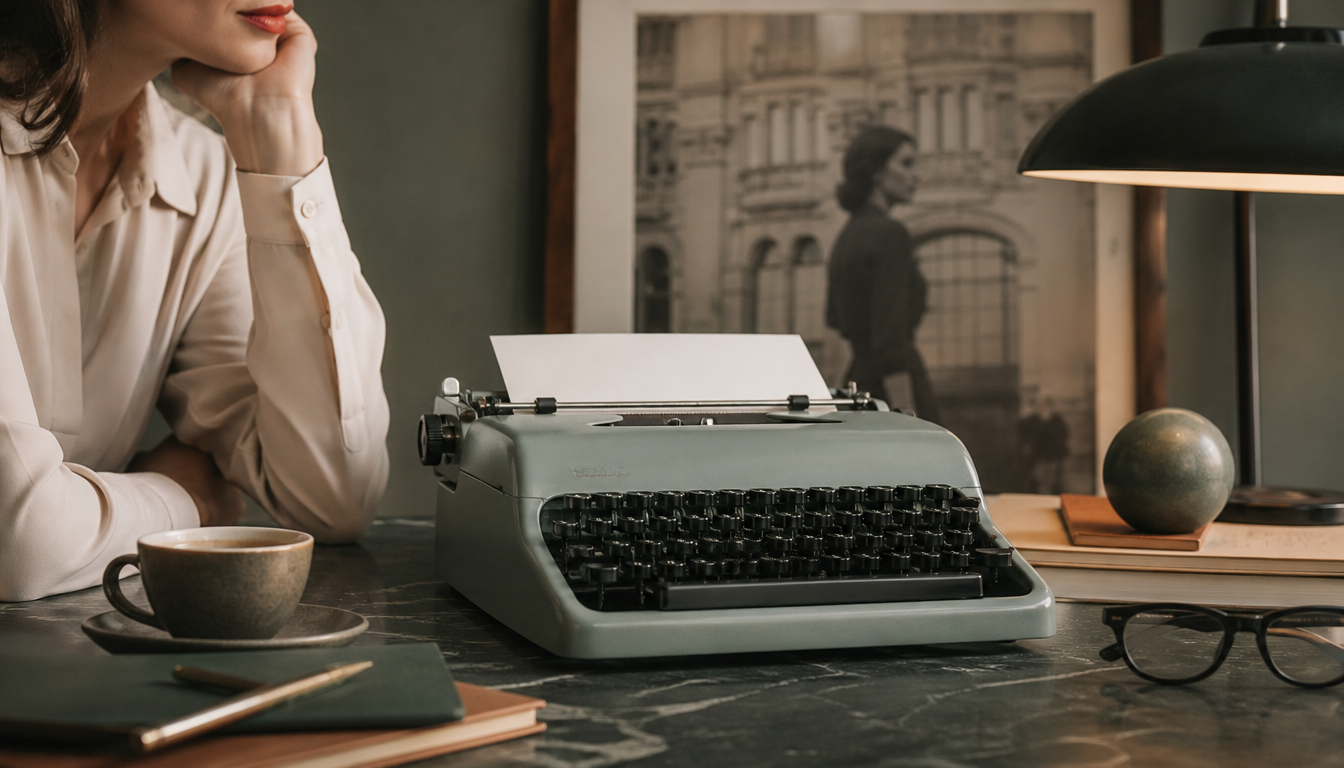
Cormac McCarthy typed an estimated 5 million words on a 1963 Olivetti Lettera 32; the machine was later auctioned at Christie’s. The Lettera 32 is more than a tool. Marcello Nizzoli designed it in 1963 as the successor to the award-winning Lettera 22, which was named the best design product of the last 100 years by the Illinois Institute of Technology in 1959. Thomas Pynchon, Bob Dylan and Leonard Cohen all reached for the same machine. Anyone who picks up a Lettera 32 today holds a piece of central Italian design history that unites form and function so consistently that it has long since found its way into museums and auction catalogues.
Olivetti Lettera 32: How a Typewriter Became a Design Object
The Olivetti Lettera 32 was designed by Marcello Nizzoli in 1963 and today is far more than a writing instrument. Cormac McCarthy reportedly typed over five million words on his machine before it was auctioned at Christie’s. Thomas Pynchon, Bob Dylan and Leonard Cohen are also said to have been among its users. No other portable office item of the post-war era has written a comparable collecting history.
Nizzoli, the Lettera 22 and the Birth of an Icon
Marcello Nizzoli (1887–1969) had already designed the Lettera 22 in 1950, the direct predecessor. The model won the Compasso d’oro in 1954 and was named the best design product of the past one hundred years by the Illinois Institute of Technology in 1959. One example is on display at the Museum of Modern Art in New York. Thirteen years after the Lettera 22 came the Lettera 32: the forms became more angular, the proportions squarer, yet the result was, according to Classic Typewriter Co., “one of the most iconic tools in the history of writing”. The New York Times describes the Lettera 32 as an expression of the aesthetic stance of Italian midcentury design.
What This Means for You: 4 Practical Points
1. Condition Determines Collector Value
Original Lettera 32 machines in good condition achieve significantly higher prices at auctions and specialist platforms than damaged examples. The McCarthy provenance effect demonstrates how strongly personal history influences value. Anyone looking to buy a machine should pay attention to the completeness of the mechanics, the original case and any missing keys.
2. Design Objects Need the Right Context
A Lettera 32 on a desk or shelf makes a statement on its own. Those who want to continue the midcentury feel throughout a room will find matching vintage-style prints at reetro — for example a Bauhaus Exhibition Poster or a Kandinsky Poster in Yellow, Blue and Red. Both are aesthetically in keeping with the reduced, form-conscious spirit of the era.
3. Italian Design History as a Room Theme
The Lettera 32 comes from the same cultural moment as the great Italian architectural and design movements of the 1960s. Those who want to extend this moment into a room concept can, for example, work with a Retro Travel Poster Capri or an Italy Tuscany Travel Poster. A LED Lightbox Tuscany also sets an appropriate accent.
4. The Machine as Inspiration for Writers
The Lettera 32 remains a cult object among writers to this day. Those who work at a desk and appreciate a vintage feel can reinforce the atmosphere with details. A Retro Arcade Mouse Pad or a DDR Computer Mouse Pad suit the spirit of analogue enthusiasm for technology without leaving the retro moment behind. Those who prefer something quieter will be well served by a Kandinsky Mouse Pad with Abstract Shapes.
Sources
- the olivetti lettera 32 typewriter, 1963 – Marcello Nizzoli (artnet)
- A Typewriter That Has Traveled the World (New York Times)
- Olivetti Lettera 22 / 32 – Classic Typewriter Co.
FAQ
Who designed the Olivetti Lettera 32 and when did it appear?
The Lettera 32 was designed by Marcello Nizzoli (1887–1969) and came to market in 1963. Nizzoli was not a pure industrial designer but a sought-after artist who brought form and function together with a rigour more commonly associated with the art world. The Lettera 32 was his successor to the legendary Lettera 22 model of 1950.
What makes the Lettera 32 a design classic rather than just an old typewriter?
The Lettera 32 embodies what is today called midcentury Italian design: clear, portable, aesthetic without a single superfluous millimetre. Its predecessor, the Lettera 22, won the Compasso d’Oro in 1954 and was named the best design product of the last 100 years by the Illinois Institute of Technology in 1959. One example is on display at the Museum of Modern Art in New York. The 32 built on this heritage and evolved the formal language further — slightly more angular, but with its own distinct energy as a result.
Which famous personalities have used the Olivetti Lettera 32?
The list reads like a who’s who of counterculture and literature: Thomas Pynchon, Bob Dylan and Leonard Cohen all wrote on a Lettera 32. Best known is probably Cormac McCarthy, who bought his example in 1963 and by his own estimate typed more than five million words on it — novels, screenplays and letters. His machine was later auctioned at Christie’s.
Why is the Lettera 32 so sought-after as a collector's item today?
Because it embodies exactly what makes collectors’ hearts beat faster: an object with genuine history, craftsmanship and an aesthetic that has outlasted decades. Added to that are the stories of the people who sat at it. When Cormac McCarthy types over five million words on one and the same machine and it ends up at Christie’s, that is no coincidence — that is cult status. The Lettera 32 is not a nostalgic gadget but a piece of lived cultural history.
What are the differences between the Lettera 22 and the Lettera 32?
Both come from Nizzoli’s hand, share the same DNA and the same aspiration towards portable elegance. The Lettera 22 of 1950 was the breakthrough — more organic in form and an immediate success. The Lettera 32 of 1963 developed the design further towards cleaner, slightly more angular lines. Less rounded, but no less beautiful — iconic in a different, more direct way. For collectors, both models are relevant: the 22 as a historical milestone, the 32 as the model that became the typewriter of creative minds.
This article was generated automatically by an AI system. Disclosure pursuant to Article 50 of the EU AI Act.