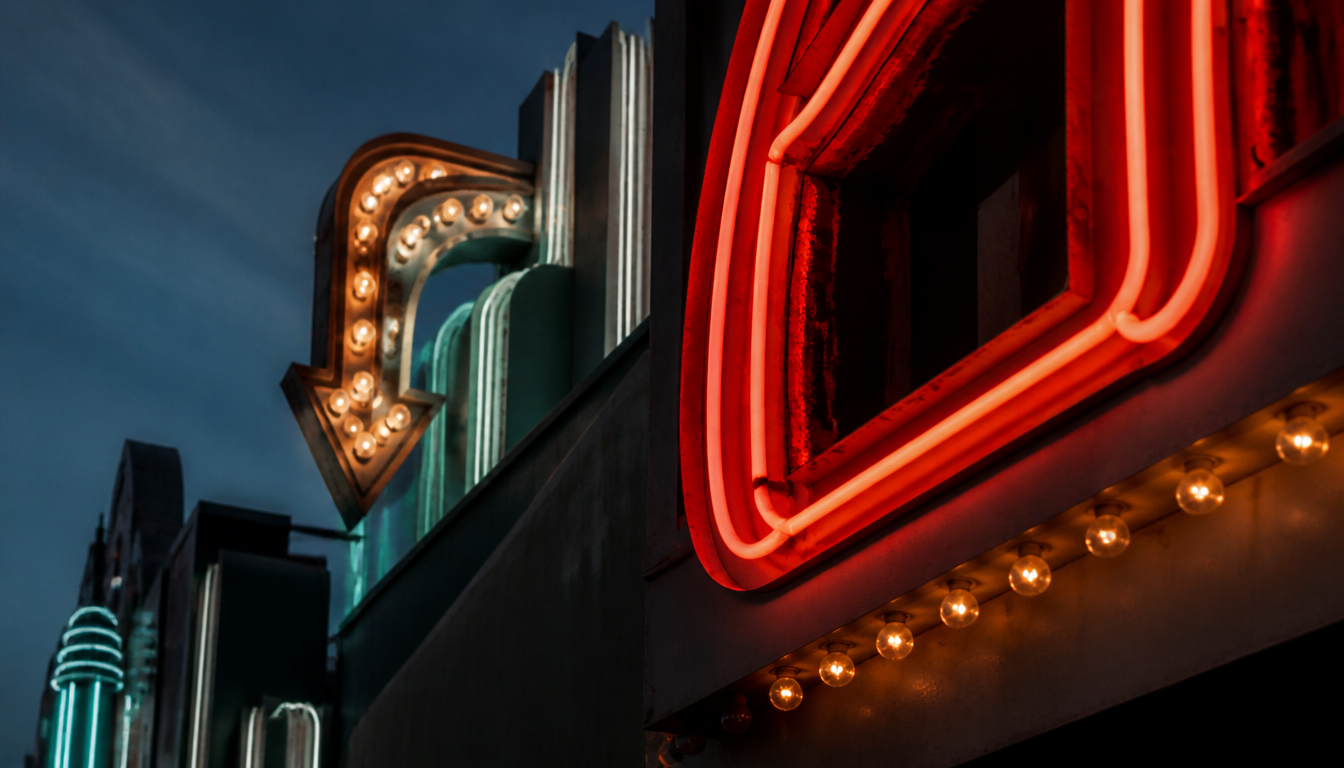
Georges Claude first presented his neon tubes in 1910 at the Paris Motor Show, and as early as 1912 the first commercial neon sign glowed above a Parisian hair salon: “Palais Coiffeur” (source: Neon Museum Las Vegas). What flickered above a hair salon back then went on to transform the entire advertising aesthetic of the 20th century. Between the 1920s and 1970s, neon typography shaped the visual identity of entire cities, from Las Vegas to Tokyo’s Shinjuku district. For anyone interested in vintage design, these glowing letters hold more than nostalgia: they are the direct precursor to every form of modern lettering in public space. Knowing the roots changes the way you read urban aesthetics entirely.
Illuminated Signs, Neon Typography, and the Birth of Modern Advertising Aesthetics
The key fact: French engineer Georges Claude is credited as the inventor of neon lighting. He first presented his neon tubes to the public in 1910 at the Paris Motor Show, before patenting the technology and marketing it through his company Claude Neon Lights. According to the Neon Museum Las Vegas, the first commercially used neon sign was already glowing above a Parisian hair salon in 1912: the words “Palais Coiffeur” thus became an early milestone in the visual language of advertising.
How Neon Reinvented the Street
Before neon, outdoor advertising was primarily a matter of painted wood, enamel, and dim incandescent lighting. Claude’s invention changed all that fundamentally. He had drawn inspiration from Heinrich Geissler’s so-called Geissler tubes and recognised that electrical current passed through rarefied gas inside a glass tube produces a luminous glow.
At the Congress of the Illuminating Society in Pittsburgh, Claude presented his neon tubes to an international professional audience. Contemporary reports describe the reaction as enthusiastic: attendees immediately recognised the potential to reshape cities, shop windows, and advertising messages through colour and form. From the 1920s through the 1950s, neon transformed the city centres of New York and Tokyo alike into glowing stages of consumer culture.
4 Practical Implications for You as a Vintage Fan
1. Neon Aesthetics Are Not a Trend — They Are History
The visual language of neon signage from 1920 to 1970 directly influenced the way we perceive typography, colour, and spatial design today. Embracing this style at home means quoting over a century of design history. Whether as wall art, a cushion, or a light picture: the reference to this era runs deep through popular culture. Start exploring in the reetro Shop.
2. Neon Typography Can Also Be Interpreted in Analogue Form
The characteristic letterforms made from bent glass quickly found their way into posters, film titles, and print graphics. This makes vintage posters a direct heir of the neon era. Products such as the Deko-Kissen Neon or the Neon Cushion draw on this visual language in a contemporary way, as does the Deko-Kissen Fluid Lights, which works with luminous colour gradients.
3. City Motifs and Neon Go Hand in Hand
Neon was an urban phenomenon from the very beginning. Cities like New York, Las Vegas, Tokyo, and Paris became visual icons through their illuminated signs. If you love city posters or city map prints, you are extending that idea into your own four walls. Take a look at the City Map New York Poster, the City Map Tokyo Poster, or the City Map Paris Poster.
4. Retro Advertising Posters Are Direct Historical Witnesses
The advertising posters of the 1920s through 1960s worked with the same design tools as neon signage: bold colours, striking typefaces, strong contrasts. You can find classics from this era as high-quality prints at reetro, such as the Vintage Advertising Poster Gitanes, the Shell Advertising Poster Retro, or the Beer Advertising Poster. The Bauhaus Advertising Poster Kunsthochschule also illustrates how closely neon typography and avant-garde poster design of those decades were intertwined.
Sources
- Sygns: The History of Neon Signs. A Luminous Journey Through Time
- Neonsignlife: The Vintage Neon Sign Timeline of the 1890s–1930s
- The Neon Museum Las Vegas: The Evolution of Neon Signs – From Vintage to Modern
FAQ
Who actually invented the neon sign?
French engineer Georges Claude is credited as the inventor of neon lighting. He drew inspiration from Heinrich Geissler’s so-called Geissler tubes and recognised that electrical current passed through rarefied gas inside a tube produces a luminous glow. He presented his first working model in 1910 at the Paris Motor Show, subsequently patented the technology, and distributed neon signs through his company Claude Neon Lights.
Where did the very first neon sign for advertising purposes hang?
The first commercially used neon sign in history glowed in 1912 above a Parisian hair salon. The words ‘Palais Coiffeur’ shone above the entrance, turning the illuminated sign into a genuine piece of street advertising. A small hair salon thus made advertising history.
When did neon signs first arrive in the United States?
Georges Claude presented his neon tubes at the Congress of the Illuminating Society in Pittsburgh, USA, to an international professional audience from the lighting industry. The reaction was enthusiastic: the glowing colours and new design possibilities for advertising and the urban landscape won immediate approval. Pittsburgh thus became the stage for the American debut of the vintage illuminated sign.
Why did neon signs become the standard in advertising so quickly during the 1920s to 1950s?
Neon signs combined two things that no other medium could achieve simultaneously at the time: they were visible from a great distance, even in darkness, and they could be bent into virtually any letterform or graphic shape. For shops and businesses, this meant a completely new way of capturing attention on busy streets. The glowing typography became the hallmark of entire neighbourhoods and redefined the commercial aesthetics of those decades.
Which cities are still particularly associated with the culture of neon signs today?
Las Vegas and Tokyo’s Shinjuku district are still regarded as the most prominent living witnesses of the neon era. Las Vegas built its entire visual identity around glowing advertising signs. The Neon Museum in Las Vegas deliberately preserves historical examples and documents the development of neon typography from vintage originals through to modern applications.
This article was generated automatically by an AI system. Disclosure pursuant to Article 50 of the EU AI Act.