
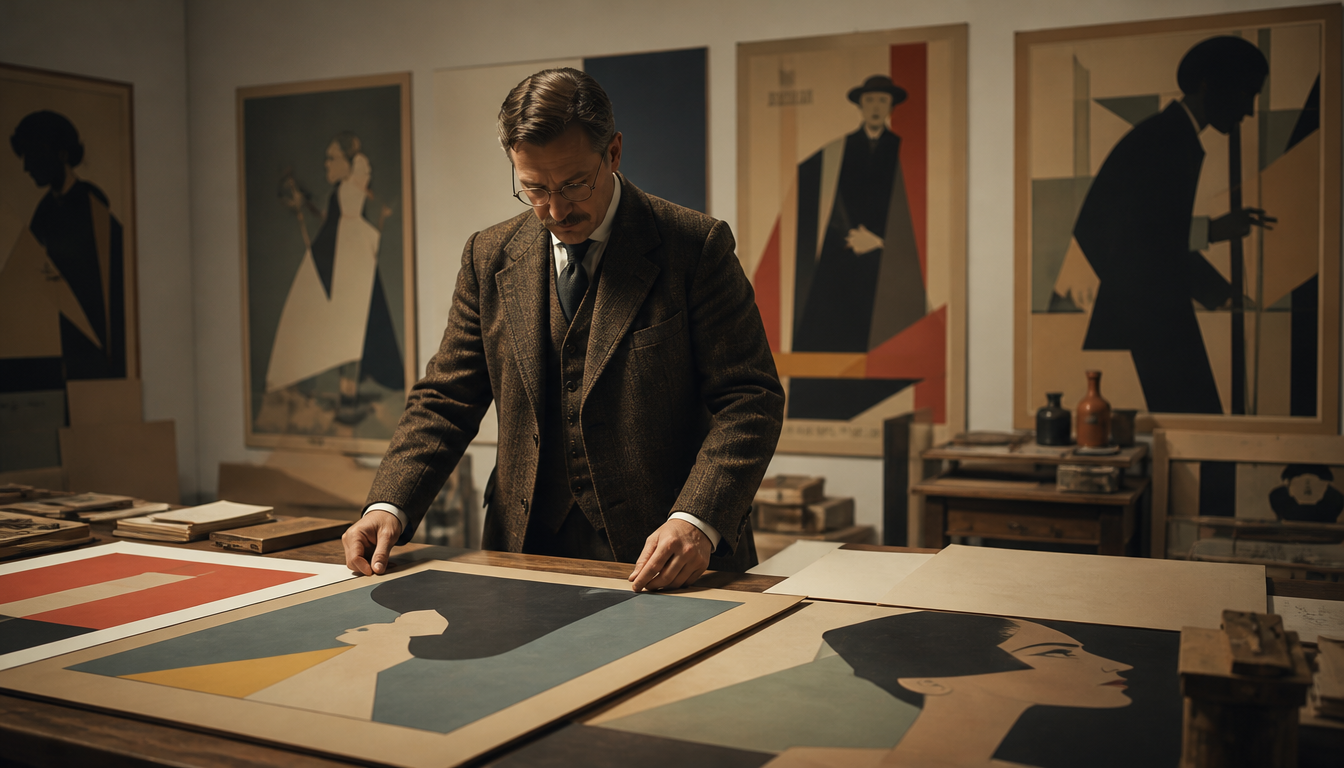
In 1906, Lucian Bernhard invented the Sachplakat (object poster) with his Priester matchstick poster: one object, one brand name, zero ornament. The Staatliche Kunstbibliothek Berlin today holds over 250 of his posters, 165 of them created before 1914. What Bernhard put on the streets back then for Priester matches, Stiller shoes and Manoli cigarettes sounds like self-evident design craft today. But it wasn’t: radical reduction as a visual language was a quiet revolution around 1906. Anyone who takes vintage culture seriously cannot ignore Bernhard’s visual vocabulary. It lives on to this day in shoe boxes, sneaker tags and campaign visuals.
Lucian Bernhard and the Sachplakat Revolution: From Secession to Modernism (1906–1930)
One matchstick. One wordmark. Done. What sounds like a simple design principle today was a quiet revolution in 1906: Lucian Bernhard, born on 15 March 1883 in Cannstatt near Stuttgart as Emil Kahn, invented a style with his Priester matchstick poster that would permanently change advertising graphics.
The Sachplakat: Reduction as an Attitude
Bernhard moved to Berlin in 1901, the industrial centre that needed new forms of commercial communication. In 1905 he dropped his birth name and from then on went by Lucian Bernhard. A year later he entered a poster in the Berlin competition held by the Priester Match Company.
The story behind this poster is legendary: Bernhard began with a dense design — dancing girls, an ashtray, matches, a burning cigar. He painted away detail after detail until only the matches remained. Plus the brand name. The jury threw the design away. Ernst Growald, a printer who arrived late, pulled it out of the waste bin, recognised what was extraordinary about it and awarded the prize to Bernhard.
The Sachplakat was born: one object, one brand name, no ornament. Bernhard used this visual language to advertise, among others, Priester matches, Stiller shoes and Manoli cigarettes.
Context: Werkbund and Berlin Kunstanstalt
From 1903 Bernhard worked for the Kunstanstalt Hollerbaum und Schmidt in Berlin. His work reflected the ambitions of the German Werkbund, which sought to unite art and industry through functionality. The new minimalism was not an end in itself — it was a programme.
The Kunstbibliothek of the Staatliche Museen zu Berlin today holds over 250 of Bernhard’s posters, 165 of them from before 1914. Among them is a poster for the XIV. Deutsche Nationale Geflügel-Ausstellung of 1910 (67.2 x 92.7 cm), which shows the characteristic signature: object, flat plane, lettering.
What This Means for Vintage Enthusiasts Today
1. Originals are genuine collector’s pieces. Bernhard’s original prints from the 1910s to the 1930s are traded as sought-after collectibles on auction platforms such as Invaluable. Anyone who takes vintage culture seriously cannot overlook Bernhard.
2. The visual language lives on. The radical reduction of the Sachplakat can still be found today in packaging design, advertising graphics and campaigns. Knowing the principle changes the way you read visual communication.
3. Reproduction posters are an accessible alternative. Anyone interested in historical advertising graphics but not looking to bid on original posters will find high-quality reprints a worthwhile option. It’s worth browsing the Poster Shop, where motifs from similar eras and styles are available — for example the Bauhaus Exhibition Poster, the Bauhaus Advertising Poster or the Hohlwein Print Zoologischer Garten, a direct contemporary of Bernhard.
4. Sachplakat aesthetics as an interior design idea. The clear formal language of this era combines well with other reduced styles. Those who want to bring the look into their home will find suitable additions: the Bauhaus Sun Poster, the Kandinsky Poster Yellow Blue Red or the Bauhaus Hexagon Picture bring period-related reduction to the wall.
Sources
- Lucian Bernhard & the Sachplakat: Advertising Graphics Without Ornament | reetro Journal
- Lucian Bernhard – Biography and Work | The Graphic Design School
- XIV. Deutsche Nationale Geflügel-Ausstellung (1910) | Staatliche Museen zu Berlin
FAQ
Who was Lucian Bernhard really – and why do so few people know him?
Lucian Bernhard, born on 15 March 1883 in Cannstatt near Stuttgart as Emil Kahn, is one of the most influential advertising graphic designers of the modern era. He changed his name in 1905, moved to Berlin in 1901 and there invented the Sachplakat with the Priester matchstick poster of 1906. The reason he isn’t in every showcase today is simply that advertising graphics were long underestimated as applied art. And yet the Kunstbibliothek of the Staatliche Museen zu Berlin alone holds over 250 of his posters.
What exactly is a Sachplakat – and what sets it apart from everything that came before?
The Sachplakat shows exactly two things: the advertised object and the brand name. No allegories, no ornaments, no dancing figures. Bernhard developed this style by stripping back his first entry for the Priester competition further and further until only the matches and the lettering remained. Before him, poster advertising was visually overloaded. Bernhard turned reduction into a language.
Which brands did Bernhard work for – and were these really real products?
Yes, absolutely real products. Bernhard designed posters for Priester matches, Stiller shoes and Manoli cigarettes, as well as for technical products such as spark plugs, light bulbs and cars. The Staatliche Museen zu Berlin hold more than 165 of his posters from before 1914 alone. Bernhard was considered at the time a recognised specialist in the depiction of technical objects.
How did Bernhard actually achieve his breakthrough – was it planned or pure chance?
Honestly: a pretty wild story. Bernhard submitted his radically simplified Priester poster to a Berlin competition. The jury threw it in the waste bin. The printer Ernst Growald arrived late to the session, fished the design out of the rubbish, recognised its potential and championed it. Bernhard won the competition. Without that one moment, the Sachplakat might never have made it onto the street.
Are Bernhard's original posters still to be found today – and what are they worth?
Yes, and they are highly coveted. Originals from the 1910s to the 1930s appear regularly on auction platforms such as Invaluable and are regarded as sought-after collector’s items. The Kunstbibliothek of the Staatliche Museen zu Berlin holds the largest public collection with over 250 posters. Anyone who takes vintage culture seriously simply cannot overlook Bernhard – his visual thinking lives on to this day, in shoe boxes, sneaker tags and campaign imagery.
This article was generated automatically by an AI system. Disclosure pursuant to Article 50 of the EU AI Act.