
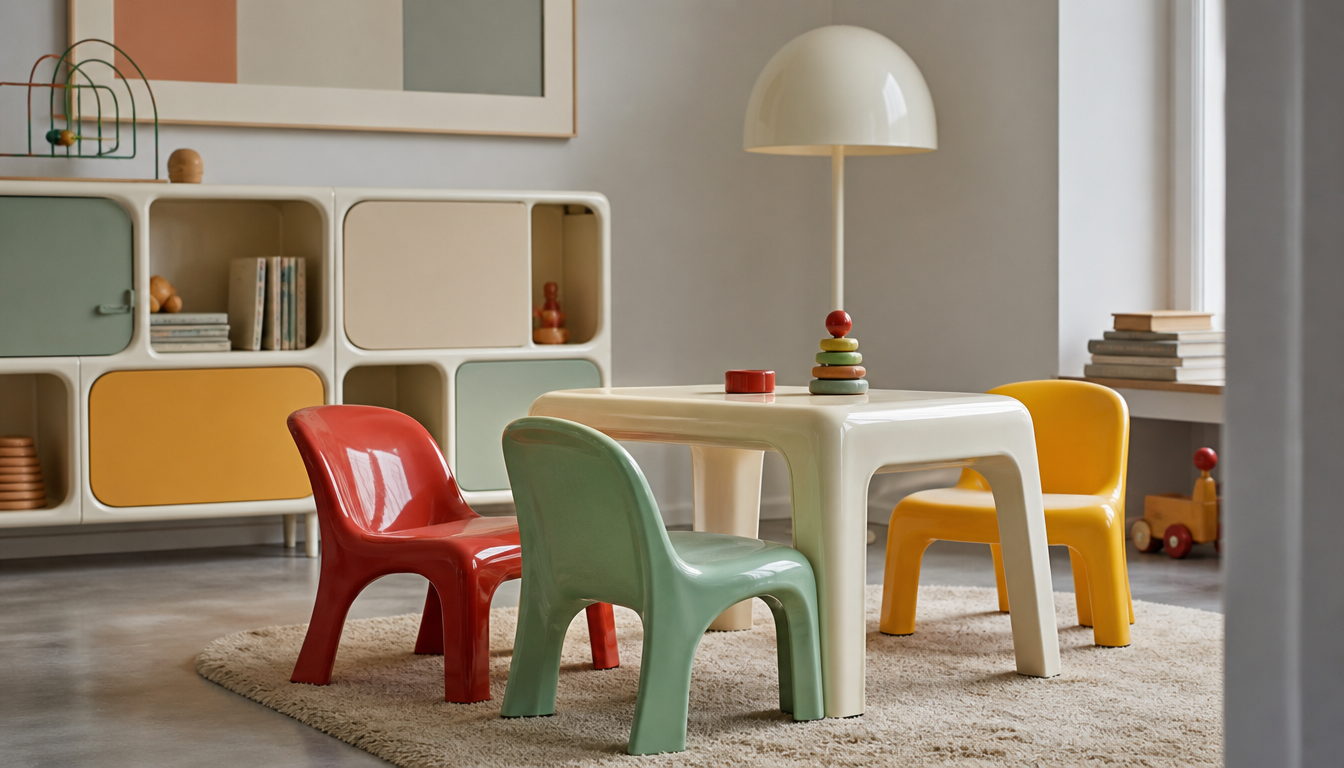
Kartell was founded in 1949 in Noviglio near Milan and revolutionized design history with plastic furniture: Today, Kartell objects are represented in more than 50 museum collections worldwide. What was once considered a bold experiment is now design legend. Giulio Castelli, a chemical engineer and student of Nobel laureate Giulio Natta, wanted to transform plastic from a wallflower material into a genuine design medium. Starting with a humble ski rack, Kartell pieces found their way into living rooms and museums around the world in the 1960s and 1970s. For you as a design fan, this means: behind every colorful chair lies a story that shows how courageous material choices can trigger entire design movements.
Kartell and the Plastics Revolution: How a Milanese Start-up Reinvented Furniture Design in 1949
Giulio Castelli, a chemical engineer and student of Nobel laureate Giulio Natta, founded Kartell in 1949 in Noviglio near Milan with a single conviction: plastic can be beautiful. What was then considered a bold experiment is today represented in more than 50 museum collections worldwide.
The Key Fact: Plastic as a Serious Design Material
When Kartell began its work, plastic was perceived as a second-rate material. It was regarded as an inferior substitute for wood, glass and metal. Castelli and his wife Anna Castelli Ferrieri wanted to correct precisely this image. Their first step was decidedly unspectacular: a ski rack. Yet behind it lay a clear agenda. Kartell adopted processing technologies from other industrial sectors and applied them consistently to household objects and furniture. The result was products that used color, form and material as independent design tools, rather than imitating established materials.
In the 1960s, the company collaborated with designers such as Gino Colombini, Joe Colombo and later Philippe Starck. In 1999, Starck designed the chair “La Marie”, the world’s first transparent chair injection-moulded in one piece from polycarbonate. From this developed the now-famous Ghost Chair. All products are still manufactured exclusively in Italy to this day, even though the USA was long the largest sales market.
What This Means for You: 4 Practical Perspectives
1. Design history always has a material history too Kartell’s journey shows: anyone who wants to understand why a chair or a shelf looks the way it does must understand the material. Plastic allowed forms that were simply not possible with wood. Curved shells, translucent surfaces, bold colors without paint. This changed not only the aesthetics but also the price and accessibility of good design.
2. “Made in Italy” in the 1960s was not marketing, but a manifesto Kartell grew in parallel with the international rise of the term “Made in Italy”. Anyone who collects or restores vintage furniture from this period is buying into an industrial as well as a cultural chapter. Provenance and depth of manufacturing are documentable for these pieces.
3. Collaborations shape collector value The long-term partnerships with Antonio Citterio, Vico Magistretti, Ron Arad, Marcel Wanders and Philippe Starck make individual Kartell objects sought-after collector’s items today. Anyone who can attribute a piece to a specific designer has a clear advantage when buying or selling.
4. The design language of the 1960s lives on The clean forms, primary colors and sculptural qualities of the Kartell era continue to appear in contemporary interiors. Those who love this look will also find it in the visual language of the Bauhaus or Pop Art. A Bauhaus poster or a Bauhaus hexagon wall print fits aesthetically beautifully into an interior featuring plastic furniture from this period. Those who prefer the Pop Art line will find fitting complements in a Pop Art cushion or a retro cushion in manga Pop Art style. More options are available in the reetro shop.
Timeline: Kartell 1949 to 1970
| Year | Milestone |
|---|---|
| 1949 | Founded in Noviglio near Milan by Giulio Castelli |
| 1950s | First household objects, including a ski rack; collaboration with Gino Colombini |
| 1960s | International recognition; collaborations with Joe Colombo and Anna Castelli Ferrieri |
| 1970s | Worldwide renown; plastic now recognized as an independent design material |
Sources
- Kartell – furnishing manufacturer (1949) – designindex.org
- Kartell: Italian Furniture and Plastic Design History – encyclopedia.design
- Kartell: bringing innovation home since 1949 – designwanted.com
FAQ
Who founded Kartell and what was the original vision behind it?
Kartell was founded in 1949 in Noviglio near Milan by Giulio Castelli, a chemical engineer who had studied under the Nobel Prize-winning chemist Giulio Natta. His idea was as simple as it was revolutionary: to transform plastic, then dismissed as a cheap material with no prestige, into genuine designer furniture. Together with his wife Anna Castelli Ferrieri, he wanted to create light, everyday objects that combined technology and design.
Why was plastic considered a problematic material for furniture in the 1950s and 1960s?
Plastic had a bad reputation at the time. It was seen as an inferior alternative to more noble materials such as wood or glass and was rarely associated with quality or aesthetics. Kartell’s real achievement was turning exactly this perception on its head, through consistent investment in technology and design projects and through collaboration with renowned designers.
What made Kartell so special in terms of production technology?
Kartell utilized processing technologies that had previously been reserved for other industrial sectors and applied them to furniture and household objects for the first time. All products were and continue to be manufactured entirely in Italy. This approach made possible forms and colors that would simply not have been achievable with traditional materials.
Which designers shaped Kartell during the period from 1949 to 1970?
In the early decades, Gino Colombini and Joe Colombo were particularly pivotal designers for Kartell. Anna Castelli Ferrieri, co-founder and designer in one, also strongly shaped the brand. Her work demonstrated that plastic need not be a substitute, but could be an independent material with its own aesthetic qualities such as color, transparency and malleability.
How successful was Kartell really by the end of the 1970s?
Kartell gained international recognition and acclaim in the 1970s, in parallel with the global rise of the ‘Made in Italy’ label. Today, Kartell pieces are represented in more than 50 museum collections worldwide. The company’s largest sales market is the USA, even though Kartell has remained a thoroughly Italian brand.
This article was generated automatically by an AI system. Disclosure pursuant to Article 50 of the EU AI Act.