
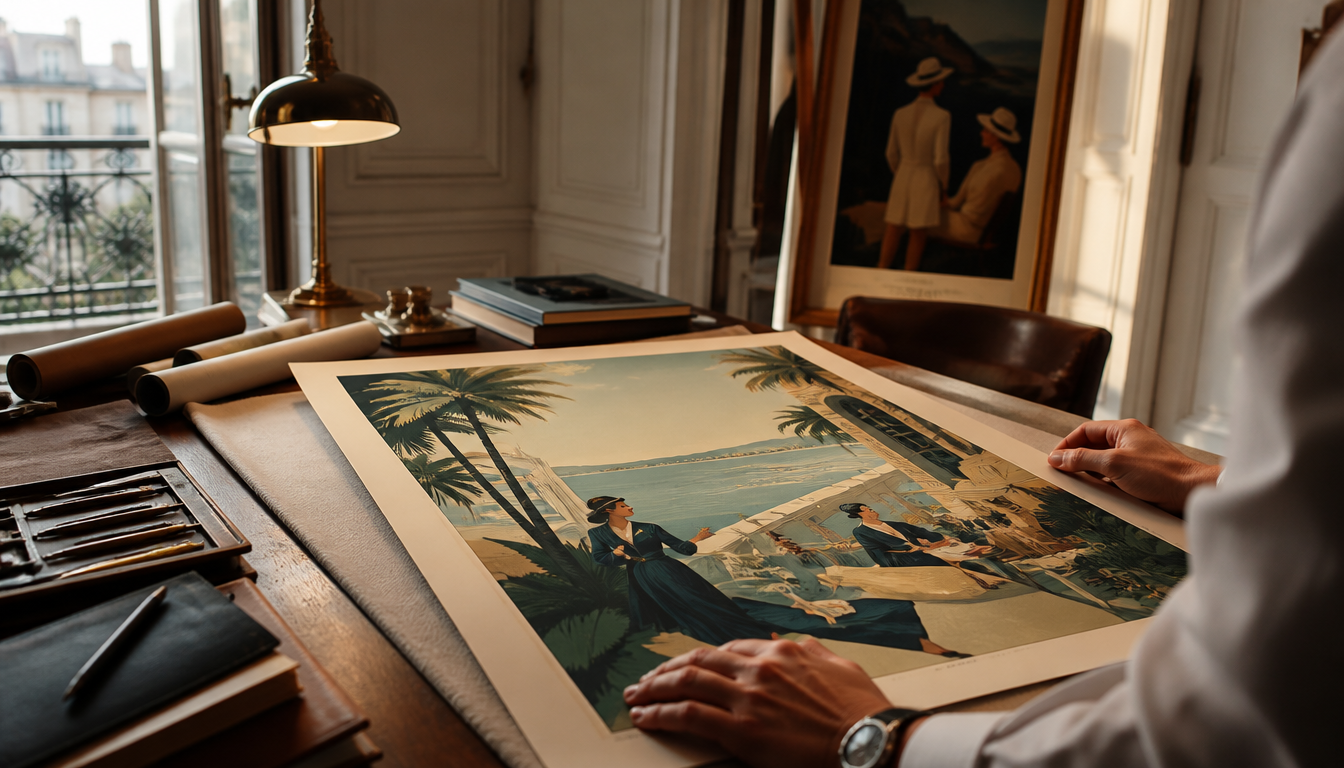
Between 1925 and 1940, French graphic artists transformed the travel poster into an independent art form: railway companies, shipping lines, and airlines competed for attention on the boulevards, commissioning the finest illustrators of their time. These posters are not mere advertising from bygone days – they are the sharpest visual memory of an entire era. Anyone who looks at the bold colours, streamlined geometry, and confident typography of these works today instantly understands why Art Deco still radiates such power. As a sneaker and culture enthusiast, a glance back is well worth your while: the same design language that once sold wanderlust still shapes the collections and aesthetics you wear every day.
Joël Benelli and the French Travel Posters: Exoticism and Luxury of Art Deco between 1925 and 1940
Between the two World Wars, French graphic artists transformed the travel poster into an independent art form. Railway companies, airlines, and shipping firms enlisted the finest graphic designers of their time to compete for attention on the street. The results still hang on our walls today.
The Key Fact: The Poster as an Art Form of an Era
According to ArtDeco.org and the curatorial work of Jack Rennert and David A. Schneider, the poster was one of Europe’s most exciting art forms for roughly two decades. The boom of the 1920s and 1930s coincided directly with the rise of Art Deco. The movement takes its name from the Exposition Internationale des Arts Décoratifs of 1925 in Paris. During this period, travel became both affordable and aspirational for a growing middle class. Transport companies needed a visual language that promised speed, glamour, and modernity. The poster delivered exactly that, in a format that made passers-by stop in their tracks on the boulevard.
Among the best-known works of the era are the Graf Zeppelin poster for the Hamburg America Line by Ottomar Anton (c. 1932) and the Air France designs by Albert Solon (1933) and Roger de Valerio (1938). Artists such as Roger Broders created posters for the Lac d’Annecy in 1930, Albert Fuss for Mediterranean voyages, and Henry George Gawthorn for English destinations. They all worked with the same visual grammar: bold, simplified forms, dynamic diagonals, flat colour blocks, and typography that was an integral part of the image.
The travel posters of this generation, as artdecocollection.com notes, were not simply selling a ticket. They were selling movement itself: speed, distance, and the promise of arrival. And they taught an entire generation to see the world anew.
What This Means for You: 4 Practical Perspectives
1. Recognise the Style, Distinguish Originals from Prints
Art Deco travel posters have one clear hallmark: forms are reduced to their essence, colours are set as flat blocks, and the lettering is never an afterthought – it is part of the composition. Once you have internalised this, you can immediately tell whether a modern reproduction poster is genuinely designed in the spirit of this era or merely references it superficially. When buying, look for exactly these qualities: strong silhouettes, bold geometry, integrated typography. Our Retro Travel Poster Hong Kong and the Retro Travel Poster India work with precisely this visual language.
2. Curate Thematically Rather Than Decorating at Random
The poster artists of Art Deco always had a clear theme: a city, a route, a mode of transport. When it comes to your own wall, it is worth following the same logic. A Paris motif in Deco style works particularly well alongside an abstract city map, for example. Take a look at our Paris Canvas in Retro Style and the Paris City Map Poster. For travel enthusiasts who want to combine further destinations, the Retro Travel Poster Capri or the Jamaica Airline Retro Poster are also worth a look.
3. Make Format Part of the Statement
Much of the impact of interwar posters came from their size: they were designed to stop passers-by on busy boulevards. The same principle applies at home. A large-format print conveys the energy of this era far more effectively than a small picture. Anyone who wants the wanderlust look at room scale will find plenty of suitable formats among our Posters and Canvases. The Funny Acapulco Retro Travel Poster and the New York Travel Poster are especially striking in XXL.
4. Think of the Era as an Ensemble
Art Deco was never about a single piece – it was about an overall feeling. Anyone who wants to recreate that in their own home combines travel posters with other motifs from the modernist sphere: Bauhaus, geometric patterns, clean lines. The Bauhaus Exhibition Poster fits this kind of arrangement perfectly in terms of style. Those who prefer something more playful can opt for the Hot Air Balloon Poster Le Tricolore, which brings the lightness of the interwar years into the present. For a thematic addition in the French context, the France Hexagon Wall Art is also recommended.
Sources
- History of Deco Travel Posters | ArtDeco.org
- A Short History of Art Deco Travel & Sport Posters | paris-poster.shop
- Art Deco Travel Posters, Postcards from the Past | artdecocollection.com
FAQ
What makes Art Deco travel posters so distinctive?
They follow a clear visual language: strongly simplified forms with bold silhouettes, sweeping diagonals that suggest speed and modernity, and flat colour blocks instead of realistic shading. The typography is not an add-on but a fixed part of the composition. All of this makes them instantly recognisable even today.
Why were so many of these posters created specifically between 1925 and 1940?
It was precisely during this period that railway companies, shipping lines, airlines, and airship operators competed for the attention of a growing middle class for whom travel was becoming both affordable and desirable for the first time. The name Art Deco derives from the Parisian Exposition Internationale des Arts Décoratifs of 1925. Companies engaged the finest graphic designers of their time to sell speed, glamour, and modernity.
Who commissioned these posters, and why did they need such eye-catching images?
Steamship lines, railway companies, airlines such as Air France, as well as spa resorts and national tourism boards commissioned the artists. A poster had to stop a passer-by on the boulevard in a split second and awaken the desire to travel. Large format and a clear visual language were the perfect tools for this.
What specific examples illustrate the style of this era?
Particularly well-known works include the Graf Zeppelin poster for the Hamburg America Line by Ottomar Anton from 1932, the Air France Golden Clipper design by Albert Solon from 1933, and Roger Broders’ Lac d’Annecy poster from 1930. They all combine exotic wanderlust motifs with the characteristic Deco geometry.
Why do people still hang these posters on their walls today?
Because they are far more than advertising. The artists of this generation created, according to historians, some of the clearest and most self-assured visual statements of the entire Art Deco period. They shaped the visual memory of the interwar years and show how an entire generation learned to see the world anew. That ambition remains palpable almost a hundred years later.
This article was generated automatically by an AI system. Disclosure pursuant to Article 50 of the EU AI Act.