
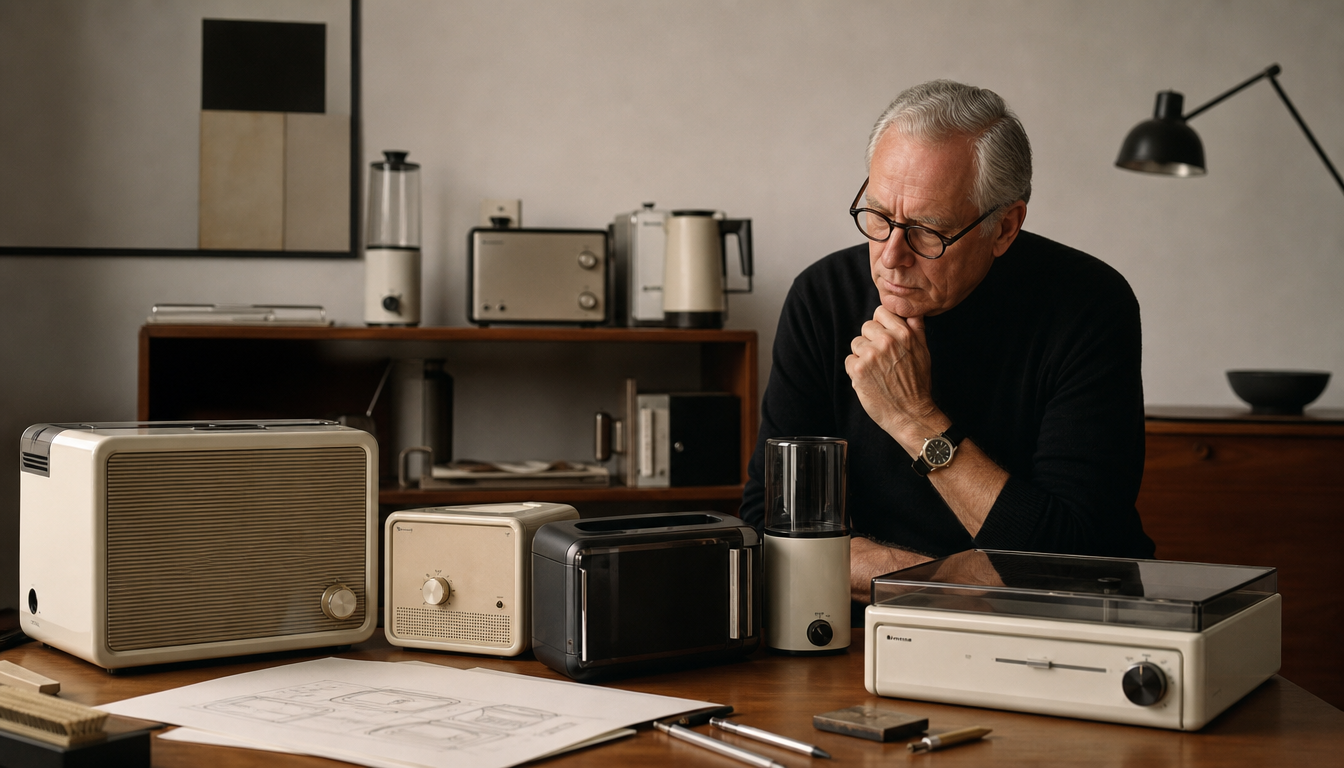
Dieter Rams, born in 1932 in Wiesbaden, shaped a functionalist design revolution as chief designer at Braun from the 1950s onwards with his credo “Less, but better” – an influence that continues to shape product aesthetics worldwide to this day. Braun’s devices from the 1950s and 1960s, including the legendary SK 4 radiogram, make one thing clear: Rams didn’t simply design toasters and radios – he invented a design language that consistently eliminates unnecessary forms and lets function speak instead. His principle “As little design as possible, not for cost reasons, but out of conviction” is still considered the blueprint for timeless product design today. When you hold a Braun device from this era in your hands, you feel why this isn’t nostalgia – it’s genuine design history.
Less, but better: How Dieter Rams reinvented product design in the 1950s and 1960s
Dieter Rams, born on 20 May 1932 in Wiesbaden, shaped an entire era of consumer goods design as chief designer at Braun. His credo “Less, but better” (Weniger, aber besser) remains one of the most cited design principles in the world to this day. Through Braun and the furniture manufacturer Vitsœ, he laid the foundation for the functionalist school of industrial design.
The key fact: Braun, Artur Braun and the rise of functionalism
Braun was founded in 1921 by engineer Max Braun. The company received its decisive momentum when his sons Artur and Erwin Braun took over management in 1951. Artur Braun recognised the market potential of progressive design in the burgeoning post-war consumer electronics market. Rams, trained in architecture and interior design, brought precisely this attitude to product development.
His most famous work from that period: the Braun SK 4 radiogram, which earned the nickname “Snow White’s coffin” thanks to its transparent lid. No superfluous detail, no decoration for decoration’s sake.
Rams put it this way: “Good design for us means as little design as possible. Not for reasons of economy or convenience. It is certainly one of the most difficult tasks to achieve a truly convincing, harmonious form through simple means.”
4 practical implications for consumers
1. Timelessness as a purchasing argument
Rams’ design philosophy gave Braun products a longevity that far exceeded fashion trends. Whoever bought a Braun razor or a Braun radio in the 1960s was investing in a device that still worked decades later and looked as if it had just come out of the shop. This principle can be applied directly to other purchasing decisions: fewer details, cleaner forms and well-considered materials often mean greater durability.
2. Aesthetics as function, not decoration
Rams’ ten principles of “good design” emphasise that aesthetics are not an end in themselves. According to Rams, unnecessary forms are “nothing more than design excuses that serve self-expression rather than product functions”. For consumers, this means: a product that looks beautiful and is simultaneously intuitive to use has been designed more consistently than one that merely draws attention.
3. Rams’ legacy in the digital world
Rams’ legacy extends into contemporary software and hardware design. Apple design chief Jony Ive cited Rams as a key inspiration for the iMac and iPod aesthetic. Anyone holding a smartphone with a clear user interface today is indirectly experiencing the Braun DNA of the 1960s. As a consumer, it is worth consciously seeking out this clarity – even in the environment at home.
4. Vintage Braun devices as collector’s items
Following the documentary film “Rams” by Gary Hustwit (2018), interest in original Braun devices from the 1950s and 1960s received a significant boost. The T-41 transistor radio from 1962 is considered a collector’s item. Those who love the style of this era can find it today in contemporary wall décor as well – for example in clearly conceived Bauhaus posters or a Bauhaus hexagon wall picture, which draw on the same design language.
Rams and the Bauhaus: Kindred spirits
Braun’s design language of the 1960s was no coincidence. It emerged in a cultural climate heavily influenced by the Bauhaus: clear geometries, functional materials, rejection of ornament. Although the Bauhaus had closed in 1933, its ideas lived on in the West German design scene of the post-war period. Those who also enjoy this style on their walls will find what they’re looking for among Bauhaus advertising posters or in the reetro poster shop.
And if you’d like to develop the overall look of your living space with a vintage aesthetic, it’s worth browsing the reetro shop as well as the cushion category, where you’ll find, among other things, a Bauhaus-style cushion or an abstract retro cushion that carry this reduced, form-driven aesthetic further.
Sources
- Dieter Rams – Wikipedia
- How Dieter Rams Transformed the Design Landscape With Braun’s Less-Is-More Ethos – Interior Design, 26 September 2018
FAQ
Who was Dieter Rams and what is his connection to Braun?
Dieter Rams, born on 20 May 1932 in Wiesbaden, is a German industrial designer best known for his work with the company Braun. From the 1950s onwards, he shaped an entire era of functionalist product design there, the impact of which continues to be felt to this day.
What is behind the phrase 'Less, but better'?
This is Dieter Rams’ design credo. He was convinced: “Good design for us means as little design as possible. Not for reasons of economy or convenience.” For him, anything superfluous in design was a mistake that distracts from the actual purpose of a product.
How did Braun come to develop its revolutionary design approach?
Braun was founded in 1921 by engineer Max Braun. The decisive change came with his sons Artur and Erwin, who took over management in 1951. Artur Braun recognised early on the potential of progressive design in the emerging post-war consumer electronics market.
Which products from this period are considered design classics today?
A central example is the Braun SK 4 radiogram, one of Dieter Rams’ most celebrated works. It is emblematic of the Braun philosophy: clean forms, no superfluous elements, full focus on the function of the device.
What influence did Braun's design philosophy have beyond electrical appliances?
Rams’ approach influenced not only Braun’s product world, but the entire design practice of the 20th century, as well as aesthetics and culture far beyond the consumer goods industry. His ten principles of ‘good design’ are still taught and discussed in design schools around the world today.
This article was generated automatically by an AI system. Disclosure pursuant to Article 50 of the EU AI Act.