
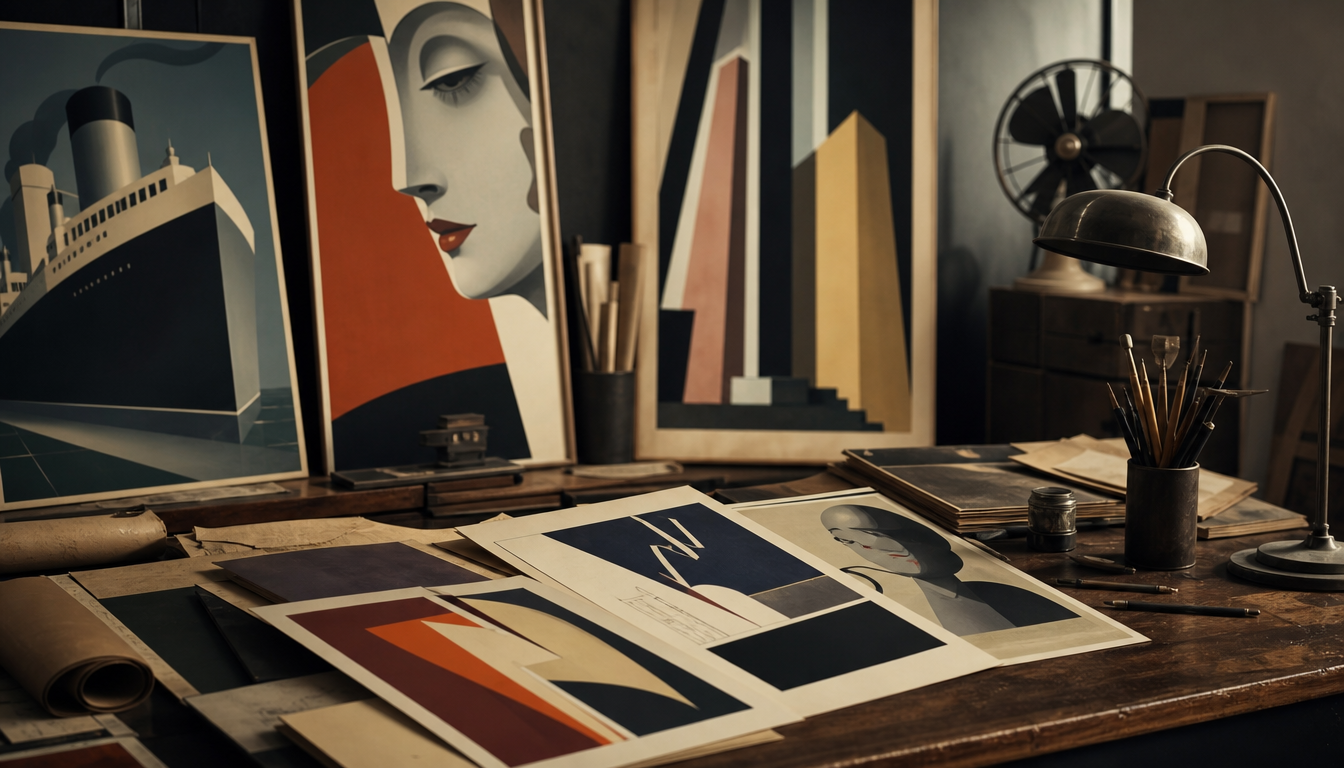
Since the Exposition Internationale des Arts Décoratifs et Industriels Modernes in Paris in 1925, Art Deco shaped poster design in Europe and America for nearly two decades – and turned masters like A.M. Cassandre into the blueprint for an entire generation of French graphic artists. What Cassandre and his contemporaries committed to lithographic stone between 1930 and 1950 was no accident: bold geometry, vivid colours and an almost kinetic energy were designed to stop passers-by on busy streets within seconds. That very principle – no scrolling, no swiping, just a single glance – keeps these posters relevant to this day. Surviving examples from the years 1925 to 1935 are now considered highly sought-after collector’s items, because they distil the visual language and zeitgeist of an entire era into a single image.
Cassandre’s Students and the Art Deco Legacy: French Poster Designers 1930–1950
Key fact: Art Deco established itself as an international movement with the Paris Exposition Internationale des Arts Décoratifs et Industriels Modernes in 1925 and dominated the style of Europe and America until the onset of the Second World War. What followed lived on its impulses.
How a Style Changed the World
Before algorithms decided what people saw, it hung on street corners. Posters in the 1920s and 1930s had the same job as a viral social media post today: command attention, and do it within seconds. According to the IVPDA, Art Deco represented a clear break with what came before. Away from the sweeping, organic forms of Art Nouveau, and towards rhythmic repetition, bold geometric shapes, luminous colours and a kinetic sense of movement and acceleration.
The movement’s name derives directly from that Paris Exposition of 1925 – a seven-week world’s fair format that cemented the “style moderne” as a truly international movement. Here, European avant-garde ideas met traditionally commercial manufacturers, and the result could be read across everything: architecture, fashion, industry and, of course, posters.
A.M. Cassandre designed his famous Normandie poster in 1935, which today stands as a prime example of this aesthetic. The generation of designers who worked after him followed the same principles: clean lines, dramatic perspectives, an iconography of modern travel.
Travel Posters as Propaganda Machines of Progress
According to ArtDeco.org, travel as a leisure pursuit was once the preserve of the Grand Tour – a multi-year educational journey through Europe for aristocratic young men. That changed in the late 19th century, when doctors began recommending travel as a medical necessity. The railway, then the ship, then the aeroplane transformed mobility into a mass-market product.
The designers of the 1930s seized on this. Ottomar Anton, for instance, created the poster for the Hamburg-Amerika Line’s Graf Zeppelin around 1932. Albert Solon designed the Golden Clipper for Air France in 1933. Roger de Valerio followed in 1938 with the Air France poster for Paris–London. These works shared a visual language: drama through extreme perspective, reduction to the essential, a promise of speed and modernity.
This was no coincidence. The entire modernist project, as Jack Rennert and David A. Schneider describe it on ArtDeco.org, was about seeing old things in new ways. Modigliani, Brancusi, Henry Moore – they all stripped away ornament to create an aesthetic for the 20th century. The poster designers did the same, only in the service of shipping lines and airlines.
What This Means for You Today: 4 Practical Implications
1. Original posters from this era are collectibles with price appreciation potential. Surviving Art Deco posters from around 1925 to 1935 are now coveted collector’s items, according to Antiques and the Arts Weekly. Anyone who owns an original Tungsram poster from 1933 (lithograph, 46¾ × 33½ inches) holds a document of advertising history in their hands – not merely decoration. Do your research before buying.
2. Reproductions make the style accessible without the auction-house price tag. The visual language of Art Deco – geometry, contrast, display lettering – can be reproduced today as high-quality prints. A retro travel poster India or a hot-air balloon poster “Le Tricolore” translate this visual vocabulary into contemporary wall décor. The same applies to Porto Constantino by Jean Dylen – a work that stands directly in the tradition of French Deco poster art.
3. Combining it with Bauhaus aesthetics is no contradiction. Art Deco and Bauhaus emerged in parallel, influenced each other and together laid the foundations for modern graphic design. A Bauhaus exhibition poster or the Bauhaus art school advertising poster pair naturally with Art Deco travel posters, because both spring from the same era of bold new beginnings. The eye connects the lines.
4. City motifs tap directly into the travel romance of the Deco era. The Air France and Zeppelin posters turned Paris, London and the world’s great metropolises into dream destinations. That association lives on in city map posters: Paris, London or New York work as visual quotations of that epoch. Anyone who wants to browse our posters will find a wide selection of travel and city motifs in vintage style.
Sources
- Focus on Style: Art Deco Posters, IVPDA
- History of Deco Travel Posters, ArtDeco.org
- Selling Desire: Celebrating 100 Years Of Art Deco Posters, Antiques and the Arts Weekly
FAQ
What makes Art Deco posters from the 1930s so unmistakable?
Art Deco relied on strong lines, geometric structures and the rhythmic repetition of bold shapes in luminous colours. This was a deliberate break with the organic, flowing forms of Art Nouveau. The posters of this era convey a kinetic energy – almost like movement frozen on paper. No wonder they instantly caught the eye on busy streets at the time.
Where does the term 'Art Deco' actually come from?
The name derives from the Exposition Internationale des Arts Décoratifs et Industriels Modernes, held in Paris in 1925. This seven-month-long event established the “style moderne” as a genuine international movement and brought the European avant-garde together with commercial design. Without this exhibition, we might speak very differently today about the visual legacy of the interwar period.
What themes dominated the poster art of French designers between 1930 and 1950?
Travel and mobility topped the list. Airlines such as Air France advertised with spectacular printed graphics from 1933, while shipping lines like Hamburg-Amerika presented the Graf Zeppelin on iconic posters around 1932. Beyond that, cigarettes, alcohol, food and entertainment venues were promoted. The posters sold not just products, but an entire aspirational lifestyle.
How truly international was the influence of French poster design from this era?
Highly international. Art Deco was never a purely French affair from the outset: the Paris Exposition of 1925 drew together the best ideas of the European avant-garde and turned the style into a transatlantic movement. From Europe to America, the clean geometric forms of the French poster school shaped architecture, fashion and advertising simultaneously.
Can surviving Art Deco posters from this period still be found, and why are they so sought after?
Yes, even though they were originally conceived as ephemeral advertising materials with a short lifespan. That is precisely what makes surviving examples from around 1925 to 1935 so valuable today. Collector’s items such as the 1933 poster ‘Tungsram Radio-Röhren’ are now highly coveted objects, because they unite visual language and historical significance in one piece. They are, in a sense, the analogue predecessors of the viral social media post.