
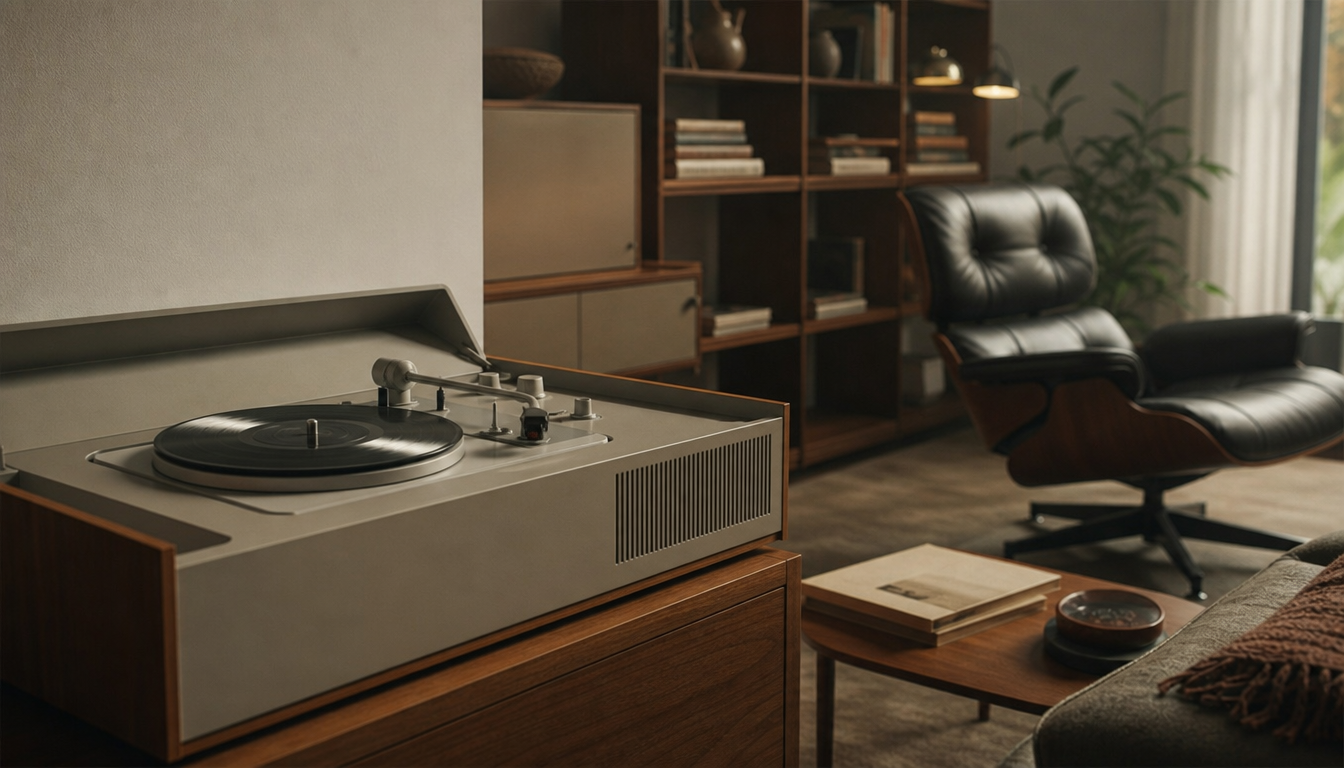
In 1971, Braun introduced the audio 310, the final model of its legendary compact stereo series: turntable, receiver and amplifier in a single metal enclosure, designed by Dieter Rams. Anyone who tracks down a Braun audio 310 in mint condition today holds more than a playback device in their hands. The compact series, which began in the 1960s with the audio 1, audio 2, audio 250 and audio 300, stood for a design philosophy that treated the living room as a serious acoustic space. Rams’ formal language and the Frankfurt engineering work continue to influence how we perceive audio technology and everyday objects to this day. For you as a collector or design enthusiast, this means: these devices are not decorations, but living design history.
Braun Phono Radios and the Sound Aesthetics of the 1950s–1970s: Dieter Rams’ Audio Culture in the Living Room
Key fact: Braun was founded in 1921 by Max Braun in Frankfurt, began as a radio manufacturer and evolved into one of the most influential design brands of the 20th century. The legendary stereo systems of the 1960s and 1970s, designed by chief designer Dieter Rams, are still regarded today as icons of sound aesthetics and living room culture.
From Radio to Cult Object: Braun’s Journey into the Living Room
Max Braun started producing radios in Frankfurt in the 1920s. At the time, radio sets were luxury goods that only wealthy households could afford. The Great Depression forced the company to develop more affordable models and thereby tap into the mass market. After the Second World War came the next pivot: in 1950, Braun launched the S 50, its first electric shaver, which permanently established the company in the household and personal care sector.
Yet the audio division remained a cornerstone of the brand. In the 1960s, Dieter Rams designed a series of compact stereo models, including the audio 1, audio 2, audio 250 and audio 300. All came in a solid metal enclosure — understated, precise and timeless. The final model of this line, the Braun audio 310, came to market in 1971. It combined turntable, receiver and amplifier in a single unit and features additional inputs for CD and streaming. Today the audio 310 is a sought-after collector’s item, especially in immaculate condition with full working order.
What Makes Rams’ Design Philosophy So Special
Dieter Rams shaped Braun’s design with a formula that still holds true today: function determines form, ornament is distraction. The devices were meant to fit into the living room without dominating it. Grey, white, black lettering, clear controls. It is no coincidence that the audio 310 is known in collector circles as “Snow White’s Coffin” — a nickname that describes the gleaming white, almost clinical beauty of the system.
This aesthetic strongly influenced Apple co-founder Steve Jobs and lives on today in countless products and design movements.
4 Practical Tips for Consumers and Collectors
1. Check the condition carefully before buying. Braun stereo devices from the 1960s and 1970s are decades old. Look for technically verified units with documented functionality. According to collector sources, the audio 310 is particularly sought after in mint condition with verified electronics — and priced accordingly.
2. Spare parts are scarce. Original Braun components from this era are hard to come by. Anyone buying a unit should look into repair options and available service workshops before investing.
3. Compatibility with modern sources. The audio 310 features inputs for CD and streaming. Older models such as the audio 1 or audio 2 are designed for analogue sources. Anyone wanting to stream modern content should clarify the compatibility of the respective model beforehand.
4. Bringing Rams’ aesthetics home without the hardware. Anyone who loves the formal language of the Bauhaus and the German design movement doesn’t necessarily need to buy an expensive vintage system. Graphic references to the style of the era can also be achieved through wall décor — for example with a Bauhaus poster or the Bauhaus art school advertising poster. For those who appreciate geometry, a Bauhaus Hexagon print makes a fitting addition in the Rams spirit. Anyone wishing to design their office in the same vein will find a matching option with the Kandinsky mousepad — Kandinsky famously taught at the Bauhaus in Dessau.
Braun Audio as a Time Capsule
Braun’s stereo devices from the Rams era are more than music playback devices. They are testaments to a design ethos that sought to make the living room a place of quiet concentration. No excess, no visual noise — only form and function. Anyone who has an audio 310 on their shelf today owns a piece of Frankfurt design history.
You can find more retro and vintage wall art for the home in the reetro shop as well as in our poster collection and canvas prints.
Sources
- Dive into the History of Braun – Stories | Braun Audio
- Braun audio: legendary stereos from the 60s and 70s by Dieter Rams
- Braun Dieter Rams – Pinterest
FAQ
When did Braun actually start manufacturing audio devices?
Braun was founded in 1921 by Max Braun in Frankfurt and started out as a radio manufacturer. The company was already building radios in the 1920s — a luxury item for wealthy households at the time. After the Second World War the product range evolved, but from the 1960s onwards Braun returned to living rooms with high-quality stereo audio systems.
What makes Braun's stereos from the 60s and 70s so special?
The compact models of the range — the audio 1, audio 2, audio 250 and audio 300 — came in a solid metal enclosure and were designed by Dieter Rams. The design was reduced, functional and timeless. It is precisely this combination of craftsmanship quality and clear formal language that makes the devices so coveted among collectors to this day.
Which was the last model of the legendary Braun audio range?
The Braun audio 310 came to market in 1971 and marks the conclusion of this iconic compact series. It combines turntable, receiver and amplifier in a single unit and offers additional inputs for CD and streaming. Well-preserved, technically inspected units in mint condition are particularly sought after among Braun enthusiasts.
What role did Dieter Rams play in Braun's sound aesthetics?
Dieter Rams was the defining designer behind Braun’s audio devices of the 60s and 70s. He designed the compact stereo systems of the audio range, drawing on clean lines, understated materials and a formal language that is still cited as a reference for good industrial design today. His work for Braun anchored the principle of “less, but better” in design.
Is it still worth buying a Braun device from this era today?
For vintage audio enthusiasts, absolutely. The Braun stereo systems from Frankfurt are considered technically sophisticated and sonically convincing. Anyone buying a unit should ensure it has been technically inspected and is in full working order. The audio 310 in particular is actively sought by collectors, which drives the price of well-preserved examples accordingly.
This article was generated automatically by an AI system. Disclosure pursuant to Article 50 of the EU AI Act.