
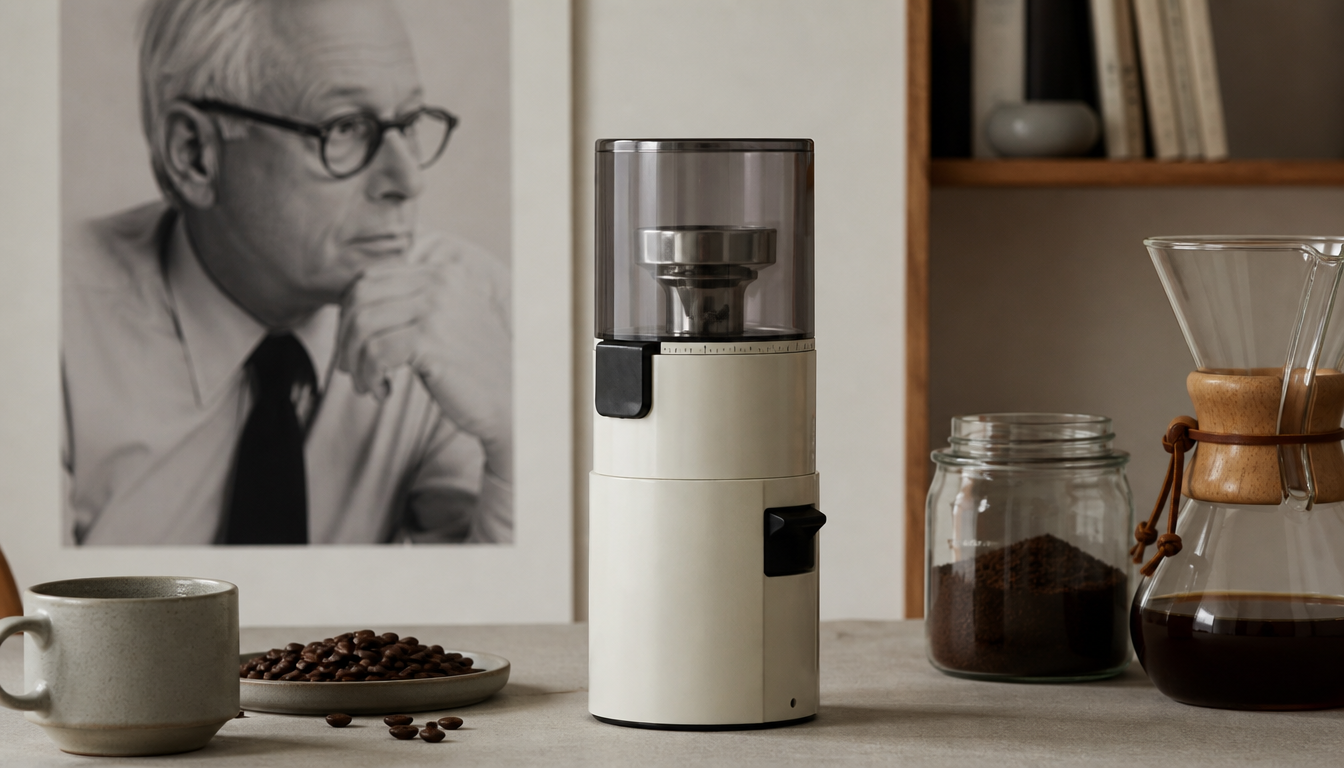
The Braun KSM-1, according to the Braun archive designed by Reinhold Weiss from 1963 and dated to 1967 by the Brooklyn Museum, belongs to the first generation of Braun electric household coffee grinders, developed under the creative direction of Dieter Rams. This very contradiction between the archive date (1963) and the museum’s date (1967) is what makes the KSM-1 so fascinating for collectors: Braun did not update catalogs, colors, and model codes in sync with production and design. Anyone holding a KSM-1 today holds a piece of the design language that Rams distilled in the 1960s — a language not formally written down as his “Ten Principles of Good Design” until 1985. Cylindrical body, a single button, no frills. That was no accident — it was a conviction.
Braun KSM1: The Coffee Grinder That Brought Dieter Rams’ Design Principles Into Your Kitchen
A cylindrical body, a single central button, a removable transparent lid. The Braun KSM1 is not an excitable device. It is the opposite of that — and that is precisely what makes it interesting to this day.
What the KSM1 Is and Where It Comes From
According to Braun’s own archive, the model KSM 1/11 was designed by Reinhold Weiss and introduced in 1963. The Brooklyn Museum, which holds an example in its collection, dates its unit to 1967 and credits both Dieter Rams and Reinhold Weiss as designers. Such discrepancies are not uncommon with Braun products from the 1960s: design, production, and catalog updates did not always run in sync.
The KSM1 belongs to the first generation of Braun’s household coffee grinders. It was created during a period in which Rams was fundamentally consolidating Braun’s design language: reduction of visual noise, clear geometry, functional clarity, and the systematic construction of product families. This period also laid the foundation for what would later become known as his “Ten Principles of Good Design,” even though these were not formally published until 1985.
The grinder operates with a blade mechanism, which was the standard for compact household grinders at the time. In Braun’s internal timeline, it appears before later models such as the KMM 2 from 1969, which was the first to introduce a disc burr grinding mechanism.
Practical Tips for Collectors and Everyday Enthusiasts
1. Don’t read model codes as a fixed system. Braun used several codes for this family. KSM-1 is the base model; KSM 1/11 denotes a sub-version of the same series. Later units carry color suffixes — such as “R” for Red — reflecting Braun’s expanding color range in the late 1960s and 1970s. Those searching the secondhand market will therefore sometimes find different designations for essentially the same object.
2. The dimensions are compact. The Brooklyn Museum records a height of 16.8 cm and a diameter of 8.3 cm for its example. Plastic, metal, rubber cable, 40–60 Hz, 1.1 amperes. A device that knows its place.
3. Working examples still exist. A unit recently rescued in Vienna reportedly still runs on its original mechanism. This shows that the material choices and construction of this generation were built to last.
4. Context makes the difference. The KSM1 cannot be understood without Dieter Rams. Born on 20 May 1932 in Wiesbaden, he shaped Braun for decades. His approach of “less, but better” is not a slogan but a constructive conviction that can be read in every detail of the KSM1.
Design History to Hang on the Wall
For those who want the spirit of this era present in their space visually — without hanging a coffee grinder on the wall: our Bauhaus Exhibition Poster or the Bauhaus Advertising Poster Art School resonate on a similar frequency to Braun’s design philosophy of the 1960s. The Kandinsky Poster Yellow-Blue-Red also fits well in a space that values reduction.
For those who want to celebrate Vienna as the KSM1’s place of rescue: the Vienna Canvas Print in Vintage Style and the Vienna City Map Poster are natural companions. Feel free to browse our entire poster shop or the canvas category.
And for patent drawing enthusiasts, the Coffee Roasting Drum Patent Drawing or the Coffee Urn Patent Drawing are two close neighbors in the spirit of the KSM1.
Sources
- VINTAGE AND OTHER THINGS on Instagram: Braun KSM-1 Documentation
- Brooklyn Museum: Coffee Grinder, Model KSM1 (1967)
- Wikipedia: Dieter Rams
FAQ
Who actually designed the Braun KSM-1 — Dieter Rams or Reinhold Weiss?
This is one of those typical archive questions where two sources give two different answers. Braun’s own archive names Reinhold Weiss as the designer and dates the launch to 1963. The Brooklyn Museum, which holds a KSM-1 in its collection, credits the device jointly to Dieter Rams and Reinhold Weiss and dates it to 1967. Such discrepancies are not uncommon with Braun products from the 1960s, as design, production, and catalog updates did not always run in sync at the time. What is certain: both names belong to Braun’s design history of that era.
What makes the KSM-1 so significant in design history?
The KSM-1 was created precisely during the period in which Dieter Rams decisively shaped Braun’s design language: reduced formal vocabulary, clear geometry, functional directness, no decorative embellishment. The cylindrical body, the single central button, and the removable transparent lid are no accident — they are a statement of intent. These principles would later become known as Rams’ ‘Ten Principles of Good Design,’ even though they were not officially published until 1985. The KSM-1 is therefore an early, tangible example of this design philosophy.
How does the KSM-1 work technically, and how does it differ from later Braun grinders?
The KSM-1 operates with a blade mechanism, which was the standard for compact household coffee grinders of its time. This clearly distinguishes it from later Braun models such as the KMM 2 from 1969, which was the first to introduce a disc burr grinding mechanism. The burr principle delivers a more uniform grind but was also more complex to construct. The KSM-1 thus stands at the beginning of a product family development that Braun consistently continued to refine.
What do the various model designations such as KSM-1, KSM 1/11, or KSM-1R mean?
Braun used several codes simultaneously for this grinder family. KSM-1 is the base designation. KSM 1/11 identifies a sub-version of the same series. The suffix ‘R’ stands for Red and appears on later units, as Braun expanded its color range in the late 1960s and 1970s. This is why collectors and museums sometimes list slightly different codes for essentially the same object. Anyone holding an example should therefore not be surprised if the archive designation differs slightly.
Can working KSM-1 examples still be found today?
Yes — and that is arguably the most remarkable thing about these devices. Since the KSM-1 is made of plastic, metal, and a simple blade mechanism, well-preserved examples are still fully functional today if they have been treated with care. A concrete example: a unit rescued in Vienna is documented as still running on its original mechanism. For collectors who want to not just display design history on a shelf but use it daily, the KSM-1 is a genuine contender.
This article was generated automatically by an AI system. Disclosure pursuant to Article 50 of the EU AI Act.