
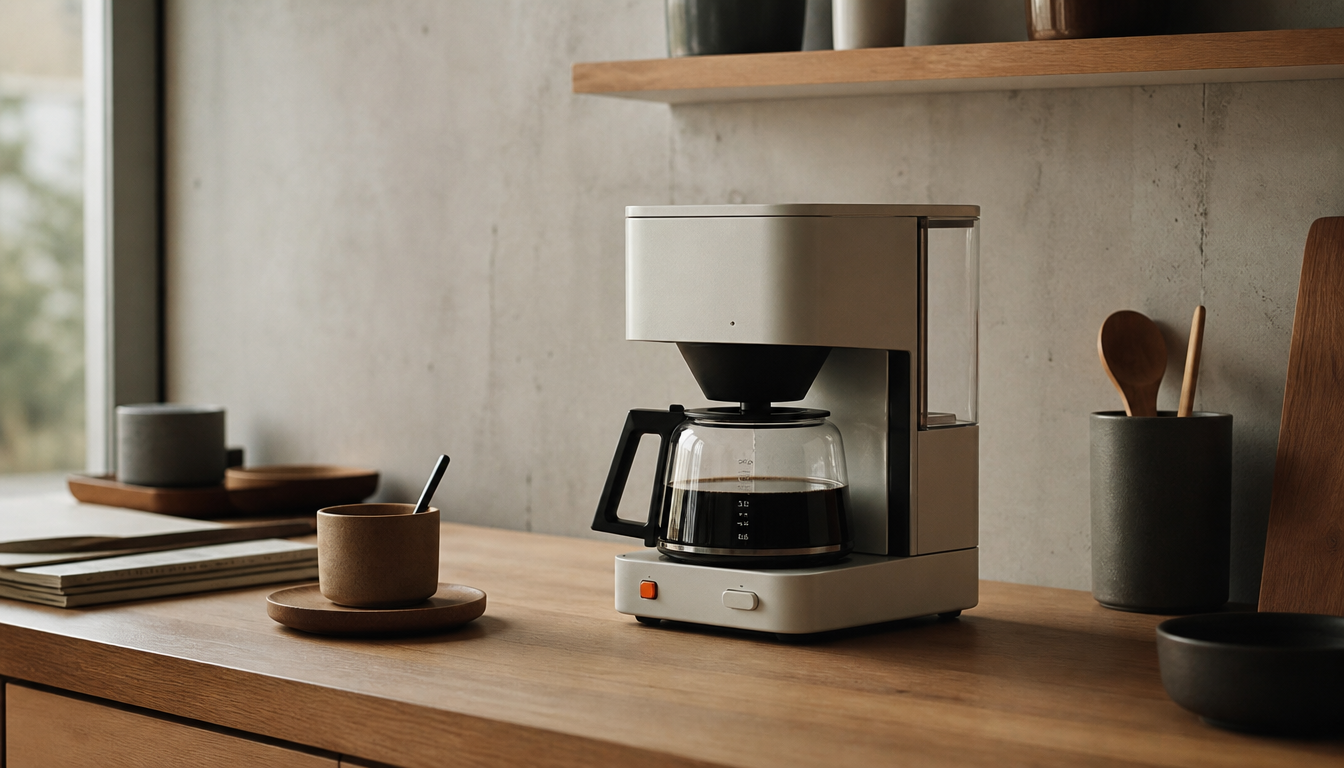
The Braun KF20 Aromaster, designed in 1972 by Florian Seiffert and overseen by Dieter Rams, was a commercial failure: its successor, the KF40, was manufactured at just 60% of the KF20’s production costs. The KF20 reveals just how radical Braun’s design philosophy truly was under Rams: crystal-clear polycarbonate, a tower-like structure of stacked elements, and separate heating circuits throughout the entire housing turned the coffee maker into a design object — and a cost problem. According to “Das Programm”, a research site dedicated to Braun design, the KF20 was produced with deliberate disregard for economic considerations. For you as a vintage fan, this is crucial: it shows why true design icons rarely stay in production for long, and why the KF20 is so sought-after today.
The Braun KF20 Aromaster: When a Coffee Maker Divided Design History
In 1972, Florian Seiffert designed a coffee maker under the direction of Dieter Rams that looked like a water tower from the future — and nearly ruined Braun in the process. The KF20 Aromaster remains one of the most fascinating objects from the era of German industrial design.
The Key Fact: Beauty Has Its Price
The Braun KF20 Aromaster was produced in Germany in 1972. Dieter Rams was responsible for the design direction, while the specific form was created by Florian Seiffert. According to the research platform Das Programm, which specialises in Braun design under Rams, the KF20 was produced “with great disregard for economic considerations”.
The housing was made from polycarbonate — Braun’s preferred plastic of the era — with a glossy surface and a distinctive stacked form of layered elements. The water reservoir and warming plate were designed as separate units, which meant Braun had to duplicate the heating elements throughout the entire body of the machine. The result: too expensive for mass production. The KF20 was eventually replaced by the KF40, whose production costs were reportedly just 60 percent of those of its predecessor. The KF40 featured a polypropylene housing, unified heating elements, and a more conventional form, in order to compete in the filter coffee machine markets of France, Germany, and the United States.
What This Means for You as a Vintage Enthusiast
1. The KF20 Is a True Collector’s Item, Not an Everyday Appliance
Buying a KF20 today means buying a design object. In Reddit threads about vintage coffee machines, the KF20 is described as a device “designed in the early 70s, when Dieter Rams was one of the most influential designers”. This is reflected in today’s market: the machines turn up at flea markets and on vintage platforms, often in surprisingly good condition — the polycarbonate housing ages very gracefully.
2. The Stacked Form Is No Accident — It’s a Statement
The tower-like silhouette of the KF20 was a deliberate departure from the competition of the time. It made the machine instantly recognisable, but was also the direct reason for its high manufacturing costs. Anyone who has an instinct for why form sometimes trumps function — and what that costs — understands the KF20 better than any instruction manual ever could.
3. The KF40 Shows What “Compromise” Means in Design History
The successor KF40 is the countermodel: more rational, cheaper, more market-ready. For collectors it holds less appeal, but for design students and historians it is at least equally revealing. A comparison of both machines shows directly how economic pressure can transform the formal language of an entire company.
4. The Design Principle Lives On — Even on Your Wall
The clear, reduced aesthetic that Rams and his team cultivated at Braun is the same one that made the Bauhaus great: function, form, attitude. If this visual language fascinates you, you’ll find it not only in old coffee machines. Our Bauhaus Sun Poster or the Bauhaus Exhibition Poster brings that same spirit directly into your living room. If you’d prefer to design an entire wall, the Hexagon Shop offers geometric wall art that fits this era stylistically.
And because coffee machine nostalgia comes with a certain patent-drawing romance: the Patent Drawing Poster of the Coffee Roasting Drum is a perfect companion for anyone who wants to hang kitchen history on their wall.
Sources
- Ángel López on Instagram: Braun KF20 Aromaster, illustration and background information
- Reddit, r/Coffee: Advice on buying vintage/70s coffee maker (Braun KF20)
- Etsy: Braun KF20 illustrations and prints
FAQ
Who actually designed the Braun KF20 Aromaster?
The KF20 Aromaster was designed in 1972 by Florian Seiffert and accompanied and overseen by Dieter Rams. It was manufactured in Germany by Braun. At the time, Rams was the defining force behind Braun’s entire design language and had a decisive influence on the formal vocabulary of the product.
What makes the KF20 visually so distinctive compared to other coffee machines of its time?
The KF20 stands out for its stacked, tower-like elements reminiscent of a water tower. This futuristic structure set it clearly apart from the competition of the day. The glossy polycarbonate body — Braun’s preferred plastic of the era — also gave the appliance a high-quality, almost sculptural quality. No wonder it is regarded as a design icon today.
Why was the KF20 discontinued despite its iconic design?
Simply put: it was far too expensive to manufacture. According to the Braun research site ‘Das Programm’, the KF20 was produced with widespread disregard for economic considerations. The separate water reservoir and the independent warming plate required duplicate heating elements throughout the entire body of the appliance, which drove production costs up dramatically.
What was the successor to the KF20 and what changed?
The successor was the Braun KF40, a considerably more pragmatic design. Its production costs came in at just 60 percent of those of the KF20. The KF40 used a unified polypropylene body, consolidated heating elements, and a more conventional form. This allowed Braun to compete on the German and French filter coffee markets, as well as — for the first time — on the American market.
Is the KF20 still considered a collector's item today?
Absolutely. The 1972 KF20 is traded today on platforms such as Etsy as a vintage object and celebrated as a design icon. Illustrations and posters of the appliance attract keen interest from design enthusiasts. On Reddit, users also report actively searching for working examples of the machine, underlining the enduring cult status of this piece of Braun history.
This article was generated automatically by an AI system. Disclosure pursuant to Article 50 of the EU AI Act.