
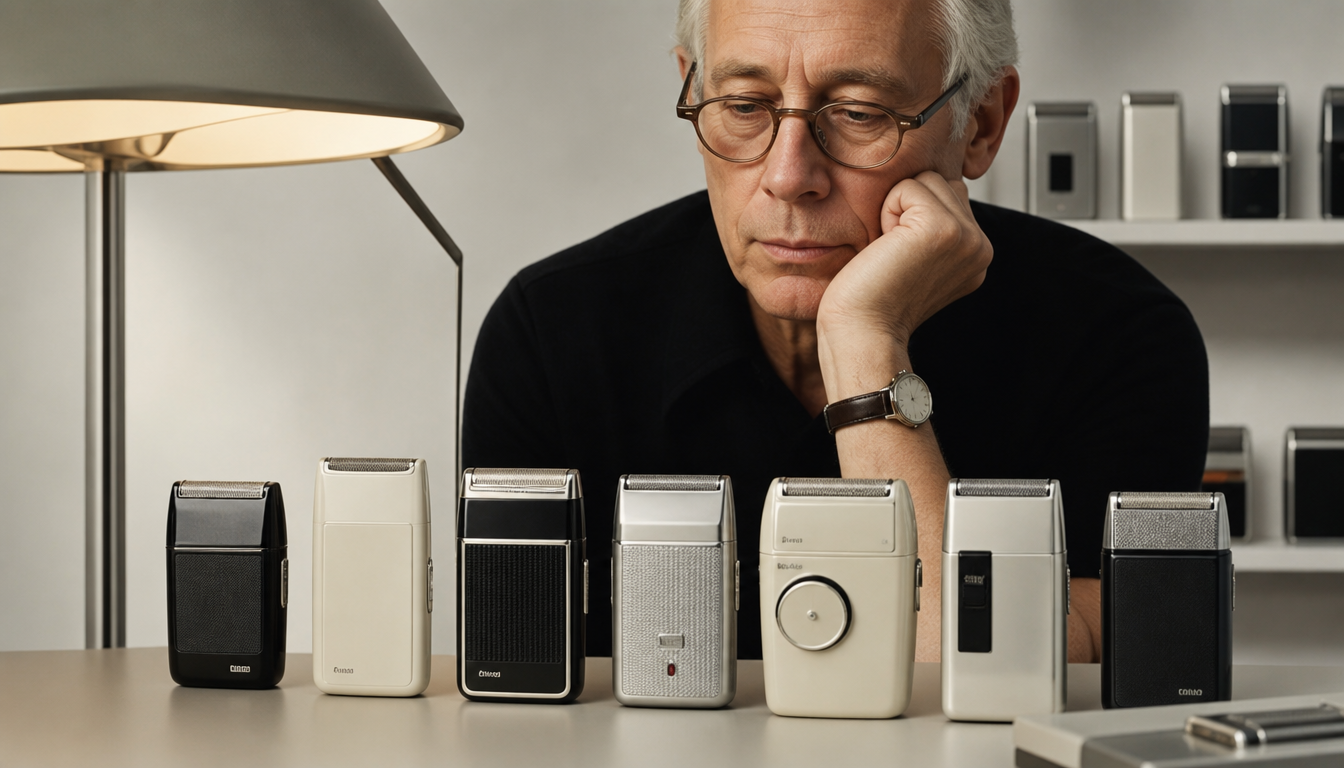
As Braun’s chief designer from 1961 to 1995, Dieter Rams shaped the product design of the German cult brand for over 30 years, laying the foundation for highly sought-after collectibles still in demand today, such as the electric shavers of the Braun era from 1962 to 1980. When you hold a Braun shaver from the 1960s or 1970s in your hands today, you are holding a piece of design history. Rams’ philosophy of “less, but better” was radical at the time and remains so to this day. Anyone who wants to understand the collector’s world surrounding these devices needs to know: this was not just about shaving – it was about inventing a visual language that shaped the entire 20th century and continues to influence the design of everyday products to this day.
Braun Electric Shavers: How Dieter Rams Turned an Everyday Object into a Design Classic
For more than thirty years, a single man shaped the face of one of Germany’s most important consumer goods manufacturers: Dieter Rams, born on 20 May 1932 in Wiesbaden, served as chief designer at Braun from 1961 to 1995. What he created there is still considered a reference point for functional industrial design – including the electric shavers of that era, which collectors today treat as objects of genuine cult status.
The Man Behind the Device
Rams originally studied architecture at the Handwerker Kunstgewerbe Schule in Wiesbaden, graduating in 1953, with a period in between spent working as a joiner’s apprentice for three years. This grounding in craftsmanship could be felt in every product he later created. His guiding principle, “Simplicity is the key to excellence!”, was not a marketing slogan but a lived constructional principle.
In a speech to the Braun supervisory board in 1980, he summed up his attitude: “I think that good designers must always be avant-gardists, always one step ahead. They should and must question everything that is generally taken for granted.” That very impulse is embedded in every Braun shaver from the sixties and seventies.
Braun itself has a longer history: Max Braun founded the company in 1921 as a small household appliance shop in Frankfurt. After the near-total destruction of the Second World War, he rebuilt the company from 1944 onwards. In the post-war period, his sons Erwin and Artur decided to combine design and engineering at the highest level. To achieve this, they brought in graduates from the Ulmer Hochschule für Gestaltung, the successor to the Bauhaus.
What Makes the Shavers of This Era So Special
At Braun, Rams developed a visual language that he himself described as “refined, concise and legible”: clearly readable, reduced to the essentials, free of ornament. The electric shavers produced between 1962 and 1980 embody this ethos like almost no other product segment.
- The handles truly fit the hand. Ergonomics was not a trend but a starting point. Rams’ principle of “less, but better” meant: nothing on the device that does not function.
- Colour was information, not decoration. Shades of grey, clear contrasts, deliberately placed accents. A Braun shaver from the seventies is recognisable as a Braun shaver at first glance.
- Materials age gracefully. Many devices from those decades still run today with proper care. This makes them attractive to collectors and explains the stable prices on the vintage market.
4 Practical Tips for Consumers and Collectors
1. Check the original condition at the switch. On many Braun shavers of this era, the sliding switch sits at a clearly defined position. Counterfeit replacement parts often do not fit flush. Anyone buying a vintage device should carefully check the switch function and panel gaps.
2. Replacement parts still exist, but availability is declining. For the most popular models from the sixties and seventies, shaving head replacements are still available from specialist retailers. Anyone planning to use a device long-term is better off stocking up while the market still allows it.
3. Storage is crucial. Plastic parts from this period are sensitive to direct sunlight and extreme temperature fluctuations. Collectors are best advised to store Braun shavers in stable environments, much like other high-quality vintage electronics.
4. Rams’ design principles help with authenticity checks. Anyone familiar with the ten principles of good design has a mental tool at hand: is the device honest in its materials? Is it constructed to last? Original devices meet these criteria in a tangible way. Conspicuous ornamentation or unclear controls are a warning sign.
Collector Culture: From Everyday Object to Display Piece
The interest in Braun products from the Rams era is no coincidence. Rams himself influenced how we perceive and purchase technology. According to the British design blog Pixart Printing, whenever the appearance of a device influences our purchasing decision, that can be traced back to Braun and Rams.
The collector scene for Braun shavers from the period 1962 to 1980 is internationally established. On auction platforms and in specialist forums, enthusiasts exchange knowledge about model variants, production years and condition. Well-preserved examples fetch prices far exceeding their original retail value.
Anyone with a passion for the visual heritage of this design period will also find analogue vintage aesthetics worth framing at reetro – such as the Bauhaus Ausstellung Poster or the Bauhaus Werbeplakat, which breathe the same design spirit as the Braun devices of those years. A fitting companion piece: the Bauhaus-style decorative cushion as a design statement in the living space.
Anyone wishing to delve deeper into the world of patent drawings and technical aesthetics will find what they are looking for in our poster shop – for example with the Patent Drawing Shaving Brush Poster, which brings the draughtsmanship quality of tool design directly to the wall.
Sources
- Dieter Rams: Celebrating the genius with 10 products for 10 commandments of design (Stirworld)
- Dieter Rams (Wikipedia)
- Honesty, consistency and precision: Braun under Dieter Rams (Pixart Printing Blog)
FAQ
Who was Dieter Rams and what does he have to do with Braun electric shavers?
Dieter Rams, born on 20 May 1932 in Wiesbaden, is one of the most influential industrial designers of the 20th century. From 1961 he was Head of Design at Braun, remaining in the role until 1995 – over 30 years. During this time he shaped the visual language of all Braun products, including the electric shavers: reduced, functional, honest. His credo ‘Less, but better’ is embedded in every device from this era.
What makes the Braun shavers from 1962 to 1980 so special for collectors?
Under Rams, Braun consistently combined high-quality design with engineering excellence and innovative materials, in part through close collaboration with the Ulmer Hochschule für Gestaltung, the successor to the Bauhaus. The shavers from this era are crafted with precision, timeless in form and radical in their simplicity. For vintage enthusiasts, they are living design history, not mere everyday objects.
According to which principles did Rams design the Braun shavers of this period?
At Braun, Rams developed a ‘refined, concise and legible visual language’ – a clear, readable formal vocabulary free of superfluous ornament. His best-known guiding thought: ‘Simplicity is the key to excellence.’ To this he added his ten principles of good design, which to this day serve as a benchmark in the design world. For him, design always had to be one step ahead – and that is exactly what you feel in the shavers of this period.
Did Dieter Rams' design philosophy only influence Braun, or does his influence reach further?
Far beyond. Rams’ conviction that ‘indifference towards people and the reality in which they live is the only true sin in design’ left a lasting mark on international product design in the 20th century. His work influenced aesthetics and design practice worldwide. Anyone holding a well-designed everyday object in their hands today often senses his influence, without even knowing it.
What awards reflect the standing of Dieter Rams in the design world?
In 2002, Rams was honoured with the Großes Verdienstkreuz of the Order of Merit of the Federal Republic of Germany. In 2013 he received the Lifetime Achievement Medal from the London Design Festival, and in 2014 the Compasso d’Oro Career Award from ADI Milan. Awards that show: what he created at Braun between 1962 and 1980 has long since become part of the design canon.
This article was generated automatically by an AI system. Disclosure pursuant to Article 50 of the EU AI Act.