
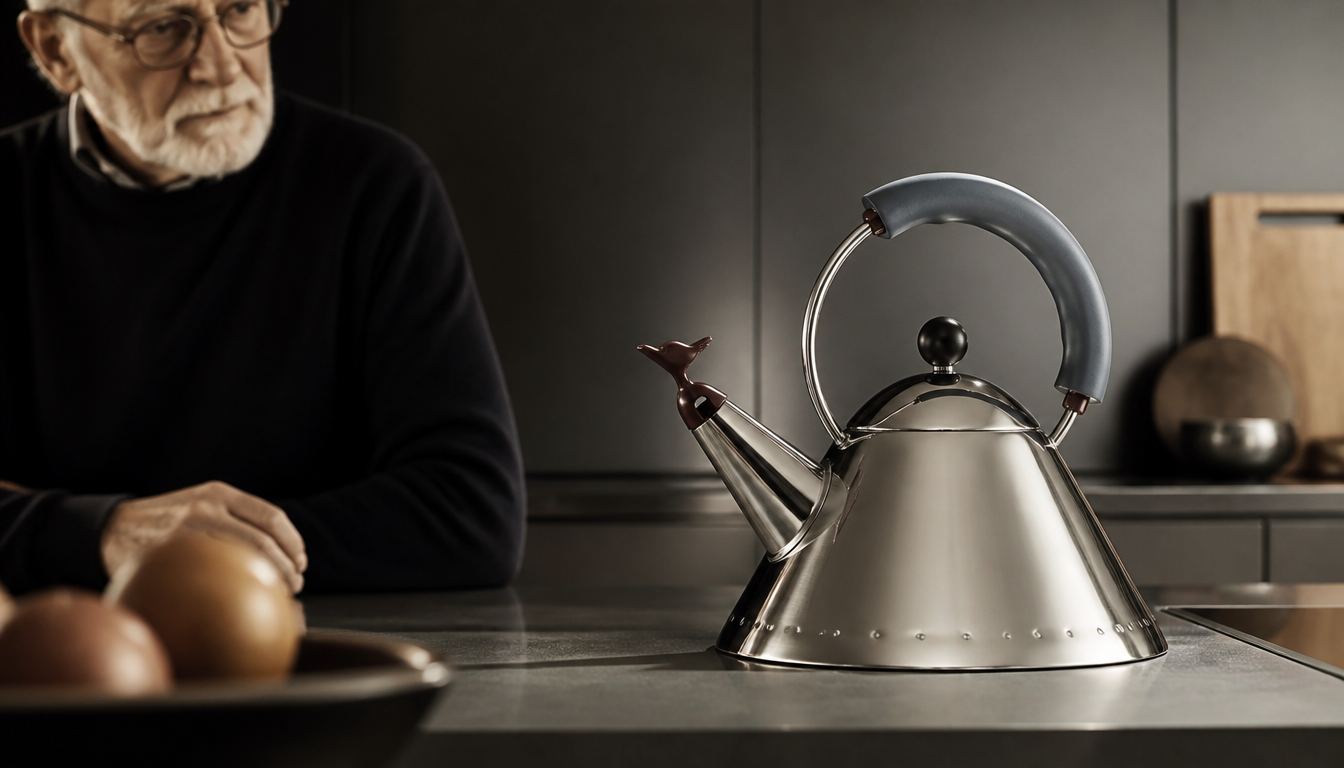
Richard Sapper’s iconic 9091 kettle for Alessi, launched in 1983, produces a two-note steam whistle when the water boils — a sound Sapper personally borrowed from a railway locomotive, as Alberto Alessi recounts in Dezeen’s 2016 film. The 9091 marks a turning point in design history: a simple kitchen utensil became a sculpture with an acoustic signature between 1979 and 1989. For you as a connoisseur of well-designed objects, this piece demonstrates how form, function and acoustics can merge into a single, unforgettable experience. No wonder the kettle is still in production today and on display in design museums around the world.
The Kettle as a Work of Art: Richard Sapper and the Alessi 9091
The Alessi 9091 by Richard Sapper is no ordinary kettle. It doesn’t whistle — it sings. Two harmonic tones, tuned like a small horn duet, ring out the moment the water boils. This is no coincidence, but the result of years of collaboration between German designer Richard Sapper and Italian manufacturer Alessi. Alberto Alessi himself has documented the story behind this piece: the development of the 9091 began in the late 1970s, and the finished product came to market in 1983.
What Makes the 9091 Still Relevant Today
1. Functional design with a clear attitude Sapper wanted to design a kettle that wouldn’t simply disappear into the kitchen. The 9091 has a sculptural form crafted from stainless steel and a handle made of black polyamide. It sits on the stove like an object placed there with intention. For those who value objects that make a statement, this is a reference example from design history.
2. Sound is part of the design Sapper had brass instrument makers specially develop the tones. This was no gimmick, but a fundamental decision: the product communicates through sound, not just through form. For consumers, this means the 9091 was conceived as a whole — not merely as a container for hot water.
3. Longevity over disposability The 9091 has been in production since the early 1980s and remains available to buy today. In an industry that thrives on models replaced every few years, that is extraordinary. A well-maintained 9091 lasts for decades — a practical argument for anyone who prefers to invest once rather than replace repeatedly.
4. Making design history visible in your home The 9091 has earned its place beyond the kitchen. It belongs among those objects that show what industrial design of the 1980s looked like when it was taken truly seriously. Those interested in this era can make that visible on their walls too. A fitting complement, for example, might be a Bauhaus poster or a Kandinsky poster in yellow, blue and red as a harmonious addition to the living space. Those who prefer something even more abstract will find many further options from the classical modernist period in the reetro poster shop.
Sapper and Alessi: A Collaboration with History
Richard Sapper worked with Alessi for decades. The 9091 was neither his first nor his last project for the company. Alberto Alessi recounts the origins of the kettle and the particular importance Sapper placed on the product’s acoustic quality in a video interview with Dezeen. Sapper reportedly insisted that the whistle must not be shrill or unpleasant, but something one genuinely enjoys hearing.
Richard Sapper died in December 2015. Dezeen’s “Remembering Richard Sapper” series paid tribute to several of his most celebrated works shortly after his death, including the 9091.
Sources
- Remembering Richard Sapper: 9091 kettle for Alessi – Dezeen
- YouTube: Dezeen video on the Alessi 9091
- Instagram Reel on the topic
FAQ
Who was Richard Sapper and what is his connection to Alessi?
Richard Sapper was a German-Italian industrial designer regarded as one of the most influential designers of the 20th century. For Alessi, he created several iconic products, including the legendary 9091 kettle, which remains in production to this day. Alberto Alessi himself described the collaboration as particularly formative for the brand.
What makes the Alessi 9091 kettle so special?
The 9091 is no ordinary kettle. Instead of a simple whistle, it produces a harmonious two-note signal when the water boils — a sound Sapper had specially developed. Alberto Alessi explained in a 2016 Dezeen film that Sapper even had bespoke brass whistles made that sound together as a chord. In 1983, this was an absolute novelty in kitchen design.
When was the 9091 developed and brought to market?
The design process took place during the later stage of Sapper’s intensive collaboration with Alessi, specifically in the period between the late 1970s and early 1980s. The 9091 was released in 1983, placing it squarely within the creative peak that reetro situates between 1979 and 1989.
Why is the 9091 considered a reinterpretation of a kitchen utensil?
Before the 9091, a kettle was simply a functional device with no aspirations toward design. Sapper treated it like a musical instrument: form, material and sound were considered of equal importance. The result was an object that redrew the boundary between design and everyday culture — and that set a precedent far beyond the kitchen.
Where can I learn more about the history of the 9091?
In 2016, following Richard Sapper’s death, Dezeen published a short film in which Alberto Alessi personally recounts the story behind the 9091. The film is available online and offers direct insight into the design decisions behind the harmonious whistle as well as the relationship between Sapper and the Alessi brand.
This article was generated automatically by an AI system. Disclosure pursuant to Article 50 of the EU AI Act.