
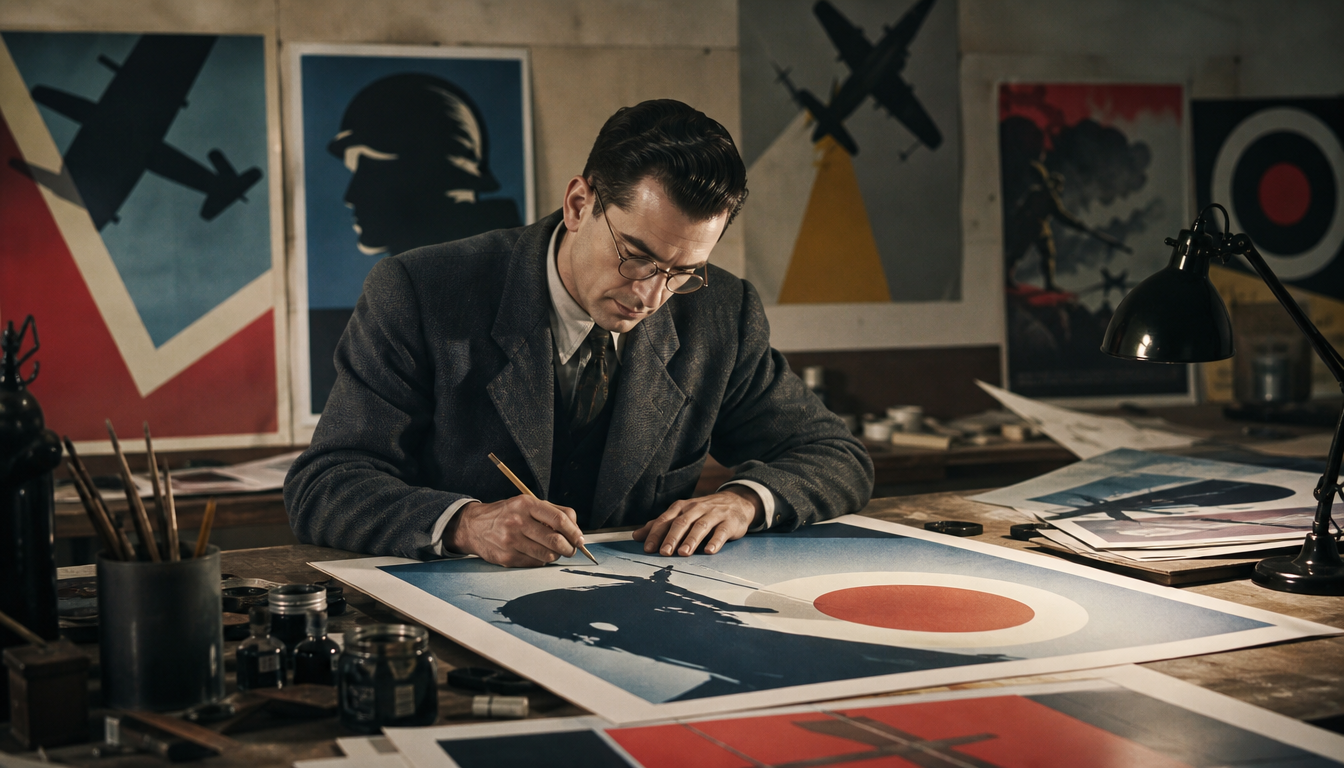
Abram Games (1914–1996) was Britain’s official war poster artist during the Second World War and created an influential poster series for the Army Bureau of Current Affairs (ABCA) from 1942 onwards, designed to show soldiers what they were fighting for. Before Games began his work for the British Army, posters were used primarily to sell products and luxury goods. From 1939 onwards, the government deliberately transformed the medium into a tool for shaping behaviour: soldiers and civilians were urged to conserve resources, donate blood and buy war bonds. Games’ motto “Maximum Meaning, Minimum Means” remains to this day a byword for a visual language that was direct, sometimes provocative and always precise. His legacy demonstrates how powerfully design can shape political and social persuasion.
Abram Games: How a Poster Artist Helped Shape the Second World War
Abram Games was the only official war poster artist in Britain during the Second World War. No other designer received this title, and no other left such a distinctive mark on British propaganda history during the years 1939 to 1945.
Who Was Abram Games?
Abram Games was born in 1914 in the East End of London, shortly before the outbreak of the First World War. His parents were Jewish refugees from various regions of the Russian Empire who had emigrated to Britain at the turn of the century. His father Joseph worked as a photographer and introduced Abram to creative design processes from an early age. The airbrush Joseph used to retouch his photographs became Abram’s most important tool. He used the same airbrush his father had passed down to him throughout his entire life.
Games was largely self-taught. By the late 1930s he had made a name for himself as a designer and poster artist, including commissions for London Transport. When war broke out, he was already well known.
Key Fact: The Poster as a Weapon of Persuasion
Before the Second World War, poster design was used primarily to sell services and consumer goods. With the outbreak of war in 1939, that changed fundamentally. The British government quickly recognised the persuasive power of the medium and used it deliberately to reach both soldiers and the civilian population.
Games produced a series of posters for the Army Bureau of Current Affairs (ABCA) that were intended to remind soldiers what they were fighting for while simultaneously offering them a vision of a better post-war society. The most famous example from this series is the poster “Your Britain. Fight for It Now” from 1942.
Games himself summarised his design principle succinctly: Maximum Meaning, Minimum Means. Maximum impact with minimal resources. This approach made his images direct, sometimes provocative and always unambiguous.
What You Can Take Away Today
1. Less is more – then and now
Games worked with reduced means, clear forms and strong contrasts. Anyone choosing wall art today will find a useful guiding principle here: a single, powerful image often makes a stronger impression than a wall crammed with pictures. Our poster shop shows just how much a single sheet can achieve.
2. Graphic posters work in any room
Games’ posters were designed for public spaces, but their impact is just as strong on a living room wall. Vintage graphic posters from the mid-twentieth century are hugely popular again today. A great starting point: the Bauhaus exhibition poster or the Bauhaus art school advertising poster, which display similarly clear, geometric design principles.
3. The poster as a historical document
Games’ works for the ABCA campaign served not only to boost morale but also to promote political education. They showed what might be possible after the war. Those who collect or display poster art of this kind are preserving a piece of communication history. Classic film posters from the same era, such as the classic retro cinema poster, carry the same spirit of the age.
4. Design heritage lives on
Games’ influence on visual communication is still felt today, according to the National Army Museum. His principle of translating complex messages into simple images can be found in modern graphic design, advertising and contemporary poster art alike. The London Underground advertising poster in our shop is a direct example of this design tradition – London Transport was one of Games’ earliest clients.
Conclusion
Abram Games proved that an image with a clear message and a sparing use of means can move people more powerfully than any lengthy explanation. His posters were politically, emotionally and aesthetically ahead of their time. The design tradition he helped shape is still alive in every great vintage poster today. Browse our poster shop or discover our canvas prints if this aesthetic speaks to you.
Sources
- Abram Games and the power of the poster – National Army Museum
- Abram Games, ABCA and the fight for post-war change – National Army Museum
- Abram Games – Maximum Meaning, Minimum Means (Pinterest)
FAQ
Who was Abram Games and how did he come to poster art?
Abram Games was born in 1914 in London’s East End, the son of Jewish refugees from the Russian Empire. His father Joseph was a photographer who introduced him to creative design processes from an early age. Particularly formative was Joseph’s use of an airbrush for retouching images – a tool he passed on to his son, who used it throughout his entire life. By the late 1930s, Games had made a name for himself as a self-taught designer and poster artist, including through commissions for London Transport.
What official role did Abram Games hold during the Second World War?
Games held the official title of ‘Official War Poster Artist’ for the British Army. In this capacity, he created numerous posters between 1939 and 1945 aimed at both soldiers and the civilian population. His works were intended to encourage specific behaviours: conserving resources, donating blood, buying war bonds and handling weapons and ammunition safely.
What is behind Games' design principle 'Maximum Meaning, Minimum Means'?
The phrase encapsulates Games’ entire design philosophy: achieving maximum impact with minimal means. In practice, this meant clear imagery, no superfluous elements and a direct visual message. For wartime posters in particular, this was crucial – a message had to be understood at a glance, whether in the daily routine of the troops or on a street corner in London.
What were the ABCA posters and what effect were they intended to have on soldiers?
The Army Bureau of Current Affairs, known as ABCA, commissioned Games to create a dedicated poster series. The best-known example is the image ‘Your Britain. Fight for It Now’ from 1942. These posters had a dual purpose: they reminded soldiers what they were fighting for, while simultaneously showing what a better society after the war might look like. The aim was not just to address the present moment, but to offer a vision for the future.
What influence do Games' wartime posters have on graphic design today?
Games’ works are still regarded today as a reference point for compelling visual communication. His direct, at times deliberately controversial approach has shaped the craft of persuasion that visual designers continue to employ. Before the Second World War, posters revolved primarily around commercial products and services. Games demonstrated that the medium is capable of far more when it comes to shaping social attitudes and mobilising people.