
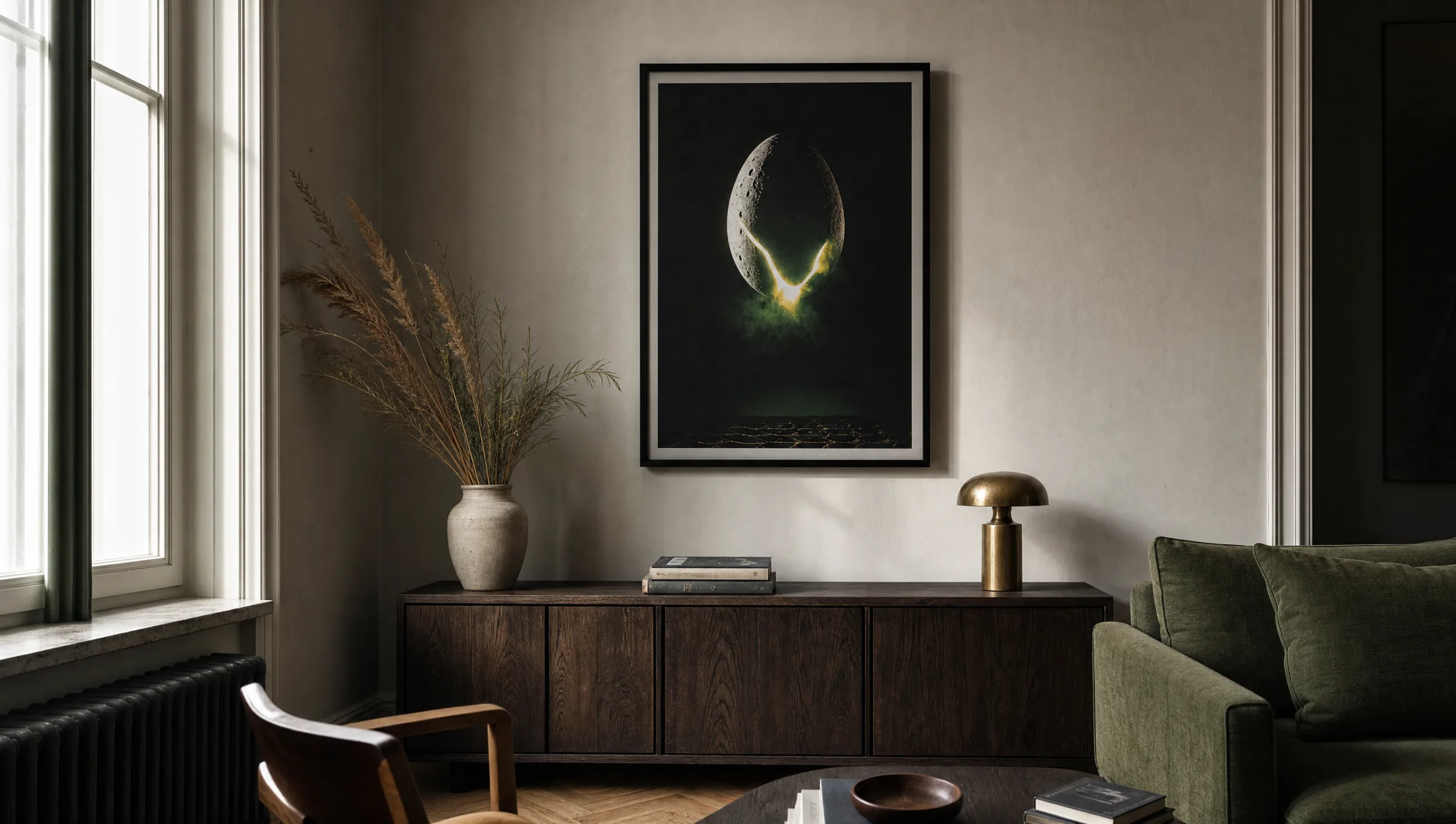
Alien Movie Poster: The Iconography of a Science-Fiction Classic
Few film posters have shaped the science-fiction genre as profoundly as the alien movie poster from 1979. This page takes an editorial look at motif variants, print formats and visual styles, and explains what to consider when choosing, framing and placing one in a living space.
Why the Alien Movie Poster Still Holds Up
The original poster for Ridley Scott's 1979 film relies on a handful of precise elements: a dark, near-black background, a cracked and glowing egg, and the now-famous tagline "In space no one can hear you scream". This restraint accounts for much of the image's lasting visual power — the motif works without characters, without action and without explanatory typography.
In this way, an alien movie poster draws on a graphic language that helped define the minimalism of later film advertising. Many re-releases, festival prints and artist variants can still be traced back to this same underlying structure. For anyone looking for a wall motif, that is a practical advantage: the poster holds its own in understated interiors just as well as in dark, high-contrast rooms.
Motif Variants of the Alien Movie Poster
From the classic egg motif to tribute works by contemporary illustrators — these four variants are the ones most commonly found on the market.
Original 1979 Motif
The black poster with the glowing egg and tagline. Clear, graphic, with no character imagery — the reference point for virtually all later adaptations.
Re-Release & Anniversary Prints
Print variants produced for milestone anniversaries, often featuring slightly revised typography, an alternative colour cast or an additional credit block along the lower edge.
Character & Xenomorph Prints
Detailed illustrations of the Xenomorph after H. R. Giger, or portraits of Ripley. These motifs are graphically denser and read particularly well at larger formats.
Alternative Artist Editions
Unofficial tribute works by contemporary illustrators, often in limited editions, with a reduced colour palette or a risograph-style aesthetic.
Formats, Paper and Framing for an Alien Movie Poster
For an alien movie poster, a matte paper from 200 g/m² upward suits the subject better than a high-gloss surface. The dark background benefits from a matte coating because reflections reduce the depth of the black. FSC-certified uncoated papers give the motif a subtly restrained feel without weakening the contrast.
In terms of format, 50 × 70 cm and 70 × 100 cm have proven the most practical. For living rooms with sufficient wall space, XXL sizes from 100 × 140 cm are worth considering. One important factor is distance from light sources: direct sunlight should be avoided, as pigment-heavy black areas can lose intensity over time.
Narrow black frames or dark oak profiles work most quietly with the design. Those who want to display the poster as a graphic object in its own right can omit a mount; a 2–3 cm white mount, on the other hand, creates separation and draws attention to the poster's edge.
An alien movie poster is less a film souvenir than a graphic statement — its restraint makes it one of the few posters that can anchor a living room without dominating it.
Reetro Editorial
Placement in the Room
In living areas, the poster reads most calmly above a low sideboard, a bench or a narrow console table. The centre axis of the motif should sit roughly at the eye level of a seated person — typically 145 to 155 cm from the floor, measured to the centre of the image.
In home offices and home cinemas, hanging the alien movie poster alongside other graphic film prints makes sense. Consistent framing is key here: when the poster is one of several motifs, identical frame profiles and gaps of 5–8 cm between prints create a gallery-like overall composition.
Original, Reprint or Artist Print?
Original posters from 1979 are now collectors' items and correspondingly rare on the open market. Anyone wanting to put an alien movie poster on the wall at a regular price will generally turn to licensed reprints or to independent tribute works that reinterpret the motif.
A reprint convinces through clean print data, calibrated colour profiles and consistent paper quality. Artist prints, by contrast, offer a more considered engagement with the source material and are often limited to a fixed edition. Both are legitimate approaches — the choice depends on whether the motif is intended to be read as a graphic reference or as an individual work of wall art.
Häufige Fragen
-
01
What makes an alien movie poster graphically distinctive?
The iconic alien movie poster from 1979 reduces its visual language to just a few elements: a dark, near-black background, a glowing egg with a fine crack, and restrained typography. This economy of means sets it apart from many later film posters and keeps it visually relevant today. Because no characters or action scenes are depicted, the motif also works in interiors where a more narrative film poster would feel out of place.
-
02
What size works best for an alien movie poster?
For most living spaces, 50 × 70 cm or 70 × 100 cm are the most practical choices. Above wider sideboards, sofas or in open-plan living and dining areas, XXL formats from 100 × 140 cm are also worth considering. More important than the exact dimensions is the proportion relative to the wall: the poster should span roughly two thirds of the width of the furniture beneath it, so the overall composition remains balanced.
-
03
Which frame suits the poster best?
Narrow black frames or dark oak profiles complement the graphic character of the motif most effectively. Light or coloured frames draw attention away from the high-contrast image composition. Anyone displaying the poster as part of a picture wall should keep the frame style consistent with the other prints. A narrow white mount is optional and adds a small amount of visual breathing room around the image.
-
04
Does a dark film poster fade more quickly?
Pigment-heavy black areas are more sensitive to direct UV radiation than lighter prints. A position away from direct sunlight is therefore advisable. High-quality printing processes using lightfast pigments, combined with UV-filtering frame glass, extend the poster's lifespan further. In normally lit living spaces, a well-produced print will remain colour-stable for many years.
-
05
How should an alien movie poster be hung?
The centre of the image should sit at approximately 145 to 155 cm from the floor. Above a piece of furniture, a gap of 15 to 25 cm between the top of the furniture and the bottom edge of the poster tends to look most natural. In picture walls, 5 to 8 cm between individual prints is the standard spacing. Before drilling, it is worth testing the position using a sheet of kraft paper cut to the poster's dimensions and held against the wall.
-
06
How does Reetro approach printing this type of motif?
Reetro has graphic film poster motifs printed to order by our production partner in the EU on FSC-certified papers from 200 g/m² with a matte coating. The matte surface minimises reflections on the darker areas of the image and gives the motif the depth it requires. Colour profiles are calibrated before each print run to ensure that black areas remain cleanly rendered and that fine light edges — such as those around the egg motif — do not blow out.