Science Fiction Poster – Wall Art Between Technology and Imagination
A science fiction poster brings together architectural visions of the future, cosmic scale and typographic classics into a distinctive image format. This page offers an overview of styles, formats and hanging guidance for sci-fi wall art – whether you are starting a collection or looking for a single statement piece.
What Defines a Science Fiction Poster?
The science fiction poster has its own visual grammar, one that sets it clearly apart from other poster genres. Typical motifs include planetary surfaces, space stations, futuristic city silhouettes and star charts. Geometric structures and industrial aesthetics frequently play a central role – a visual language rooted in engineering drawings and early Space Age illustration.
Historically, the genre grew out of pulp-magazine covers from the 1920s through the 1960s. Artists such as Frank R. Paul shaped the look of science fiction with colour-saturated, schematically clear compositions. That legacy carries forward into modern prints, which appear either as retro homages or as contemporary digital illustrations.
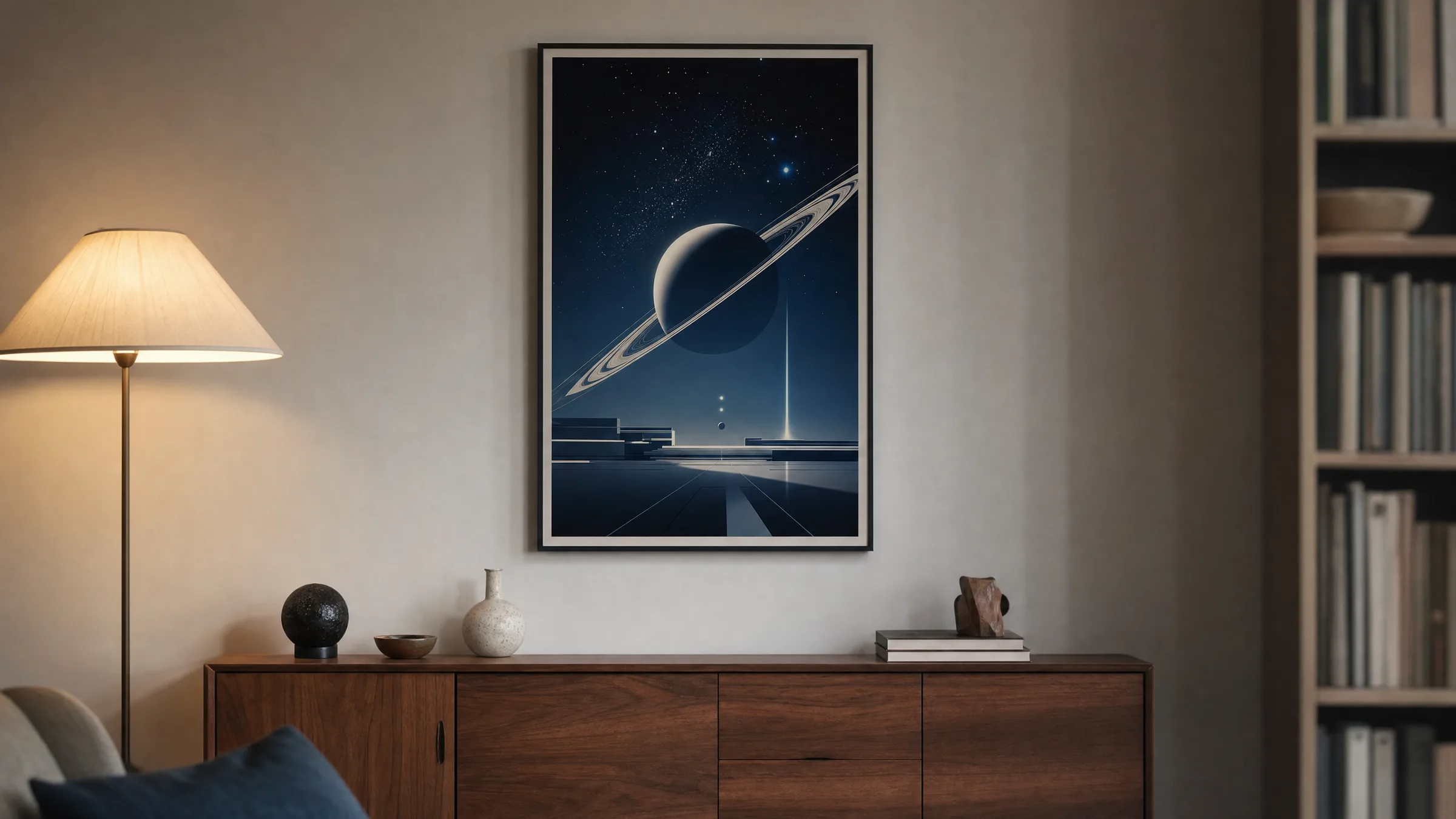
Stylistically, at least three main directions can be distinguished: the classic retro sci-fi look with warm orange tones and serif-heavy typography; a minimalist approach with reduced colour palettes and geometric forms; and photorealistic space compositions influenced by NASA imagery. Each direction places different demands on paper weight and printing process.
Science Fiction Poster Styles at a Glance
Depending on your interior style and personal taste, different visual languages suit different spaces. The overview below helps narrow down the options.
Retro Space Age
Warm earth tones, orange and beige dominate. Serif typography with a subtly weathered look recalls travel posters of the 1950s. Works well alongside wooden furniture and warm wall colours.
Minimalist Geometric
Reduced colour palette, clean lines and generous negative space. Planetary cross-sections, orbital paths and abstract structures define this style. Combines well with modern, light-filled interiors.
Photorealistic / NASA Aesthetic
High-resolution compositions drawing on telescope imagery and digital rendering. Deep blacks, galaxy structures and nebulae in blue and violet tones take centre stage. Particularly precise at large formats.
Cyberpunk & Urban Futurism
Neon accents, rain reflections and dense future cityscapes. Dark base tones with magenta or teal as the light source. Well suited to home offices and gaming rooms with an industrial character.
Format and Material Choices for Sci-Fi Wall Art
The impact of a science fiction poster depends heavily on the format chosen. Panoramic ratios such as 2:1 suit space travel motifs particularly well, emphasising the horizontal sweep of planets and galactic arms. Portrait formats, by contrast, reinforce the vertical dynamism of futuristic cityscapes and spacecraft silhouettes.
For paper, a weight of at least 200 g/m² with a matte coating is recommended. Matte surfaces reduce light reflections, which noticeably improves the legibility of fine lines and light points in detailed, dark-toned motifs – a common feature of the sci-fi genre. Gloss coatings can produce distracting reflections against deep black backgrounds.
As an alternative to classic paper prints, aluminium Dibond panels offer a robust surface that can be hung without a frame. The material sits between a poster and a wall sculpture, and it accentuates the technical aesthetic of many sci-fi motifs in a directly tangible way. All Reetro prints are printed to order by our production partner in the EU on FSC-certified stock.
Sci-fi wall art works best when motif, format and material follow a shared visual logic – not when any one of them has been chosen at random.
Editorial note, Reetro
Placing and Grouping Science Fiction Posters
A single large-format science fiction poster reads most strongly as a solitary image element on a calm, plain wall. For gallery arrangements, combining two or three thematically related prints works well – for example, a planetary scene alongside a star chart in the same colour scheme. Consistent framing and identical spacing between prints give such arrangements visual stability.
In living rooms, sci-fi posters work well above sofas or along longer hallways, where their narrative quality invites closer attention. In a study, minimalist variants are often the better choice – they create a focused atmosphere rather than competing with the work at hand.
A practical note on hanging: eye level is typically 150–160 cm from the floor. For very large formats, the visual centre of the image can be set slightly lower to balance the optical weight within the room. Direct sunlight should be avoided, as UV exposure fades pigment-based prints over time.
Care and Longevity of Poster Prints
For framed paper posters, occasional dry dusting of the frame and glass is sufficient. Direct moisture on the paper should be avoided. Unframed prints are best protected by glazing with clear or UV-filtering glass, which also slows yellowing over time.
Aluminium prints are considerably easier to maintain: a lightly dampened microfibre cloth is enough to remove dust or fingerprints without damaging the surface. They are therefore also suitable for kitchens or hallways that see heavier everyday use.
Häufige Fragen
-
01
Which formats work best for a science fiction poster?
Panoramic formats such as 91 × 61 cm or 120 × 60 cm emphasise the horizontal breadth of space and planetary motifs particularly well. For futuristic cityscapes or spacecraft imagery, portrait formats such as 50 × 70 cm or 61 × 91 cm are the stronger choice, as they reinforce the vertical dynamism of those compositions. Square formats suit minimalist, symmetrical layouts well.
-
02
Gloss or matte – which surface suits a science fiction poster?
Matte coatings are clearly preferable for sci-fi motifs with dark backgrounds. They produce no distracting light reflections and allow fine details – such as star fields or light edges on spacecraft – to read clearly at any viewing angle. Gloss surfaces can show visible reflections against deep black areas, which visually overlaps with the motif itself and reduces clarity.
-
03
How do I combine several science fiction posters into a cohesive arrangement?
The key is a shared visual anchor: a consistent colour palette, a unified style (for example, all retro or all photorealistic), or a thematic thread such as the planets of the solar system. Equal frame sizes and consistent spacing of around 4–6 cm between prints keep the arrangement calm. Asymmetric arrangements mixing different formats can work, but they require a clearly defined optical anchor point to hold the group together.
-
04
Is a science fiction poster a suitable gift?
Yes, provided you have a reasonable sense of the recipient's taste. A science fiction poster is particularly well suited for people with a strong interest in space exploration, astronomy, speculative architecture or retro popular culture. If you are unsure about the preferred style, minimalist star charts or classic NASA-influenced designs tend to be more broadly appealing than niche cyberpunk motifs.
-
05
How do I hang a large-format poster securely and straight?
For formats from 70 cm wide upwards, two hanging points with a spirit level are recommended to prevent the print from twisting. Poster rails or picture rails in wood offer a frameless-looking hanging solution and are especially practical for rolled prints. The visual centre of the image should sit roughly at eye level – typically 150–160 cm from the floor. At Reetro, XXL posters are shipped rolled in sturdy postal tubes so the paper lies flat as soon as it is unpacked.