
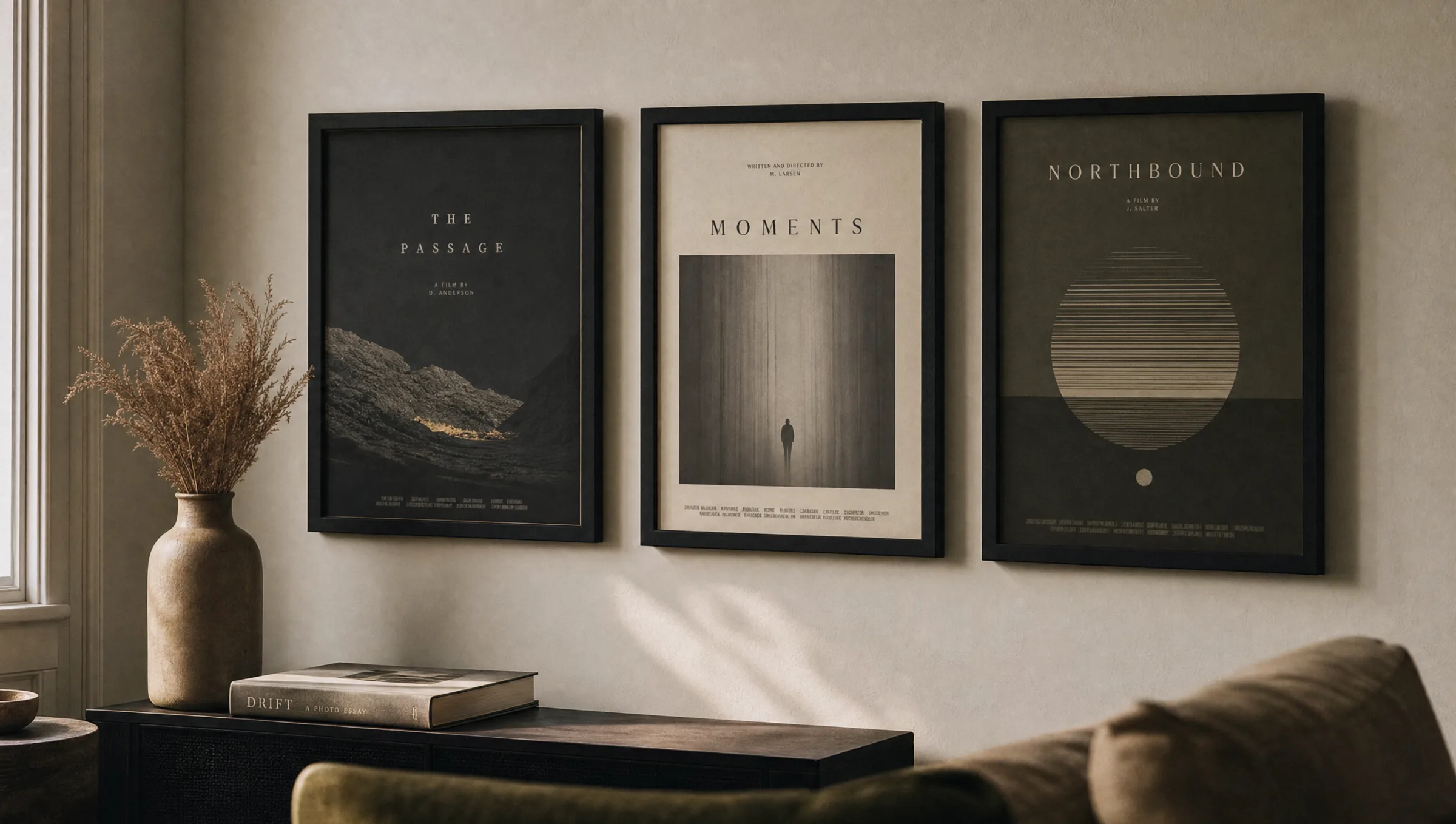
Movie Posters: Curated Prints for Your Wall
Anyone looking to buy movie posters today faces an extensive range of options: original theatrical releases, freshly interpreted designer prints and pared-back editorial editions. This overview maps the key categories, explains formats and paper qualities, and offers framing guidance – so that the print on your wall lands exactly as you imagined it.
What It Means to Buy Movie Posters Today
Buying movie posters no longer simply means picking up a nostalgic souvenir from a cinema foyer. The market has diversified considerably over recent years: alongside original theatrical prints in classic sizes such as A1 or 70×100 cm, there are alternative posters by illustrators who reinterpret individual films graphically from scratch. On top of that come pared-back, typographically driven editions that distil a film into type, colour and a single central symbol.
This variety is an opportunity, but also a challenge. Anyone planning to hang a poster above a sofa should think not only about the motif, but also about visual language, colour mood and format. A dark noir poster calls for a very different wall colour than a bold Wes Anderson composition. The question is less 'Which film?' and more 'What atmosphere should the room carry?'
Types of Movie Posters at a Glance
Before you buy movie posters, it is worth looking at the four main categories. They differ considerably in visual language, availability and price range.
Original Theatrical Prints
Official cinema posters from distributor stock, often delivered folded. Characteristic features include cast blocks, studio logos and the classic 70×100 cm format. Authentic, though not always visually restrained.
Alternative Movie Posters
New interpretations of well-known films by illustrators, frequently issued in limited runs. Reduced visual language, distinct colour palette, clear composition – well suited to living spaces with a calm aesthetic.
Typographic Editions
Posters that condense a film through type, a key quote or a scene list. Works particularly well in studies and hallways, where the print is meant to register as you pass by.
Scene Stills and Photo Prints
Black-and-white or colour-toned stills from classics, often in an editorial look. Less overtly poster-like, and easy to combine with photography and art prints in a gallery wall.
Formats, Paper and Print Quality
When you buy movie posters, the choice of materials determines whether the print retains its character for years to come. Standard poster formats include 50×70 cm, 70×100 cm and 61×91.5 cm – the American 'One Sheet'. Anyone seeking impact above a sofa wall should consider XXL formats from 100×140 cm upwards. For narrow wall strips and door recesses, portrait-oriented prints in a 2:3 ratio work particularly well.
Paper is the second key variable. A matte FSC-certified paper at 200 g/m² or above reads as calm and low-reflection, taking on colour with clear depth. Glossy surfaces emphasise contrast but reflect more strongly in daylight. For rooms with a great deal of natural light, a matte print with pigment-based inks is generally the more durable choice.
Print method also matters. Offset printing for larger runs delivers clean, even surfaces; giclée or pigment printing for smaller editions achieves finer colour gradations. Those who care about colour accuracy should look for references to calibrated colour profiles and colour management details in the product description.
A good movie poster does not retell the film – it translates it into a single moment that can hold its own on a wall.
Reetro Editorial
Framing, Hanging and Care
Once the choice is made, the second chapter begins: presentation. Plain wooden frames in oak or black suit most prints; aluminium frames work especially well with graphic and typographic posters. A mount creates distance from the edge and settles restless compositions – not every poster needs one, but for dense cast blocks it makes a noticeable difference.
For hanging, the standard rule of thumb applies: the centre of the print should sit at roughly 145 to 150 cm from the floor. Above seating, the poster can drop a little lower, leaving around 20 to 30 cm between the back of the sofa and the bottom of the frame. In gallery walls with several prints, it helps to align the movie posters along a shared axis – either the top edge or the centre line.
For care: avoid direct sunlight, and dust framed prints occasionally with a dry microfibre cloth. Unframed posters should be stored flat or rolled to a diameter of at least ten centimetres – never folded.
What to Look For When Buying Movie Posters
Three points separate a forgettable wall object from a poster that carries the room. First: licence and provenance. Reputable suppliers clearly state the source of the motifs, the edition size and – for reproductions – the legal basis. Second: technical specifications. Paper weight, coating, print method and shipping format should all be transparently documented.
Third: editorial curation. A carefully selected range is usually more helpful than an endless catalogue. Anyone looking to buy movie posters benefits when someone has already assessed which prints hold up in terms of composition, colour mood and printability. That way, a purchase becomes a considered decision for the room rather than a matter of chance.
Häufige Fragen
-
01
Where can I buy movie posters from a trustworthy source?
Reliable sources include curated print brands, specialist galleries for alternative movie posters and official studio shops. Look for transparent information about edition size, print method, paper and licensing. A well-organised supplier will clearly state whether you are buying an original theatrical print, an official reproduction or an artistic reinterpretation. Customer reviews with real images, and a clearly defined returns policy, are further indicators of reliability.
-
02
Which format should I choose when buying movie posters?
The classic formats are 50×70 cm and 70×100 cm, alongside the US standard of 61×91.5 cm. For large walls behind sofas or beds, XXL formats from 100×140 cm upwards read as calmer and more self-assured than several smaller prints side by side. In hallways and narrow wall strips, portrait-oriented formats in a 2:3 ratio work well. Measure the wall in advance and tape out the format with masking tape before committing to a size.
-
03
How much do quality movie posters cost?
The price range is wide. Offset-printed posters from standard production runs typically fall between £20 and £60. Limited alternative movie posters with an artist's signature generally range from £40 to £150, while original vintage theatrical prints in good condition can reach three- or even four-figure sums. The key pricing factors are edition size, print method, paper quality and – for originals – condition and rarity.
-
04
Are movie posters durable as wall art?
Yes, provided the materials and location are right. Pigment prints on matte paper at 200 g/m² or above retain their colour depth for many years as long as direct sunlight is avoided. Framing with UV-filtering glass extends longevity further. In kitchens and bathrooms, coated materials or aluminium prints are more practical, as paper is sensitive to moisture in those environments.
-
05
Original or reproduction – which is the better option?
It depends on your intention. Collectors often seek the original for its material history: fold marks, storage traces, period print techniques. Those who want a movie poster as a composed, restful wall piece are usually better served by a high-quality reproduction or a curated new interpretation – colours are fresher, the format more predictable, the price easier to plan. Both approaches are entirely valid; they simply address different needs.
-
06
What should I look for when buying movie posters at Reetro?
Reetro operates as an editorial curator, selecting motifs on the basis of composition, colour mood and printability. All prints are printed to order by our production partner in the EU on FSC-certified papers of at least 200 g/m² with a matte coating. When ordering, pay attention to the listed formats and the framing guidance – most motifs are composed so that they read cleanly even without a mount, fitting standard off-the-shelf frames without adjustment.