
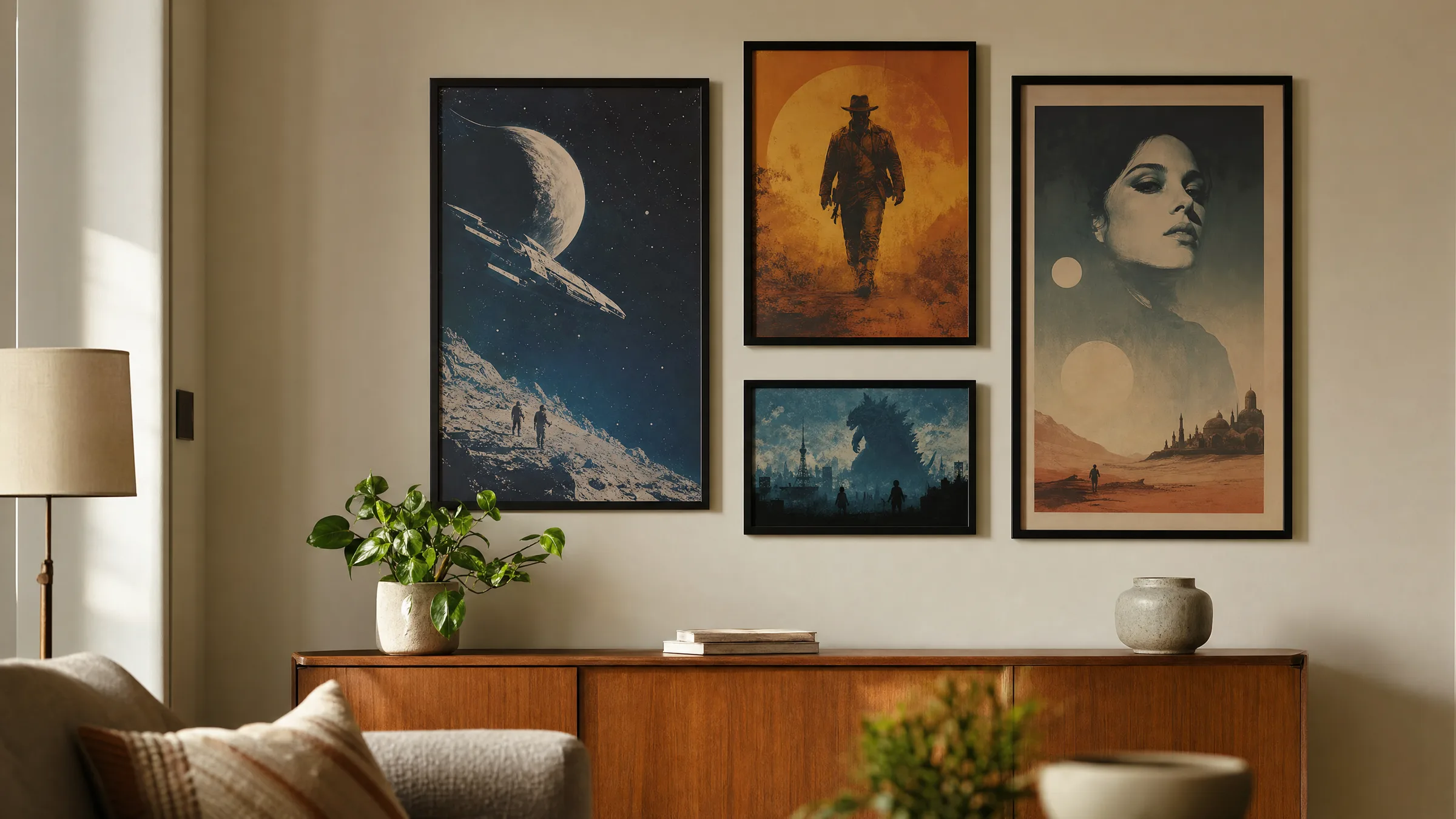
Movie Poster Prints – Cinema Motifs for Your Wall
Movie poster prints are among the most enduring image formats in interior design. Whether a quiet black-and-white photograph from Hollywood's Golden Age or a graphically reduced illustration from a contemporary production — a well-chosen movie poster print connects personal film history with visual intention. Reetro prints motifs to order through a production partner in the EU on certified FSC materials.
What makes a great movie poster print?
A movie poster print is more than a decorative accessory. In its original form it was a communication tool for cinema — designed to compress atmosphere, genre and tone into a small space. Good film posters fulfil this purpose on a home wall too: they say something about the person who lives there, invite conversation and carry a typographic or illustrative quality that works independently of any knowledge of the film.
When choosing, it is worth paying attention to the design quality of the motif — composition, colour palette and typography. Many of the most iconic movie poster prints were created by graphic designers now celebrated in design history: Saul Bass for Alfred Hitchcock, Drew Struzan for the blockbusters of the 1980s. These motifs hold up easily even as large-format wall pieces.
Movie poster prints: formats at a glance
Anyone looking to buy a movie poster print faces a choice between different substrates and printing methods. Each format has specific properties that influence how the motif appears on the wall.
Poster on FSC paper
The classic print on 200 g/m² paper with a matte finish. Reduced reflection, natural colour reproduction, ideal for living rooms and studies. Can be framed or hung with an aluminium rail.
Premium canvas
Canvas prints have more depth than paper posters, as the fabric structure scatters light slightly. No frame needed, since the canvas is stretched over a wooden stretcher bar. Particularly suited to large-format motifs from 60×90 cm upwards.
Hexagonal aluminium
Direct aluminium printing produces a lightly glossy, robust surface. The hexagonal format allows multiple panels to be combined into a modular wall arrangement — well suited to home cinema rooms or media spaces.
XXL poster
For walls with sufficient space, XXL formats from 100×140 cm offer a presence close to that of a framed painting. Several motifs placed side by side form a gallery wall with a clear curatorial statement.
Styles and eras: which film motifs work together?
Movie poster prints can be grouped by design era: the hand-drawn illustrations of the 1930s to 1960s, the photomontages of the 1970s and the digitally composed campaign artworks from the 1990s onwards differ markedly in their visual language. If you want to combine several film prints in one room, it helps to stay within a single era or graphic style.
Black-and-white motifs from silent film or noir cinema integrate particularly well into neutral interior schemes. Colourful prints from giallo cinema or Japanese animated productions bring their own strong colour palettes and call for more restrained wall colours or simple framing.
A consistent framing choice — for example, uniform slim black wood frames or frameless aluminium profiles — ties together different motifs into a coherent arrangement, even when the film prints span different genres or decades.
A film poster is a compressed image of an entire story — on the wall it works like a window into a world you already know, or one you want to explore.
Reetro Editorial
Hanging, care and longevity
Anyone buying a movie poster print with the intention of displaying it long-term should look for UV protection in the frame glazing. Direct sunlight causes colours on uncoated paper to fade within just a few years. Anti-reflective museum glass or a UV-protective film protects the printed image even in bright rooms.
Canvas prints are less sensitive than paper posters: the firm substrate makes them resistant to mechanical stress, and the matte surface can be cleaned with a lightly dampened cloth. Aluminium wall prints are equally low-maintenance and moisture-resistant, making them suitable for rooms with higher humidity.
For paper posters the rule is: always frame behind glass, never adhere directly to porous walls. Aluminium frames with spacers keep the paper away from the wall and prevent moisture damage.
Häufige Fragen
-
01
Where can I buy high-quality movie poster prints?
Movie poster prints can be purchased from specialist art-print retailers such as Reetro, from galleries with a film motif range, or from licensed dealers. The key quality indicators are the printing method, paper weight (at least 200 g/m²) and colour accuracy. Mass-market prints are often produced on lightweight 135 g paper and fade quickly. Premium prints on FSC-certified material, printed to order in the EU, last for many years when correctly framed and protected from direct light.
-
02
Which formats are most common for movie poster prints?
The classic cinema format is 70×100 cm, which corresponds to the European standard and fits most off-the-shelf frames. Alongside this, 50×70 cm and 61×91 cm (the US standard) are widely used. If you want to combine several movie poster prints in a gallery wall, it is best to keep to one or two formats in order to maintain a calm overall appearance.
-
03
Are movie poster prints better as canvas or on paper?
It depends on the room context. Paper prints in frames have a more classic feel and recall an exhibition setting. Canvas prints need no frame, sit slightly more prominently in a room and are more mechanically robust. For a home cinema or media room, canvas often works better; for a living room or study with a more decorative intent, a framed paper print is the more natural choice.
-
04
How do I hang several movie poster prints as a gallery wall?
First, try out the arrangement on the floor before drilling any holes. A consistent gap of 5–8 cm between frames looks tidy. Aligning the top edges horizontally creates order when frame sizes differ. For heavier frames over 2 kg, use wall plugs in a load-bearing surface. Picture rails offer a flexible, wall-friendly alternative that allows you to rearrange prints without additional holes.
-
05
Buying movie poster prints: what do I need to know about copyright?
Original theatrical release film posters are archival pieces and are generally not cleared for private reproduction. Reputable retailers such as Reetro work exclusively with licensed motifs or specially created art prints that are legally sound. When purchasing, check whether the supplier clearly discloses licensing information — this is a reliable indicator of quality and legal compliance.
-
06
How do I protect my movie poster print from fading?
The most important factor is UV light: direct sunlight causes even high-quality pigment prints to fade over time. Anti-reflective museum glass with UV protection, or UV-protective film under standard glass, helps significantly. Reetro uses exclusively lightfast pigment inks on FSC-certified paper, which considerably improves fade resistance compared to lower-grade dye-based inks — keeping your movie poster print looking its best for years.