
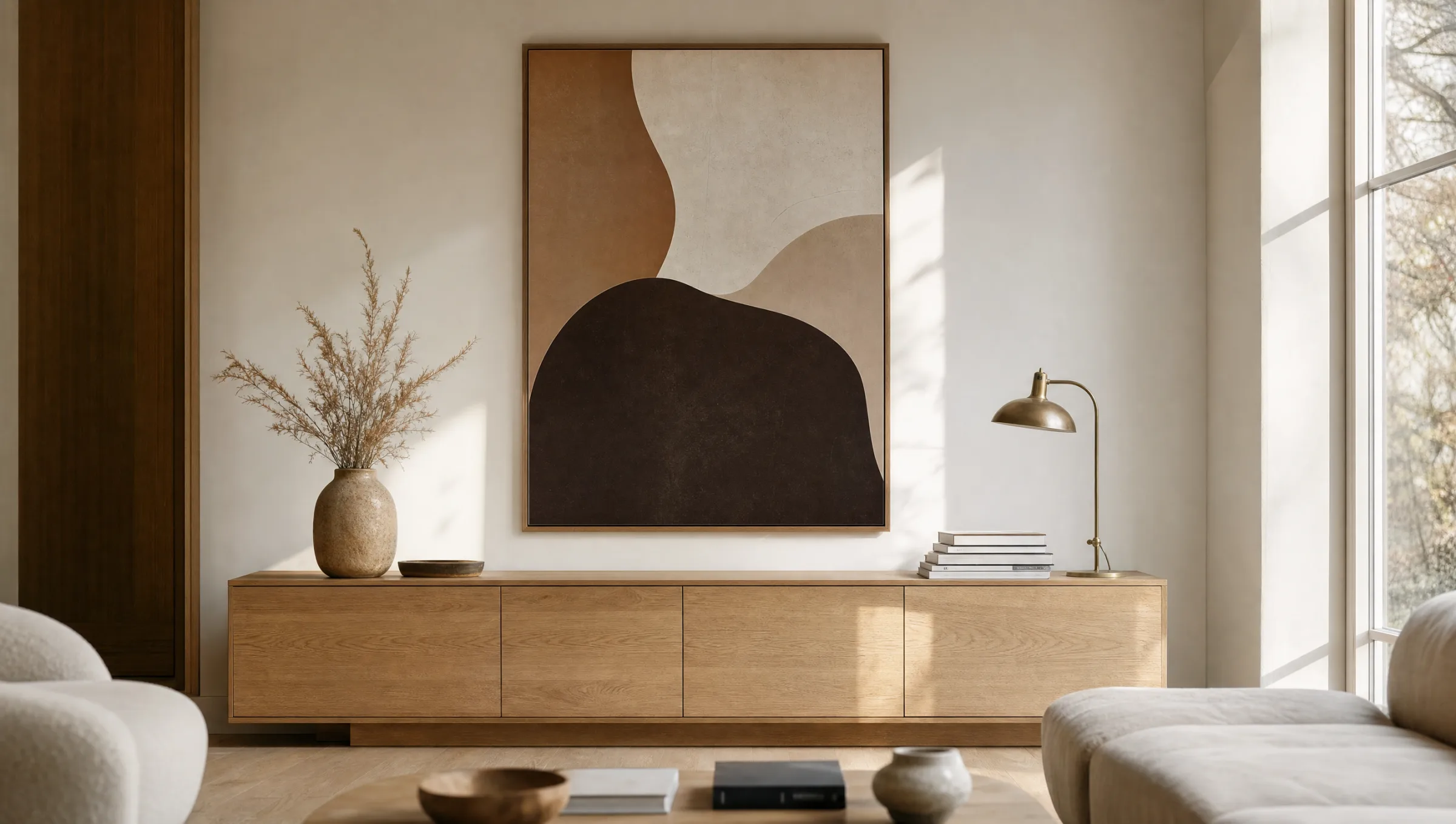
X large poster: oversized prints for walls that mean something
An x large poster shifts the hierarchy of a room: instead of several small pictures, a single oversized print takes on the role of the central wall surface. This guide covers formats, papers and compositional logic, and explains what really matters when it comes to selection, framing and hanging.
What an x large poster does for a room
Oversized prints work differently from conventional wall art. While a 30 × 40 cm print retains a decorative character and fits comfortably into a salon-style arrangement, an x large poster takes on the role of an architectural element. It defines the centre of a wall, calms restless furniture lines, and visually anchors a sofa, a bench or a sideboard back to the wall.
Unlike a gallery wall, large-format work lives by reduction. A single motif carries the entire visual load, and the surrounding furniture is allowed to recede. This approach is particularly effective in open-plan layouts where several zones overlap and a clear focal point provides orientation.
In practical terms: anyone hanging above a 220 cm sofa should plan for a print of at least 100 × 140 cm. Smaller formats look lost in such settings and throw the wall proportions off, to the detriment of the motif itself.
Formats at a glance: when is an x large poster the right choice?
The following formats have established themselves in editorial practice. They offer useful orientation, but do not replace measuring the wall and the furniture in front of it.
70 × 100 cm – entry into large format
A good step up from standard paper sizes. Works above narrower sideboards, in hallways with sufficient viewing distance, and as a standalone piece in smaller bedrooms. Still manageable to transport and available in standard frames.
100 × 140 cm – the classic XL
The most popular large format above sofas and dining tables. Offers enough surface area for calm compositions and detail-rich photography without dominating the room. Compatible with both shadow-gap frames and frameless magnetic hanging rails.
120 × 180 cm – an architectural statement
Firmly in oversized poster territory. Suited to living rooms from around 25 m², gallery hallways or tall period-building walls. Requires wall clearance so the motif reads as a composition, and calls for solid hanging hardware.
Custom sizes
For very narrow wall segments, staircases or flush built-in situations, bespoke dimensions make sense. Here the deciding factor is less the standard grid than the relationship to surrounding architecture – door frames, ceiling height and the like.
Material and print quality: what to look for in an x large poster
Large formats are more demanding to produce than small prints. Every tonal break and every slightly rough edge becomes visible at 120 × 180 cm. The choice of paper matters accordingly: from 200 g/m² upward, the sheet gains the stability needed to resist warping during transport and hanging. Matte or satin-matte surfaces are preferable to glossy ones because they do not reflect scattered light from large windows back into the viewing space.
Print resolution should reach at least 150 dpi at the actual image dimensions even when enlarged. Lower values produce a visible pixel grid as soon as viewers approach the work. Reetro uses giclée printing on FSC-certified fine art papers with a matte coating, printed to order by our production partner in the EU, preserving colour depth and tonal range throughout.
For very dark motifs, a paper with high opacity is advisable. Large-format prints are sometimes hung on walls with direct sunlight; a sufficiently dense substrate prevents the motif from showing light through from behind or the wall colour bleeding into the image.
A large format is not simply a small picture scaled up – it is a distinct design decision. It demands calm from the composition and discipline from the furniture around it.
Reetro Editorial
Framing, hanging and care
Unframed large-format prints have a lighter visual presence and reinforce the poster aesthetic. Magnetic or wooden clamp rails hold the paper flat without trimming it and can be removed easily when switching motifs. For a more gallery-like effect, shadow-gap or aluminium frames with anti-reflective glass are the appropriate choice.
For hanging, the general rule is: centre of the image at roughly 145–150 cm eye level, measured from the finished floor. Above furniture, leave at least 20–25 cm between the bottom of the print and the top of the furniture, so that print and furniture read as two distinct volumes. When an x large poster is placed above a dining table, this clearance increases to 50–60 cm to maintain comfortable headroom.
Care is straightforward: a dry microfibre cloth is all that is needed. Paper prints tolerate neither moisture nor prolonged direct sunlight. Anyone placing a large-format print on a south-facing wall should consider UV-filtering acrylic glazing to prevent colour shift over the years.
Häufige Fragen
-
01
From what size is a print considered an x large poster?
An x large poster generally refers to formats from 70 × 100 cm upward, with 100 × 140 cm and 120 × 180 cm being the most common. The boundary is not standardised, but anything above A1 (59.4 × 84.1 cm) is widely treated as XL or XXL. What matters more than the exact measurement is the effect in the room: an x large poster takes on the role of a standalone anchor within the furniture arrangement and therefore works best with considerably more wall space than a typical gallery-sized print.
-
02
What paper is best for an x large poster?
For large-format prints, a paper of at least 200 g/m² with a matte or satin-matte surface is recommended. Lighter paper is prone to warping at this scale, and glossy surfaces create unwanted reflections across large areas. FSC-certified fine art papers at 240–250 g/m² offer a good balance of stability, natural feel and colour depth. For very dark motifs or photographic work, a matte-coated paper with high opacity is particularly useful, as it prevents light showing through and reproduces fine tonal gradations cleanly.
-
03
How do I hang an x large poster securely?
For any format over one metre on its longest side, the poster should be framed or mounted on a backing to prevent warping. For unframed prints, magnetic or wooden rails that clamp the paper top and bottom distribute the weight evenly. For framed versions, a two-point fixing with wall anchors is advisable, since frames wider than 100 cm can weigh several kilograms depending on the glazing. The motif should be centred at approximately 145–150 cm eye level from the finished floor.
-
04
Which subjects work well as an x large poster?
Large formats suit calm, clearly composed subjects better than busy ones. Restrained landscapes, architectural lines, abstract colour fields and typographic work all gain presence through scale. Highly detailed photography also works at XL size, but needs sufficient viewing distance so the composition can be read as a whole. Subjects with many small elements are best avoided, as these tend to lose their visual hierarchy when enlarged.
-
05
How does an x large poster differ from a canvas print in the same format?
A poster retains the classic paper character – matte surface, fine grain – while a canvas shows a textile texture and has more physical depth in the room thanks to its stretcher frame. Paper suits graphic and photographic work requiring high detail resolution; canvas suits painterly motifs. Reetro has both printed to order by its production partner in the EU, the former on FSC papers from 200 g/m² and the latter on primed cotton fabric, so the same motif can be ordered in whichever material best fits the room and furniture.