
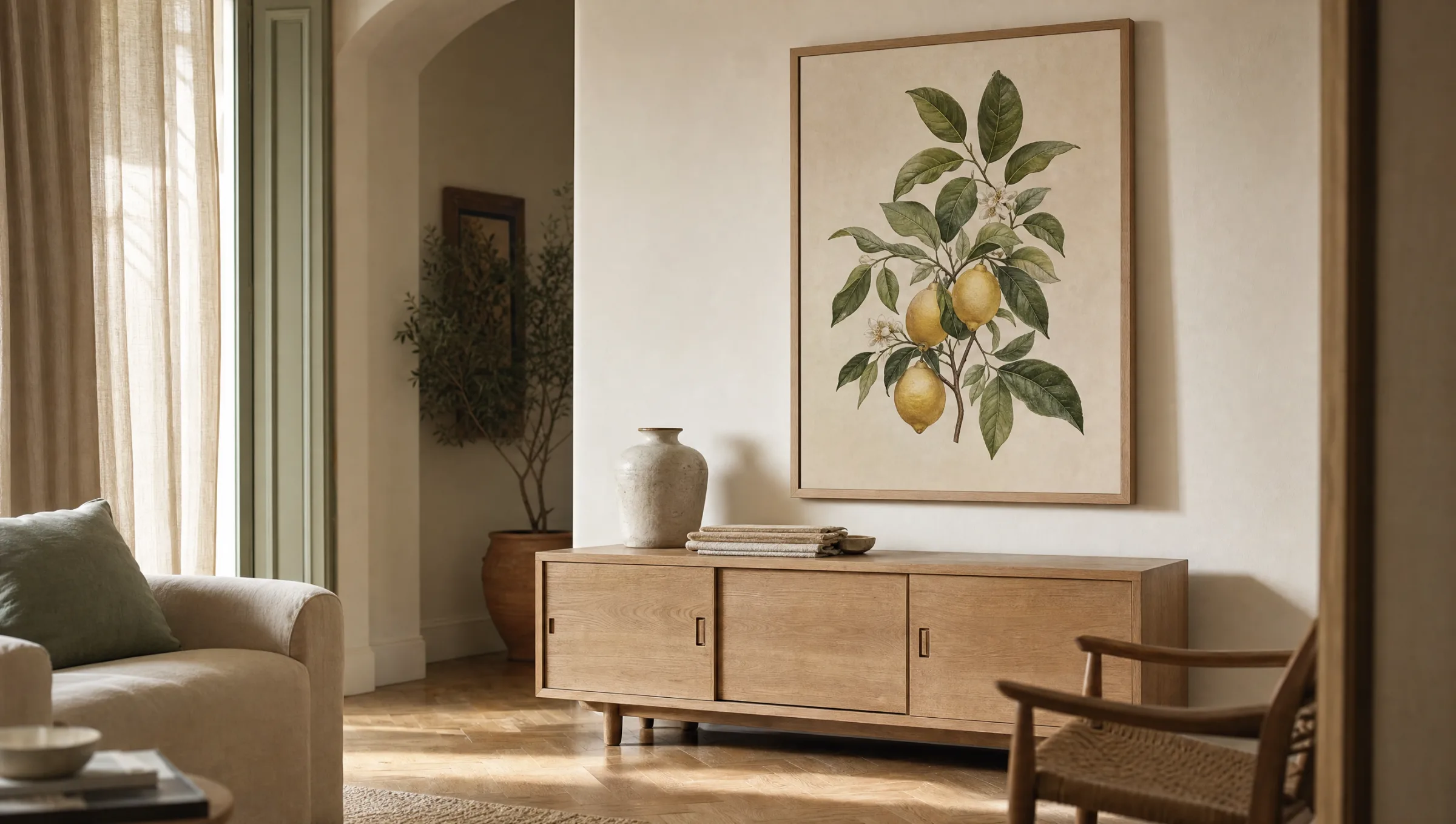
Large Lemon Tree Print – Motifs, Formats and Materials
A large lemon tree print brings a quiet Mediterranean atmosphere into a living space without the need to tend a real plant. This overview categorises the most common motif variants, compares materials, and offers guidance on hanging the artwork in different rooms.
Why a Large Lemon Tree Print Works as Wall Art
The large lemon tree print combines two deeply familiar images: the well-kept orangery of southern European gardens and the restrained botanical illustration of the 19th century. Both pictorial traditions sit quietly in a modern interior because they rely on clean contours, muted greens and selectively placed yellow accents.
Unlike small-format prints, a large-format motif takes on the role of a spatial anchor. It defines the visual axis without overloading the room, provided the format and wall area are properly matched. The motif develops its calm effect most fully in bright rooms with reduced furnishings.
The colour palette is also highly versatile: olive green, sandy beige, terracotta and off-white combine without difficulty, as do warm wood tones and undyed natural textiles.
Motif Variants: Large Lemon Tree Print at a Glance
The visual language of a motif significantly changes its effect. The following four variants cover the most common preferences and can be selected according to room and interior style.
Botanical Illustration
A precise drawing of leaf, fruit and blossom against a neutral background. Looks composed and objective; suits dining rooms, kitchens and studies, and harmonises with classic furniture.
Mediterranean Photography
A photograph of an actual tree in front of a stone wall, pergola or terracotta pot. Conveys a summery atmosphere and suits modern, brightly furnished living spaces.
Watercolour and Ink Drawing
Loose brushwork, visible pigment edges, a restrained colour palette. Well suited to bedrooms and reading corners where a softer motif is desired.
Still Life with Fruit
A close-up detail of a branch, leaves and individual lemons, often in the tradition of Dutch painting. Works quietly and with focus in dining rooms and open-plan kitchen-living spaces.
Format and Hanging: Placing a Large Lemon Tree Print Correctly
For a motif like a large lemon tree print, portrait formats from 70 × 100 cm are recommended; in larger rooms 100 × 150 cm is equally suitable. Portrait orientations emphasise the vertical growth form of the tree and look particularly balanced above sideboards, armchairs or console tables.
The lower edge of the artwork should sit roughly 20 to 30 cm above the top of the furniture beneath it, creating a visual connection without the motif bearing down on the piece below. For freestanding walls, the general guideline is to position the centre of the artwork at around 145 cm from the floor.
Several prints hung side by side only work when the subjects are thematically related — for instance a lemon tree paired with an olive branch or a Mediterranean landscape. Identical frame colours and uniform mount widths keep the arrangement calm and cohesive.
A large-format lemon tree print is not a decorative object but a quiet spatial axis — it works best where the wall around it is allowed to breathe.
Reetro Editorial
Materials Compared
On matte FSC-certified paper from 200 g/m², botanical illustrations and watercolours look particularly authentic because the paper texture supports the visual language. Reflections are avoided, which improves the legibility of fine lines. All papers and canvases at Reetro are printed to order by a production partner in the EU to consistent quality standards.
Premium canvas on a stretcher frame suits photographic motifs and still lifes. The subtle texture of the fabric adds depth to the image and removes any purely digital feel. For rooms with higher humidity — such as open-plan kitchen-living spaces — aluminium panels are a low-maintenance alternative.
When choosing a material, the lighting situation is worth considering: strongly lit south-facing walls call for matte surfaces, while quieter north-facing walls also allow lightly satin-finished prints.
Care and Longevity
High-quality prints are designed for colour stability but should not be exposed to prolonged direct sunlight. A position to the side of a window noticeably extends the brilliance of the artwork over time.
For cleaning, a dry microfibre cloth is sufficient; canvas and aluminium surfaces can be wiped carefully in one direction. Cleaning agents are not necessary and may damage the coating.
Häufige Fragen
-
01
What format is suitable for a large lemon tree print as wall art?
For a large lemon tree print, portrait formats from 70 × 100 cm are recommended. In generous living rooms, hallways or stairwells, 100 × 150 cm or XXL formats up to 120 × 180 cm also work well. The key factor is the ratio to the available wall area: the artwork should occupy roughly two thirds of the free wall width above any furniture beneath it. If the wall is quite narrow, two medium-sized prints hung side by side often look calmer than a single oversized motif.
-
02
Which interior style suits a large lemon tree print?
The motif adapts well to a wide range of styles. Botanical illustrations feel classic and suit period properties, farmhouse interiors or Scandinavian-minimal spaces. Photographic versions support modern, minimalist interiors. Watercolours work well in softer, more romantic settings with linen and natural wood. Colour coordination is important: olive green, sandy beige and terracotta in furniture or textiles echo the tones within the artwork and create an overall sense of calm.
-
03
Is the motif also suitable for a kitchen or dining room?
Yes. In dining rooms and open-plan kitchen-living spaces, a citrus motif is thematically particularly fitting. In rooms with higher humidity or the risk of splashing, an aluminium wall panel is preferable to a classic paper print, as the surface is more resistant. A print should not hang directly above the hob or sink; a position on the end wall of a dining table or above a sideboard is more practical and visually considered.
-
04
Which frame colour is recommended for a large lemon tree print?
Narrow frames in natural oak, matt black or warm white are understated and do not compete with the motif. For botanical illustrations, a light wood frame with a white mount looks especially calm. For photographic motifs, a black frame can enhance the contrasts. Gold or heavily ornate mouldings tend to compete with the subject and are generally not recommended.
-
05
How does canvas differ from a poster print?
Poster prints on matte fine-art paper render fine lines and subtle colour gradients with great precision — ideal for illustrations and watercolours. Canvas adds depth to photographic motifs through its woven texture and feels more physically present in the room. On large formats, the canvas texture also reduces light reflections. At Reetro, both paper and canvas variants are printed to order by a production partner in the EU on FSC-certified materials, making it straightforward to compare the two and choose based on the specific room and lighting situation.