
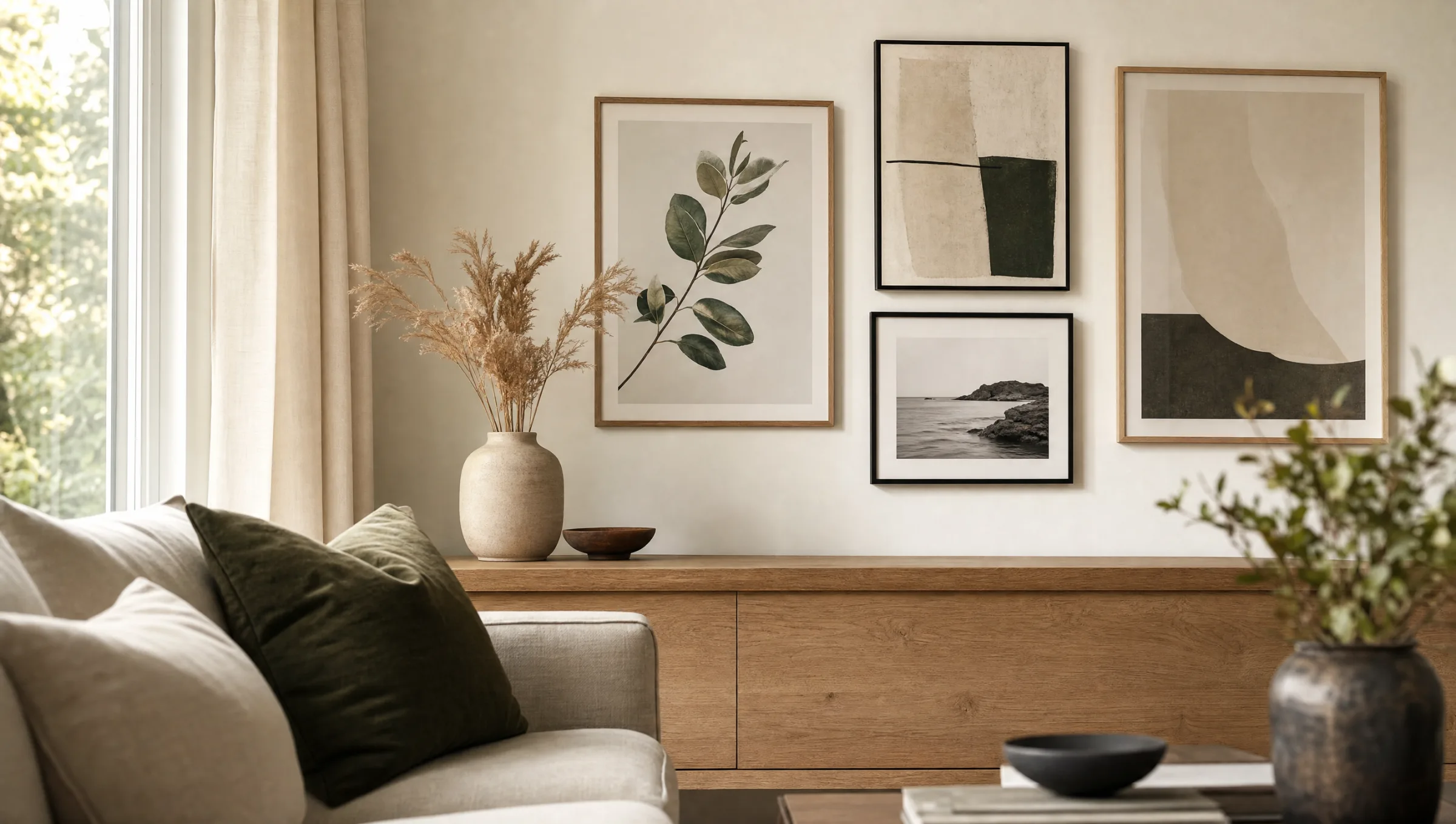
Art Prints: An Editorial Guide to Styles, Materials and Selection
Anyone who has looked into wall design quickly encounters a broad range of styles, motifs and printing techniques. This overview maps the most important aspects of art prints for the home — from classical movements and material questions to choosing the right format for a given space.
What Art Prints Can Do in a Living Space
Art prints, in the broadest sense, represent a visual engagement with motifs, colour and composition — translated into a format you can hang on a wall. In the home, they serve several functions at once: they structure walls, create visual anchor points, and give rooms a recognisable character without requiring any structural changes.
Unlike purely decorative wall objects, prints always carry a layer of meaning as well. A botanical still life from the nineteenth century speaks of scientific precision; an abstract colour field from post-war modernism speaks of reduction and surface. These contexts remain legible even in reproduction and shape the atmosphere of a room in lasting ways.
When choosing, it therefore pays to look beyond the motif itself: which era, which mood, which colour register fits the existing furniture? Answering these questions leads to decisions that hold up over years, not just seasons.
Styles in Art Prints
Four stylistic categories that are particularly sought after in contemporary wall design — with brief notes on their character and effect in a room.
Classical Modernism
Works by Klimt, Schiele or Hammershøi define this category. Restrained colour palettes, clear lines and a measured visual language make them a long-lasting choice for living rooms and home offices alike.
Botanical Illustration
Historic plates from botanical publications combine scientific precision with decorative quality. Hung in a series they read as particularly calm, and suit light, nature-oriented interiors well.
Abstract Composition
Colour fields, geometric forms and gestural lines take centre stage. Works of this kind set clear accents and function well as a single statement piece above a sofa or sideboard.
Photography as an Art Print
Landscape, architectural or still-life photography complements classical painting. Black-and-white works read as especially timeless and combine readily with painted motifs.
Materials and Print Quality in Art Prints
The impact of an art print depends substantially on its substrate. Matte fine-art paper from 200 g/m² upwards renders colours with depth and quiet presence, without distracting reflections. It suits classical painting, watercolours and botanical motifs especially well, because the surface closely mirrors the character of the originals.
Canvas introduces a spatial quality through its texture and emphasises gestural brushwork. For large-format abstract pieces it is a sensible choice. Hexagon aluminium, by contrast, delivers a fine, precise print on a smooth, lightly lustrous surface and suits photographic motifs and graphic compositions well.
Anyone who wants art prints to stay on the wall for years should pay attention to pigment lightfastness and FSC-certified papers. Both extend longevity significantly and have become standard in the premium segment. Reetro's prints are printed to order by our production partner in the EU on FSC-certified papers with matte coatings and pigment inks throughout.
An art print is not decoration you pass by — it is a decision you live with every day. Material and motif deserve equal care in the choosing.
Reetro Editorial
Formats and Hanging Arrangements for Art Prints
Format and arrangement both determine how a motif reads in a room. Above a three-seat sofa, a single work ideally spans around two-thirds of the sofa's width. With a salon-style grouping of several smaller pieces, it helps to define a notional central axis and keep gaps of roughly five to eight centimetres between frames.
XXL formats from 100 × 140 cm come into their own on large, relatively bare wall surfaces — a stairwell, for instance, or above a low sideboard. Smaller formats up to 50 × 70 cm suit gallery walls, hallways and studies, where the eye naturally moves closer to the wall.
Curating Art Prints Rather Than Collecting at Random
A curated selection differs from spontaneous collecting by virtue of a connecting thread — an era, a colour family, a recurring motif or a consistent print technique. Such a common element ensures that even varied works enter into dialogue with each other, rather than competing side by side.
Reetro works according to exactly this principle in its editions: styles are grouped thematically, materials are coordinated, formats offered consistently. Individual works can therefore be added over the years without losing the original line of the arrangement.
Häufige Fragen
-
01
How do art prints differ from ordinary wall decoration?
Art prints originate from works with an artistic source — a painting, an illustration or a work of fine-art photography. They carry a layer of meaning and visual language that goes beyond purely decorative intent. Ordinary wall decoration, by contrast, is designed primarily for ornamental effect, often without a clear artistic or historical context. The difference shows most clearly in lasting impact: an art print remains legible over time because it refers back to an original and its inherent visual logic.
-
02
Which material works best for art prints in a living room?
For classical painting, watercolours and botanical motifs, matte fine-art paper from 200 g/m² upwards is a calm, long-lasting choice. Canvas suits large-format, gestural works and brings out texture. Aluminium prints — such as the hexagon format — come into their own with photographic or graphic motifs. Which material fits best depends on the motif, the light conditions and the style of the room. When in doubt, matte paper in a simple frame is the most versatile solution.
-
03
How large should a picture above the sofa be?
A useful rule of thumb: the picture or group of pictures should cover roughly two-thirds of the sofa's width. For a sofa 220 cm wide, that means a work around 140 to 150 cm across. The lower edge of the frame ideally sits 15 to 25 cm above the backrest, so a visual connection forms between the furniture and the wall. When hanging several smaller works together, it is the total area of the group that counts, not each individual piece.
-
04
Can different styles of art prints be combined in one arrangement?
Yes, provided a connecting element exists. This might be a shared colour palette, a consistent frame style, or a recurring thematic thread such as nature, architecture or portraiture. Mixing periods also works when the colour worlds are compatible. Things become harder when very different visual languages hang side by side without any common thread — the wall quickly reads as restless. A calm, unified framing often reliably reconciles stylistic differences.
-
05
How should art prints be cared for over time?
Direct sunlight should be avoided, as it gradually fades even lightfast pigments. Art prints should not hang in rooms with persistently high humidity — directly above a dining table in an open kitchen without extraction, for example. Dust can be removed with a dry, soft cloth; for glazed frames a slightly damp microfibre cloth is sufficient. Choosing high-quality prints, particularly those printed to order by our production partner in the EU on certified papers with pigment inks, generally means many years of unchanged colour intensity.
-
06
What standards does Reetro apply to its art prints?
Reetro prints to order through its production partner in the EU on FSC-certified papers from 200 g/m² with matte coatings, using lightfast pigment inks throughout. Canvases are stretched over stable wooden stretcher bars; aluminium wall prints are produced by direct printing. Motif selection follows an editorial approach — curated by style, period and colour register — rather than a marketplace-volume logic. This means individual works can be added deliberately over time without the overall visual language of a wall being lost.