
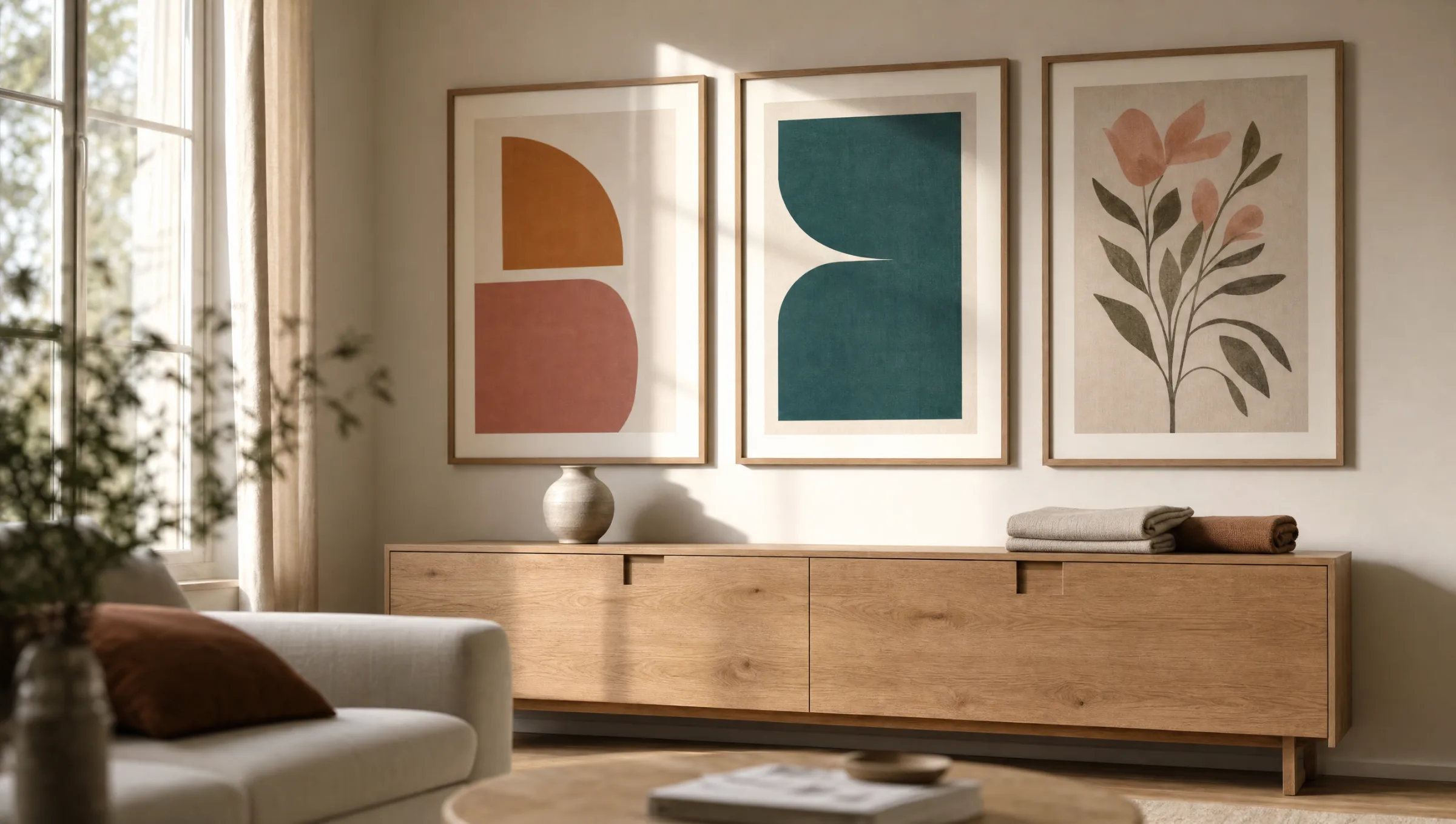
Colourful Modern Art Print – Colour with Purpose on Your Wall
Choosing a colourful modern art print is not a matter of chance — it is a deliberate decision to bring colour with genuine design intent into a room. Whether as a single statement format or as part of a gallery wall, vivid motifs combine expressive quality with contemporary aesthetics and set clear visual accents in any space.
Why a colourful modern art print does more than decorate
Colour fundamentally changes the way a room is perceived. A large-format print with saturated tones — a strong ochre placed beside a muted teal, for instance — creates a visual weighting that recalibrates how furniture and surfaces read in the space. The motif takes on the role of a quiet anchor rather than a loud focal point.
Modern colour compositions are rarely accidental. Many contemporary graphic artists and illustrators work with defined palettes that consciously control contrast ratios, saturation levels and tonal weight. The result is a visual language that reads differently up close than from three metres away — and that quality is precisely what makes a colourful modern art print well suited to living spaces.
When selecting a print, it helps to look at the overall mood of the motif in relation to the available room light rather than evaluating individual colour tones in isolation. North-facing rooms with diffused light benefit from warm yellows and rust reds, while sun-drenched rooms can absorb cooler blues and greens without feeling cold.
Formats for your colourful modern art print at a glance
Reetro offers vivid motifs across a range of substrates. Each format suits different wall situations and room sizes.
Premium poster on FSC paper
Printed on matte papers from 200 g/m², posters deliver consistent colour reproduction without distracting reflections. Ideal for living rooms and home offices, in formats from A3 to XXL.
Canvas print
Canvas gives colour-block areas a subtle texture that adds depth to the motif. The material feels warmer than paper and integrates naturally into timber-rich interiors.
Hexagon aluminium wall print
For rooms with a clean, reduced design language: the hexagon format in brushed aluminium combines the colour intensity of digital printing with a matte metal surface.
XXL format as a room anchor
From 100 × 140 cm, motifs develop a room-structuring effect. Particularly colour-dense compositions work well as a visual endpoint behind a sofa or bed.
Colour choice and room context: what works together
The common advice that a wall piece should simply pick up a colour already present in the room falls short. A more effective approach is deliberate contrast: a motif that introduces a tone currently absent from the room can complete a colour palette and give the overall picture more tension.
Neutral walls — white, beige, light grey — are not an obstacle for colour-intensive prints but rather their most natural stage. The motif gets the room it needs without competing with existing wall colours. If you already have coloured walls, choose prints within the same colour temperature: warm wall tones pair with warm prints, cool walls with cool palettes.
Print size affects how powerfully colour registers. A small, intensely coloured motif remains an accent; the same image in XXL takes over the room. If you are uncertain about intensity, start with a medium format and build the gallery wall gradually.
Colour on a wall does not need to be loud. It only needs clarity — in the composition, in the print, and in the decision about where it hangs.
Reetro Editorial
Care and hanging: keeping your colourful modern art print long-lasting
Posters on fine art paper are sensitive to light. UV-filtered glass or framing behind anti-reflective acrylic significantly slows fading, especially under direct sunlight. Canvas prints are somewhat more robust but equally benefit from indirect lighting.
For cleaning, a dry, lint-free microfibre cloth is sufficient. Moisture — even a slightly damp cloth — can cause wavering in matte paper prints and should be avoided. Aluminium wall prints, by contrast, can be wiped down with a lightly dampened cloth without any concern.
For unframed paper posters, a sturdy clip passepartout or a simple metal clip frame is recommended. This keeps the paper flat and prevents edge curl, which, while less pronounced on heavier paper weights, can still occur over time.
Creating a gallery wall with colourful modern art prints
A gallery wall made up of several colourful modern art prints requires an overarching organising principle. This might be a shared colour temperature, a common stylistic trait — such as reduced geometry or botanical elements — or a consistent format that brings calm to the overall composition.
A reliable method is to lay the motifs out on the floor first and test the spacing before a single nail is driven. A gap of 4 to 6 cm between frames looks considered without feeling rigid. When combining different formats, place the largest print slightly left or right of the central axis to serve as a visual anchor.
In terms of colour, a gallery wall can consist of motifs that echo one another: a blue tone in the left-hand print reappears as an accent in the right. This subtle repetition creates cohesion without making the wall feel uniform.
Häufige Fragen
-
01
What sets a colourful modern art print apart from an ordinary colour poster?
A colourful modern art print follows a design logic: colour selection, composition and saturation are calibrated against each other rather than chosen at random. Contemporary graphic artists and illustrators define palettes that work in printed form — not only on screen. An ordinary colour poster can feature vivid imagery without that imagery doing anything meaningful in a room. The difference lies in the intention behind the motif and the print quality that communicates that intention faithfully.
-
02
Which format suits a colourful modern art print best in a living room?
That depends on the available wall area. As a general rule, a single motif above a sofa should span at least two-thirds of the sofa's width — typically 80 to 120 cm wide. If you are planning a gallery wall, smaller formats from 40 × 50 cm can be combined effectively. For maximum room impact, XXL prints from 100 × 140 cm deliver colour depth that reads well even from a distance.
-
03
How do I combine a colourful modern art print with my existing interior?
The easiest way in is through colour temperature. Warm rooms featuring timber tones, terracotta or brass suit warm prints in ochre, red and yellow. Cooler rooms with grey, white and metal finishes harmonise with teal, slate blue or mint. If you want tension rather than repetition, choose a deliberate complementary tone — a blue-green print in a predominantly warm room sets a fresh, calm counterpoint without clashing.
-
04
Do colourful art prints fade quickly?
This depends primarily on light exposure and the paper used. Pigment inks on high-quality fine art papers are significantly more lightfast than inexpensive colour laser prints. Direct sunlight accelerates fading; UV-protective glass or acrylic in the frame substantially reduces this effect. Canvas prints are somewhat more resistant due to their coating. As a general principle, indirect or diffused light extends the vibrancy of any print over time.
-
05
Can a colourful modern art print work in a smaller room?
Yes — in a small room a single, well-chosen colourful modern art print often has more impact than several smaller pictures. The key is not to oversize the format: in a narrow hallway or a compact home office, 40 × 60 cm or 50 × 70 cm is sufficient to introduce a strong colour accent without overwhelming the space. Motifs with generous white space or a quiet background work particularly well because they give the eye room to breathe.
-
06
What should I look for when buying a high-quality colourful art print?
The critical factors are the substrate (at least 200 g/m² fine art paper or a primed canvas), the inks used (pigment rather than dye for longevity) and where the print is made. All Reetro prints are printed to order by our production partner in the EU on FSC-certified papers with a matte coating that minimises reflections and reproduces colour evenly — without overproduction, since every print is made to order after purchase.