
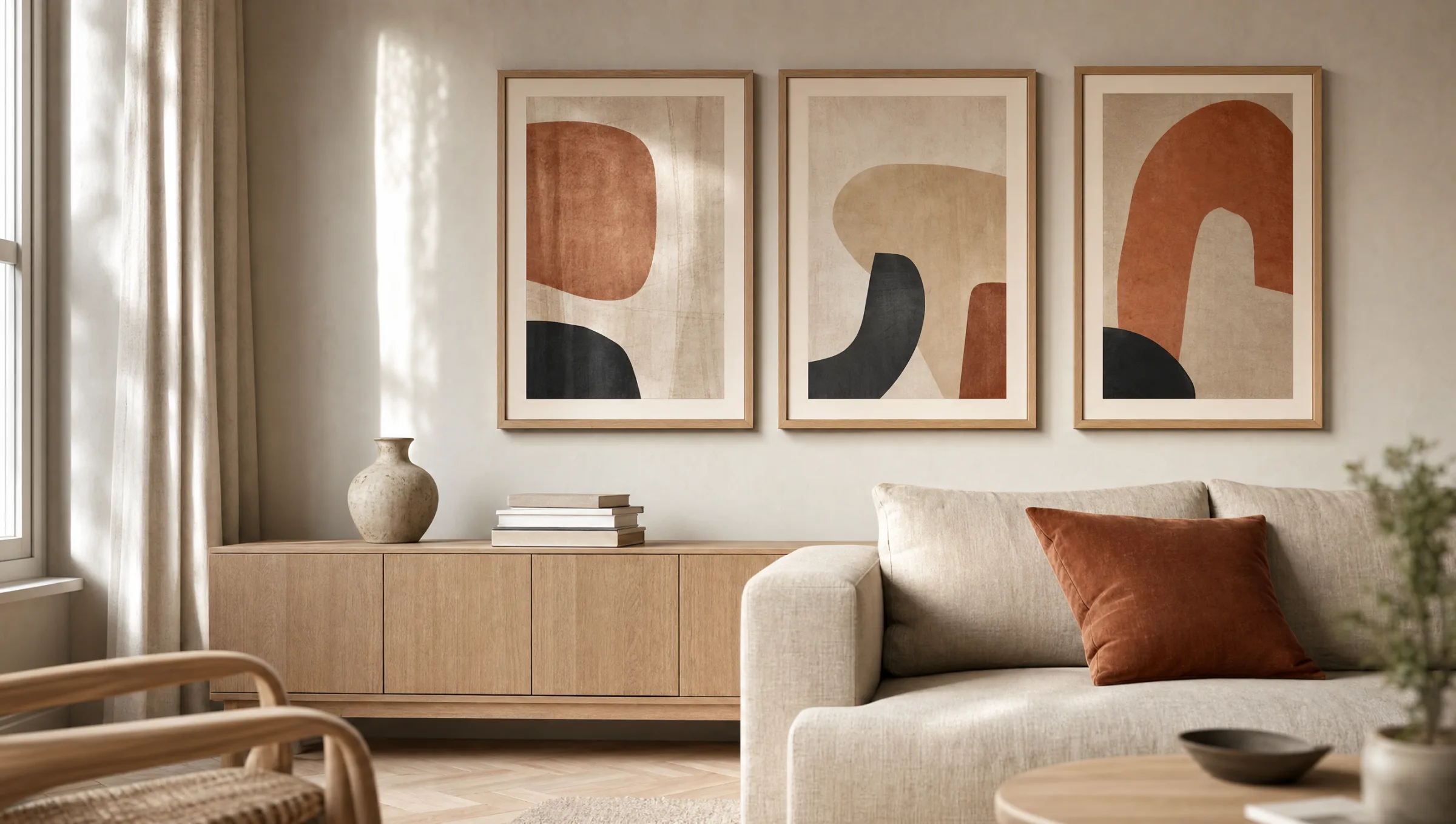
Modern Art Prints for Contemporary Wall Design
Modern art prints unite graphic clarity with a contemporary visual language. Whether abstract composition, reduced line work or photographic subject: the right choice depends on the room, its light conditions and the effect you want to achieve. This overview sets out styles, formats and materials in an editorial context.
What Defines Modern Art Prints Today
Modern art prints are typically produced in limited runs or as curated open editions. They differ from classic reproductions of old masters in their visual language: reduced forms, clean colour fields, photographic abstraction or graphic typography. The spectrum runs from Bauhaus-influenced work through Scandinavian minimalism to contemporary mixed-media pieces.
Technically, pigment printing on fine-art papers now dominates. It delivers stable colours over decades, provided direct sunlight is avoided. Print quality shows itself most clearly in halftone transitions, neutral grey values and the depth of black areas — criteria that a print reveals quickly when compared side by side.
In terms of content, modern art prints follow less a fixed canon than an editorial selection. Galleries, publishers and curated brands organise their ranges by style, colour palette or subject matter, making them usable in living spaces without tipping into generic decoration.
Styles of Modern Art Prints at a Glance
The following four directions cover the majority of contemporary wall art assortments and combine well with a range of interior styles.
Abstract Painting
Colour fields, gestural marks and textures without a figurative subject. Well suited to calm walls where a single large format is intended to anchor the space visually.
Line Art & Minimalism
Reduced linework, often figure or botanical motifs in black on white. Quiet in character, it pairs naturally with Scandinavian-influenced interiors featuring wood and muted tones.
Photographic Prints
Landscape, architecture or still life with a clear compositional intent. Works well in medium formats and in groupings of two or three related subjects.
Typography & Graphic Art
Quotes, poster art and geometric compositions. They bring rhythm to hallways, home offices or kitchens, where images are perceived more in passing than in focused contemplation.
Formats and Hanging: How Modern Art Prints Work in a Room
Format and hanging position both determine whether a print reads well in a space. A useful rule of thumb: above a sofa or sideboard, the image should occupy roughly two thirds of the furniture's width. Individual XXL formats from 70 × 100 cm carry large walls confidently, while smaller prints come into their own in grouped arrangements.
The centre of the image is classically placed at around 145 to 150 cm from the floor. In living rooms with low furniture it can sit slightly lower, so the image remains comfortably in the field of view when seated. For salon-style arrangements, the overall composition matters more than strict symmetry — a good eye and a layout drafted on the floor beforehand both help considerably.
For modern art prints, narrow frames in natural oak, black or aluminium work well. A mount gives the subject additional breathing room, though it is not essential. Frameless solutions such as dibond aluminium composite panels or canvas prints feel more contemporary and require no glass.
A good wall piece does not demand attention — it creates it for the room in which it hangs.
Reetro Editorial
Materials and Print Quality for Modern Art Prints
The choice of paper shapes the character of a print significantly. Matte fine-art papers from 200 g/m² upwards with a slight texture have a painterly quality and absorb reflections — ideal for abstract and photographic subjects in bright rooms. Semi-matte surfaces increase colour depth and suit high-contrast imagery.
Canvas introduces a tactile element and works well with large-format compositions. Aluminium composite panels, including geometric formats, are an option for minimalist interiors where a traditional frame would feel too heavy. Across all substrates, lightfast pigment inks and accurately calibrated colour profiles are the fundamental requirement for durable results.
Those who prioritise sustainability should check paper origin, certifications such as FSC and the production location. Prints printed to order close to the customer — as offered by Reetro in the EU and the US — keep transport distances and allow shorter delivery times without compromising quality control.
Combining and Curating Modern Art Prints
A cohesive wall arrangement rarely comes together by chance. A shared reference point helps: a common colour palette, a thematic thread or a consistent style concept such as minimalism or mid-century. Three to five prints are usually sufficient to give a wall structure without overcrowding it.
When mixing subjects, a ratio of roughly two to one tends to work well: two quieter pieces alongside one stronger focal point. This keeps the composition legible. Repeated frame colours or consistent formats act as a unifying element without making the overall arrangement feel uniform.
Häufige Fragen
-
01
What are modern art prints?
Modern art prints are high-quality reproductions or originally designed print works in a contemporary visual language. They encompass abstract painting, line art, photography and typographic work. Unlike classic reproductions of old masters, they favour reduced forms, clean colour fields and current subject matter. They are most commonly produced using pigment printing on fine-art papers from 200 g/m² upwards, or on canvas and aluminium composite substrates.
-
02
What formats are suitable for modern art prints?
Above sofas and sideboards, larger formats from 50 × 70 cm through to XXL sizes of 70 × 100 cm or beyond work well. For gallery walls and hallways, smaller formats between 30 × 40 cm and 50 × 70 cm are well suited, particularly in groups of three or five. The centre of the image is classically positioned at around 145 to 150 cm from the floor. The format should occupy approximately two thirds of the width of any furniture below it, so that the proportions feel balanced.
-
03
How do I care for modern art prints properly?
Prints should not hang in direct sunlight, as even lightfast pigment inks can fade over the years with sustained exposure. High humidity — in a bathroom without adequate ventilation, for instance — is also inadvisable. For framed works, dry dusting of the frame and glass is sufficient. Canvas prints can be treated with a soft, dry cloth. Aluminium composite panels may be wiped carefully with a slightly damp cloth. Direct contact with the printed surface should always be avoided.
-
04
Which frames suit modern art prints?
Narrow frames have a contemporary feel and keep the focus on the subject. Natural oak suits warm, Scandinavian-inspired rooms; black brings graphic definition; aluminium or white works well in minimalist interiors. A mount gives smaller prints additional visual breathing room. Those who prefer a frameless look can opt for dibond aluminium composite panels or canvas — both need no glass and reduce reflections on well-lit walls.
-
05
How do I combine several modern art prints on one wall?
A shared reference point makes the process easier: a common colour palette, a thematic connection or a consistent style concept. Three to five works are usually enough to structure a wall well. A ratio of two quieter modern art prints to one stronger focal piece has proven effective. Matching frame colours or identical formats provide a unifying element. Before drilling, it is worth laying the arrangement out on the floor or testing positions with paper templates on the wall.
-
06
How can I tell whether modern art prints are high quality?
Key quality markers include calibrated pigment printing, FSC-certified fine-art papers from 200 g/m² with a matte or semi-matte coating, clean cut edges and neutral grey tones free of colour cast. The production location is also informative: modern art prints printed to order close to the customer, such as those offered by Reetro in the EU and the US, keep supply chains short and consistent quality control. A curated selection — rather than an anonymous mass catalogue — also points to editorial care in both subject choice and reproduction.