Portrait Format Art Prints: Structuring Spaces with Vertical Imagery
Portrait format art prints follow their own logic: they guide the eye upward, extend walls visually, and bring order to narrow surfaces. Used with intention, the vertical format can give rooms a clearer structure without overcrowding them. This overview covers formats, motifs, and hanging considerations from an editorial perspective.
Why Portrait Format Art Prints Work Differently
The portrait format mirrors the way we perceive upright objects: trees, doorways, figures. Portrait format art prints activate this vertical reading, drawing the eye naturally from bottom to top or top to bottom. The result is a directed tension that landscape-oriented images simply do not produce.
In terms of spatial effect, this translates into a visual stretching. A low ceiling appears taller; a narrow hallway feels less confined. In period properties with high walls, or in modern rooms with unused vertical space, this effect can be applied deliberately — without moving a single piece of furniture.
There are also differences in how subjects are read. Portraits, botanical studies, architectural details, and abstract colour gradients often feel more composed in portrait format because they are not spread panoramically across the picture plane — they retain a concentrated central axis.
Common Formats and Aspect Ratios
Not every portrait format suits every wall. The following aspect ratios have proven practical in art print production and cover most interior situations.
2:3 (e.g. 50 × 70 cm)
The classic poster format. Well balanced, neutral in effect, and compatible with most standard frames. Well suited to photography, illustration, and understated motifs.
3:4 (e.g. 30 × 40 cm)
Slightly more compact and closer to a square impression. Has a classic feel reminiscent of book pages, and works particularly well above sideboards or grouped with other prints.
1:2 Narrow (e.g. 50 × 100 cm)
A distinctly slim portrait format. It suits staircases, wall strips beside doors, or as a graphic accent placed between pieces of furniture.
XXL 70 × 100 cm and larger
Large-format prints take on the role of a solo statement. They replace picture groupings and work best when the surrounding wall remains largely empty.
Choosing Motifs for Portrait Format Art Prints
Which subjects work well depends less on genre than on the internal composition. Portrait format art prints benefit from a clear vertical axis: a tree trunk, a spine running through the composition, a flow of light from top to bottom. Landscape motifs forced into portrait format tend to appear cropped and restless.
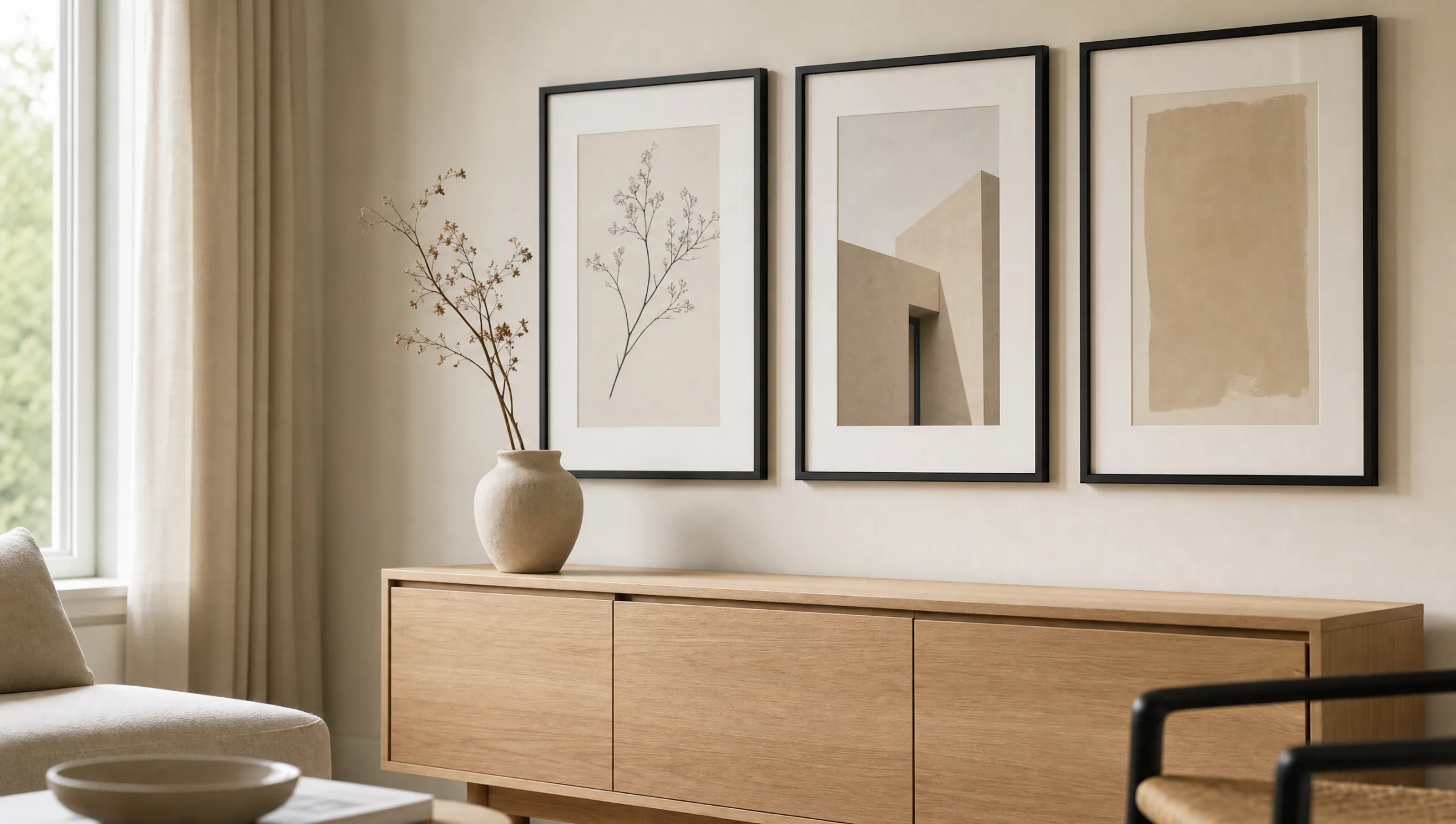
Good fits include botanical prints, architectural photographs of individual façades, line and ink drawings, classical portraits, and minimalist colour fields with a horizontal division. Still lifes that show a table edge or a base plane also sit comfortably within the vertical.
With abstract motifs, it is worth examining the distribution of visual weight. When the heaviest element sits in the lower third, the image feels grounded. When it sits at the top, there is a sense of lightness — sometimes even weightlessness. Both can be intentional, but each should suit the wall it is placed on.
A portrait format organises a wall; a landscape format tells a story. The decision is not made by the motif but by the axis of the room.
Reetro Editorial
Hanging and Arranging Vertical Prints
The centre of a single portrait format print should ideally sit at eye level for a standing person — roughly 145 to 150 centimetres from the floor. Above sofas and sideboards, this value shifts downward so that the image relates visually to the seated position rather than floating above the furniture.
Multiple portrait format art prints arrange well in rows. A consistent gap of five to eight centimetres reads as calm; wider gaps introduce a gallery-like quality. When mixing sizes, at least one shared reference line — typically the top edge or the centreline — should be maintained so that the arrangement holds together.
When combined with landscape-format prints, the portrait piece often serves as an endpoint: closing a row, or marking a transition — beside a door, for instance, or at the end of a seating group.
Material, Framing, and Light Conditions
Matte paper from 200 g/m² upward reduces reflections and supports the calm quality that defines portrait format art prints. Glossy surfaces can catch more glare on vertical prints because the light source — a window or ceiling fixture — typically enters from above and travels across the full height of the image.
In terms of framing, a slim moulding carries the vertical line without interrupting it. Wider frames reinforce the format further and work well for large solo pieces. A passepartout of three to five centimetres gives the motif breathing room and is especially worthwhile for photography and drawings.
Printing on canvas or aluminium removes glass entirely, eliminating reflections altogether. For portrait format art prints in light-filled rooms, this is often the quieter solution. Reetro prints are printed to order by our production partner in the EU on FSC-certified papers with matte coatings and colour-stable pigments, so the image retains its depth for years.
Häufige Fragen
-
01
What aspect ratio is most common for portrait format art prints?
The most widely used ratio is 2:3, available in sizes such as 30 × 45 cm, 40 × 60 cm, or 50 × 70 cm. It is considered well balanced, compatible with most standard frames, and equally suited to photography, illustration, and graphic motifs. The 3:4 ratio feels slightly more compact, while 1:2 is noticeably slimmer. Which ratio works best ultimately depends on the available wall area and the subject: narrow wall strips suit a long 1:2 format, while broader surfaces read more calmly in 2:3 or 3:4.
-
02
At what height should portrait format art prints be hung?
The general rule is to position the centre of the print at approximately 145 to 150 centimetres from the floor — roughly eye level for a standing person. Above sofas, sideboards, or beds, this value shifts downward so that the print relates visually to the furniture below it. A gap of 20 to 30 centimetres between the top of the furniture and the bottom of the print has proved practical. For very large portrait format pieces of 70 × 100 cm or more, placing the centre slightly lower can prevent the composition from feeling overbearing.
-
03
Are portrait format art prints suitable for small rooms?
Yes — often especially so. Portrait format art prints stretch the wall visually upward, making low or narrow rooms feel taller. In small hallways, stairwells, or compact bathrooms, a single vertical print is frequently more effective than a group of pictures, because it structures the wall without fragmenting it. The key is a restrained frame and a motif with a clear vertical axis, so that the elongating effect is not undermined by a busy composition.
-
04
Can portrait and landscape format prints be combined?
This works well as long as a shared organising line remains visible. In practice, that means either aligning the tops or bottoms of the prints flush, or keeping their horizontal centrelines at the same height. In mixed arrangements, portrait format art prints often act as endpoints or accents, while landscape pieces anchor the centre. A random mix of different sizes and axes without any shared reference tends to make the wall feel unsettled.
-
05
Which material is best suited to portrait format art prints?
Matte FSC-certified paper from 200 g/m² upward is a calm choice, as it minimises reflections and avoids the glare that can travel across the full height of a vertical image. For large solo pieces, premium canvas or aluminium are worth considering — both are frameless options that remain reflection-free even with angled light. Reetro's portrait format art prints are printed to order by our production partner in the EU with matte coatings and colour-stable pigments, ensuring the image retains its depth over the years.