Portrait Format Prints: Effect, Sizes and Hanging at a Glance
Portrait format prints belong to one of the oldest pictorial traditions there is — from devotional panels to modern fashion photography. In interiors they draw the eye upward, give walls structure, and tend to feel calmer than wide landscape formats. This editorial overview covers sizes, motifs and hanging guidelines in a straightforward, practical way.
Why Portrait Format Prints Change a Room
Portrait format prints follow the eye's natural reading movement from top to bottom. They pull the gaze into the vertical, making ceilings feel higher and rooms more upright. In period apartments with classical proportions, or in narrow hallways, they bring an ordering quality that a horizontal format rarely achieves.
Where landscape orientation evokes breadth and open scenery, portrait format emphasises the figure, the face and the single object. This formal concentration is one reason why fashion photography, book covers and classical panel painting have traditionally relied on vertical picture planes.
Portrait format prints are also often the more discreet practical choice: they fit between doors and wardrobes, above sideboards and console tables, and fill narrow wall strips without looking overcrowded.
Common Sizes for Portrait Format Prints
Most wall prints on the market follow a handful of standardised aspect ratios. Knowing your formats makes planning layouts and frames considerably easier.
DIN Series (e.g. A2, A1, A0)
The 1:√2 aspect ratio feels classical and harmonises with book and print aesthetics. Ideal for typographic motifs and illustrations.
2:3 (e.g. 50 × 70 cm)
The photographic standard ratio, derived from 35 mm film. Proven for portraits, fashion and travel photography.
3:4 (e.g. 60 × 80 cm)
Slightly more compact and restful — a ratio that shaped many Renaissance panel paintings and integrates well above sofas.
XXL Portrait (e.g. 100 × 150 cm)
Large-scale statement pieces for high walls. They work best viewed from a distance, in rooms with restrained surrounding decor.
Motifs That Work Especially Well in Portrait Format Prints
Not every subject benefits from a vertical orientation. Portrait format prints work particularly well when the image composition itself is arranged vertically: trees, architectural details, standing figures and plants with long stems all find a natural frame in portrait orientation.
Abstract works with clear vertical lines — colour-field painting or graphic compositions, for example — also take on a particular stillness when hung vertically. Botanical illustrations, figure studies and classical portraits have belonged to the established canon of portrait format for centuries.
Landscapes, by contrast, can feel unfamiliar in portrait orientation — unless the subject itself is a waterfall, a gorge or a tall cliff face, where depth matters more than breadth.
A portrait format print needs no grand gesture to hold a wall — it is enough that the composition itself breathes upward.
From an atelier visit, Reetro Editorial
How to Hang Portrait Format Prints Correctly
The classic rule of thumb: the centre of the print should sit roughly at eye level, typically 145 to 155 cm from the floor. With portrait format prints this height does not shift — but the visual centre of gravity does, because the motif reaches more strongly upward.
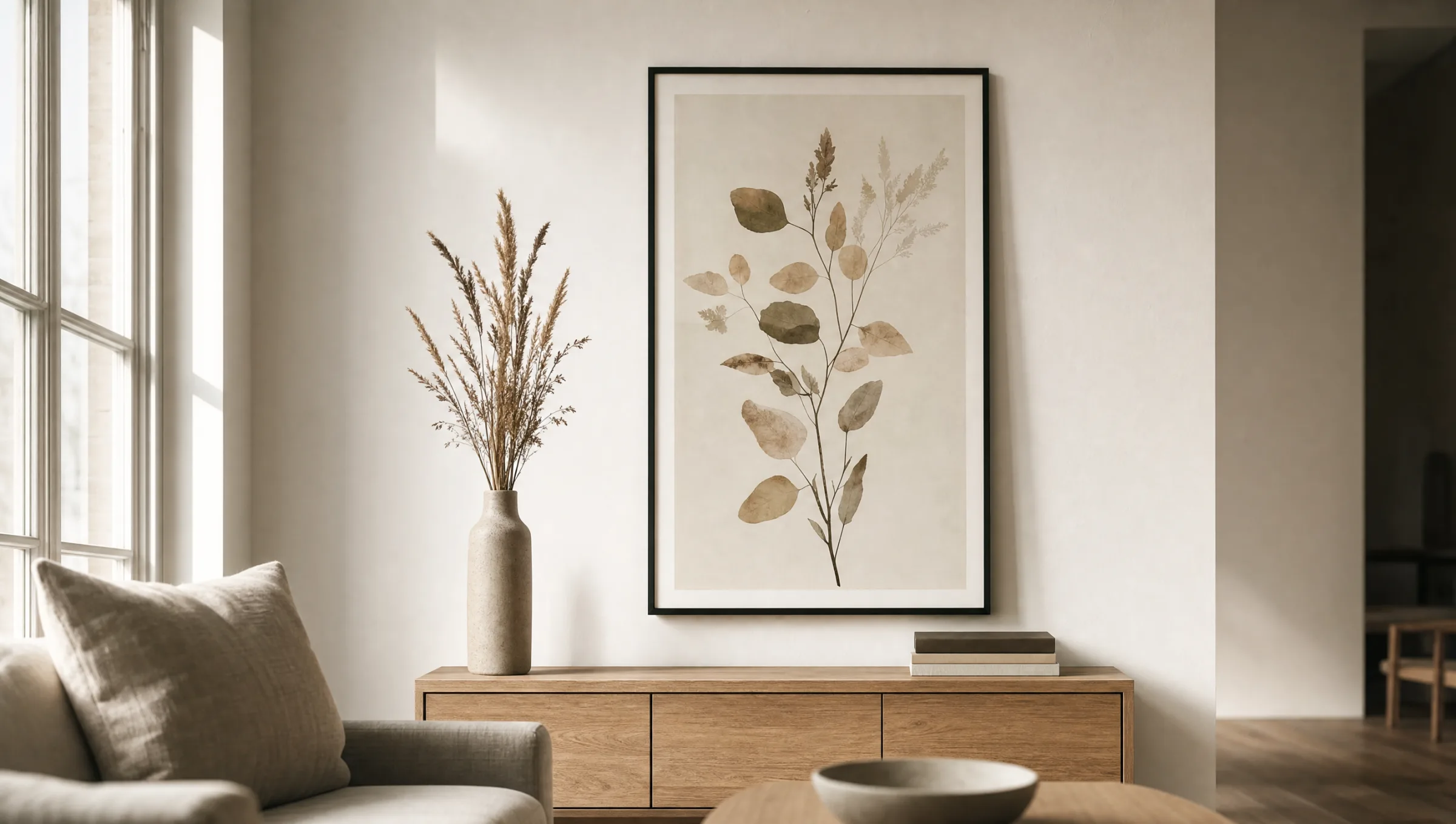
Above furniture, the print should be narrower than the piece below it and ideally not exceed two-thirds of its width. A gap of 20 to 30 cm between the top of the furniture and the bottom edge of the print is recommended, so that the artwork and the sideboard read as a unified composition.
In salon-style gallery walls, portrait format prints work well as vertical anchors to stabilise the overall arrangement. Hung individually, they have the greatest presence on calm, uncluttered wall surfaces with no competing decoration alongside.
Materials and Framing for Portrait Format Prints
The material influences how a portrait format print is read in a room. Matte FSC-certified paper from 200 g/m² upward feels graphic and restrained — ideal for illustrations and typographic work. Canvas emphasises painterly qualities and requires no glass, which avoids reflections.
Aluminium wall prints, whether in hexagon form or classic rectangular, give photographic motifs depth and a slightly cool presence. For traditional framing, narrow wooden mouldings in oak or black contain the image without dominating it.
Anyone displaying portrait format prints without a mount should ensure a cleanly printed edge and precise finishing — on large formats especially, inaccuracies at the border become noticeable quickly. All Reetro prints are printed to order by our production partner in the EU to consistent production standards.
Häufige Fragen
-
01
When do portrait format prints work better than landscape formats?
Portrait format prints are most convincing where wall surfaces are tall and narrow — in hallways, between doors, beside tall wardrobes or above slender console tables. They accentuate the vertical dimension of a room and make ceilings appear higher. Landscape formats, by contrast, suit wider pieces of furniture such as sofas or beds, where they pick up the horizontal line of the piece. Motif-wise there is also a natural tendency: portraits, standing figures, architectural details and vertical plant studies all benefit from portrait orientation, while landscapes generally find their natural frame in a horizontal format.
-
02
Which size portrait format print works above a sofa?
Above a sofa, portrait format prints in sizes between 50 × 70 cm and 70 × 100 cm are usually appropriate, depending on the sofa's width. As a rule of thumb, the print should not exceed roughly two-thirds of the sofa's width. With very wide sofas a single portrait format print can look isolated — in that case either a group of three vertical prints or an additional landscape piece often works better. The gap between the sofa back and the bottom edge of the print should be between 20 and 30 cm so that the furniture and artwork read as a composed unit.
-
03
How high should a single portrait format print be hung?
The centre of the print should be at average eye level, between 145 and 155 cm from the floor. With portrait format prints this means the top edge sits noticeably higher than it would for a landscape print of the same area — this is intentional and supports the vertical effect. Above furniture, take the furniture height as your reference and allow 20 to 30 cm from the top of the piece to the bottom edge of the print. In rooms with very high ceilings, the centre of the print may move slightly above eye level to address the proportions of the space.
-
04
Which motifs work particularly well as portrait format prints?
Portraits, botanical illustrations, architectural photography, figure studies and abstract compositions with strong vertical lines all work well in portrait orientation. Fashion photography is traditionally vertical too, because it shows the full figure. Landscapes are more difficult — they read convincingly in portrait format only when the subject itself emphasises depth rather than breadth, for example waterfalls, forests seen from below or narrow mountain passes. Typographic works and illustrations also lend themselves well to portrait format, particularly in the classic DIN proportions.
-
05
Can portrait format prints be produced on premium materials?
Yes. Reetro has portrait format prints printed to order by its production partner in the EU on FSC-certified paper from 200 g/m² with a matte coating, on premium canvas and on aluminium, including hexagon wall prints. Matte paper reduces reflections and emphasises graphic qualities; canvas feels painterly and requires no glass; aluminium gives photographic motifs a clear, slightly cool presence. The right choice depends on the motif and the atmosphere you want in the room — for illustrations, paper is generally recommended; for photography, aluminium or canvas is often preferable.