
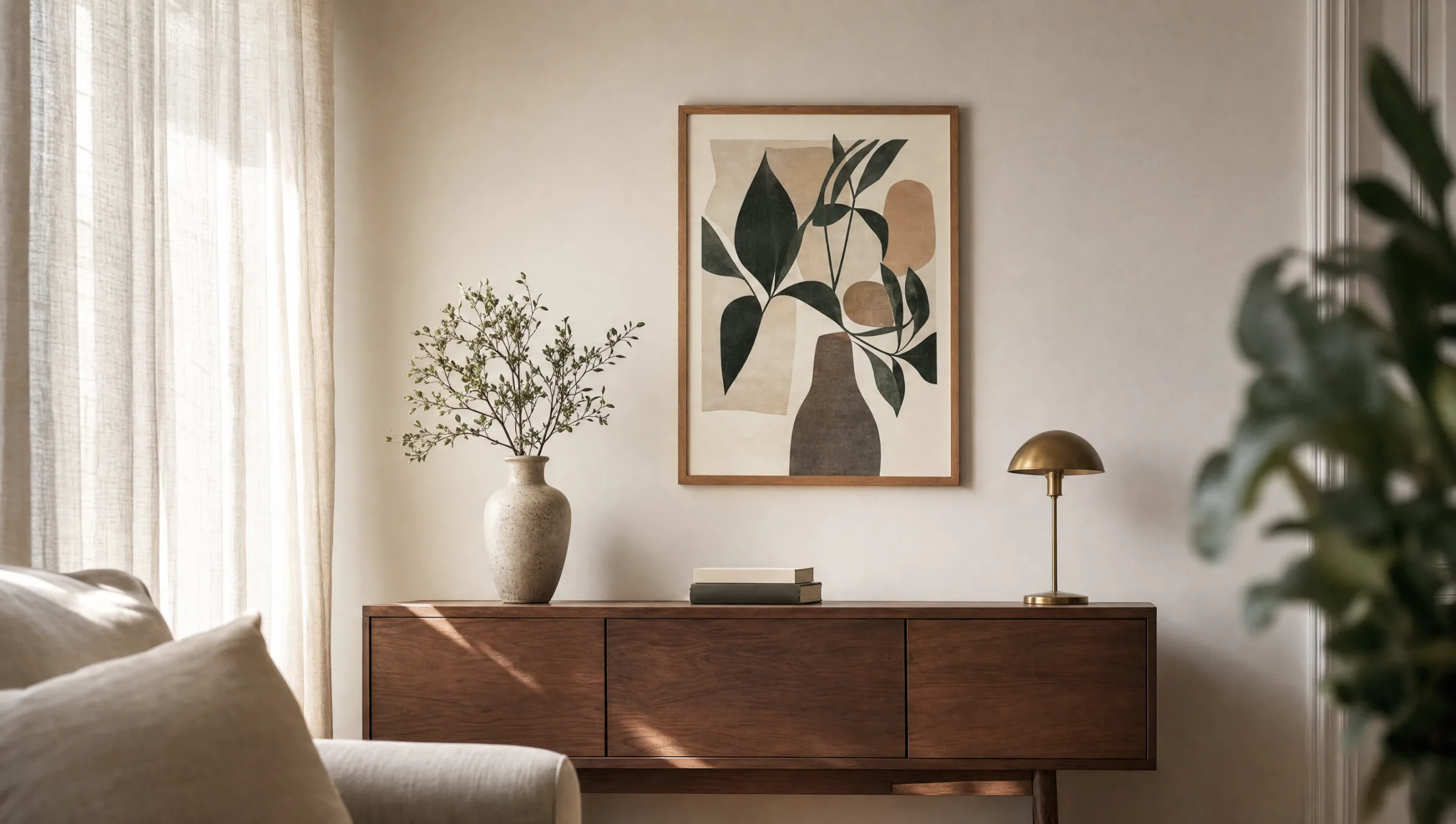
Portrait Print 50x70: an editorial guide to a classic poster format
The 50x70 format is one of the most widely used poster sizes across Europe. In its portrait orientation it brings a calm verticality that sits comfortably in living spaces and home offices alike. This guide covers proportions, motif choice, framing and placement in a straightforward, editorial way.
Why a portrait print 50x70 works
At 50 centimetres wide and 70 centimetres tall, the format sits in a 5:7 ratio — close to the classic proportions that have evolved from DIN standards and common poster conventions. It is large enough to function as a standalone wall object, yet compact enough to fit standard frames and slot into many furniture niches.
The portrait orientation draws the eye upward and accentuates ceiling height. In older buildings with high ceilings, a portrait print 50x70 acts as a balancing vertical element; in contemporary apartments it structures open wall surfaces without overwhelming them.
Compared with landscape formats, the portrait orientation is particularly well suited to figurative subjects, botanical studies, architectural motifs and typographic prints, where a vertical reading is part of the image's visual effect.
Motif categories for a portrait print 50x70
Four motif groups that have proved themselves in this format and appear regularly in curated interior concepts.
Botanical studies
Single branches, grasses or palm fronds follow a natural vertical axis and fill the portrait format calmly and evenly.
Architecture & façades
Towers, stairwells or narrow façade details benefit from the vertical picture axis and read with more depth than they would in landscape.
Portraits & figure studies
Classic portrait composition and the 50x70 portrait format complement each other naturally. The figure gains sufficient breathing room above and below.
Typography & line drawings
Type posters, abstract lines and minimalist drawings appear ordered and gallery-ready in portrait orientation.
Frames, mounts and material choices for a portrait print 50x70
Matching frames for a portrait print 50x70 are widely available. Simple wooden frames in oak, ash or black are understated and durable; aluminium frames in matte tones read more graphic and suit technical or photographic motifs. Those who want more breathing room around the image can choose a 60x80 frame with a mat cut for 50x70.
For paper, a matte fine-art stock from 200 g/m² upward is recommended. It reflects less light than gloss surfaces and renders subtle tonal values cleanly. FSC-certified papers are now standard in quality print production and are used by Reetro — printed to order in the EU — for posters in this format.
For a frameless display, poster rails in wood or metal are a practical option. They emphasise the top and bottom edges while allowing the print to breathe freely against the wall.
A well-chosen portrait-format print organises the wall without dominating it — it gives the room a vertical line that the eye can follow.
Reetro Editorial
Placement in the living room
Above a sofa, a single portrait print 50x70 looks balanced when the top edge hangs at roughly 150 to 160 centimetres from the floor and the bottom edge ends about a hand's width above the sofa back. With a wide sofa, two portrait prints side by side — or a triptych — can pick up the horizontal furniture axis.
In a hallway, the narrow floor plan almost naturally calls for portrait orientation. Several 50x70 prints in matching frames, hung with a consistent gap of eight to twelve centimetres, create a quiet row that makes the corridor feel longer.
In a study or bedroom the portrait format often serves as a focal point behind a desk or bed. Here a restrained motif pays off — one that does not tire the eye even with repeated, prolonged viewing.
Combining portrait prints 50x70 in a gallery wall
When building a gallery wall, it works well to place a portrait print 50x70 as the anchor image and group smaller formats — such as 30x40 or 21x30 — around it. The varying sizes create hierarchy; a consistent frame colour keeps the overall arrangement calm.
Mixing portrait and landscape formats is possible but should be composed deliberately. A reliable principle: align the outer edges to form an imagined rectangle within which the prints are arranged freely. This keeps the wall readable even when many motifs are on display.
Häufige Fragen
-
01
What aspect ratio does a portrait print 50x70 have?
A portrait print 50x70 has an aspect ratio of 5:7, roughly 1:1.4. That makes it slightly narrower and taller than a standard A2 sheet (42x59.4 cm) and places it squarely within an internationally recognised poster standard. This proportion is considered visually balanced and is commonly used for art prints, posters and photography.
-
02
Which frame fits a portrait print 50x70?
Standard frames in 50x70 cm are widely available in specialist and furniture retailers. Simple wooden frames in oak, ash, walnut or black have an understated, editorial look. If you want more white space around the motif, a 60x80 frame with a mat cut for 50x70 is a good option. Matte aluminium frames suit graphic or photographic subjects particularly well.
-
03
At what height should I hang a 50x70 portrait print?
The standard reference is the museum hanging height: the centre of the print sits at approximately 145 to 150 centimetres from the floor. When hanging above furniture, use the top of the piece as your guide instead — leaving about a hand's width between the sofa back or sideboard top and the bottom edge of the print tends to look right in most interior settings.
-
04
Which motifs work best in portrait orientation?
Botanical studies, architectural details, portraits, typographic posters and minimalist line drawings often follow a natural vertical axis and come into their own in portrait format. Landscapes and panoramas, by contrast, usually read more calmly in landscape orientation. With travel photography it is worth reviewing the composition before printing to determine which format suits the image best.
-
05
Can I combine several portrait prints 50x70?
Yes. Two or three portrait prints 50x70 placed side by side in matching frames with a consistent gap of roughly five to ten centimetres make a quiet, cohesive row — ideal above a sofa, sideboard or along a hallway. In gallery wall arrangements, a portrait print 50x70 works well as an anchor image surrounded by smaller formats.
-
06
What paper does Reetro use for a portrait print 50x70?
Reetro prints its 50x70 posters to order through a production partner in the EU on FSC-certified fine-art paper from 200 g/m² with a matte coating. The matte surface reflects very little light, renders subtle tonal values precisely and ages evenly over the years. The same motifs are also available as premium canvas prints or hexagonal aluminium wall art on request.