
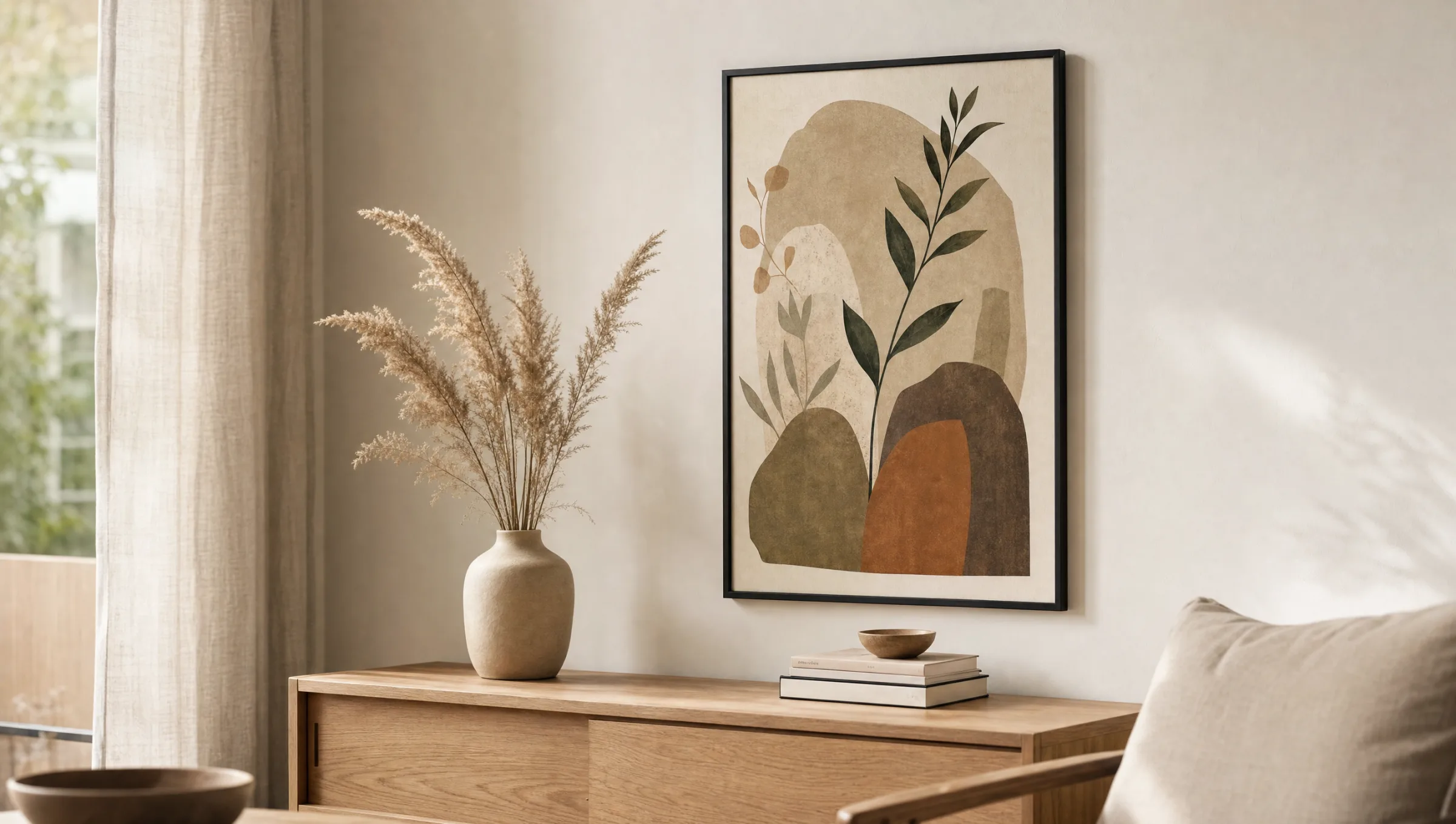
Large Poster: Wall Formats and Their Effect, Editorially Assessed
A large poster changes a room more decisively than almost any other wall object. It creates a clear focal point, structures surfaces and gives furniture something to relate to. This overview covers which formats, materials and motif categories work best for oversized prints – explained calmly, without exaggeration.
When a Large Poster Makes Sense
A large poster earns its place wherever a wall needs more anchorage than a small grouping of prints can provide. Above sofas, sideboards or double beds there is often a visual vacuum that a single, appropriately sized print resolves far more calmly than several small frames. A reliable rule of thumb: the print width should cover roughly two-thirds of the furniture width below it.
In hallways, stairwells and entrance areas, large-format prints also have an organising effect. They reduce the perceived busyness of long walls because the eye gains a clear anchor point. In tall rooms with period-building proportions, a portrait-oriented large poster can compensate for an imposing ceiling height without making the wall feel overcrowded.
Viewing distance is an important factor. At around two and a half metres, a format smaller than 50 × 70 cm begins to shrink visually. Anyone perceiving the wall from across the room rather than standing directly in front of it will benefit from 70 × 100 cm upwards.
Common Formats for a Large Poster
These four format classes cover most living situations and pair well with standard frames.
50 × 70 cm
The classic entry-level large poster format. Suits narrow sideboards, home offices and as part of a three-piece arrangement. Still easy to transport and available in standard frames.
70 × 100 cm
The most popular format for living room walls. Sits well above two-seater sofas and dining tables, and works particularly well with motifs that have a clear centre of gravity.
100 × 140 cm
XXL scale for open-plan living spaces with ceiling heights of 2.60 m or more. Requires calm motifs, as details dominate strongly at this size. Ideal above wide sofas or as a solo piece on an open wall.
Panoramic 60 × 180 cm
A horizontal format for hallways, above sideboards or as a headboard alternative. Works well with landscapes, architectural subjects and abstract line compositions.
Material and Paper for a Large Poster
With a large poster, material choices matter more than with small prints, because any waviness, reflection or colour drop-off becomes far more visible at scale. Papers of 200 g/m² or heavier with a matte or satin-matte coating are recommended. They prevent glare under ceiling lights and give motifs a calm, deep pictorial quality.
Gloss papers tend to look harsh at large formats and highlight every fingerprint. Textured papers with a tactile surface are an alternative for fine-art reproductions, but they require motifs with clear tonal contrast, since fine details can be lost in the paper texture. FSC-certified papers from European production are the more ecologically transparent choice for larger runs – Reetro prints to order through a production partner in the EU on certified stock.
Those who prefer to go frameless will find aluminium dibond or hexagonal aluminium options provide a frameless alternative with their own sense of depth. True canvas gives classical motifs a painterly quality, though it suits graphic or typographic subjects less well.
A large poster replaces three small pictures – but only if the motif can carry the surface.
Reetro Editorial
Motif Selection: What Works at Large Poster Scale
Not every image tolerates enlargement. At large-poster scale, composition and colour fields come forward more strongly than detail. Motifs with a calm structure, clear horizon lines or a reduced colour palette gain from the size, while detail-heavy collages quickly feel busy. Botanical studies, architectural photography, abstract colour-field work and minimalist line drawings are reliable categories.
Black-and-white photography also performs very consistently at large scale, because the eye focuses on tonal values rather than colour stimulus. Those who want colour should look for one dominant tone accompanied by two or three supporting tones – this restraint reads as more considered at size than a wide palette.
With figurative motifs, the rule is: the larger the print, the more distance the image needs from the viewer. Portraits of 100 cm height or more only come into their own at around three metres of viewing distance.
Hanging and Caring for a Large Poster
The centre of the image should sit at eye level – in living rooms typically between 145 and 155 cm above the floor. Above furniture, the lower edge of the print may sit 20 to 30 cm above the top of the piece so that print and furniture read as a unit. For very large formats, two hanging points are advisable to prevent warping over time.
Direct sunlight should be avoided, as UV light fades even pigment-based prints over the years. Dust can be removed with a dry microfibre cloth or a soft brush; damp cleaning is only advisable for coated aluminium or acrylic variants.
Häufige Fragen
-
01
What size is typically considered a large poster?
A large poster generally starts at 50 × 70 cm. The most common living-room formats are 70 × 100 cm and 100 × 140 cm. From 100 × 140 cm upwards, the term XXL poster is commonly used. Which size fits depends on wall width, the furniture width below and the viewing distance. Above a 2.2 m wide sofa, for instance, a landscape-format 100 × 70 cm print sits well balanced, while an open gallery wall can accommodate 120 × 160 cm.
-
02
Which paper is best suited for a large poster?
Papers of 200 g/m² or heavier with a matte or satin-matte surface are recommended. They prevent reflections, feel more premium than gloss papers and disguise minor waviness more effectively. With a large poster, any material flaw shows far more than on small prints, which is why FSC-certified premium papers with pigment-based inks are worth the investment. Textured papers are an option for fine-art reproductions but are less suited to graphic or typographic motifs.
-
03
How do you hang a large poster correctly?
The centre of the image should sit roughly 145 to 155 cm above the floor – corresponding to average eye level. Above furniture, allow 20 to 30 cm between the top of the piece and the lower edge of the print. For formats from 100 × 140 cm upwards, a two-point hanging using a picture rail or two fixings is advisable, since the frame weight can otherwise cause warping over time. A spirit-level app helps with accurate alignment.
-
04
Does a large poster necessarily need a frame?
No. A frame protects the edges and gives the print a classic finish, but it is not essential. Alternatives include mounting on aluminium dibond, hexagonal aluminium or canvas – all of which require no glass and often feel lighter at large scale. A simple wooden magnetic batten also works well for unframed prints. For long-term display on sunny walls, however, UV-protective glass is a worthwhile consideration.
-
05
Which motifs work best at large poster scale?
At large poster scale, motifs with clear composition, restful colour fields and reduced detail perform best. Botanical studies, black-and-white photography, architectural imagery and abstract colour-field work are reliable categories. Detail-heavy collages or motifs with many small elements can feel unsettled at this size. With colour, the principle is: one dominant tone plus two or three supporting tones reads as more considered than a broad palette.
-
06
How are Reetro large posters printed?
Reetro produces large-format posters to order through a production partner in the EU – on FSC-certified papers of 200 g/m² or heavier, with matte coatings and pigment-based inks for long-lasting colour fidelity. Formats range from 50 × 70 cm through to XXL sizes at 100 × 140 cm. The same motifs are also available as premium canvas or hexagonal aluminium wall art on request. The curated motif selection is assembled editorially, not through an open marketplace.