
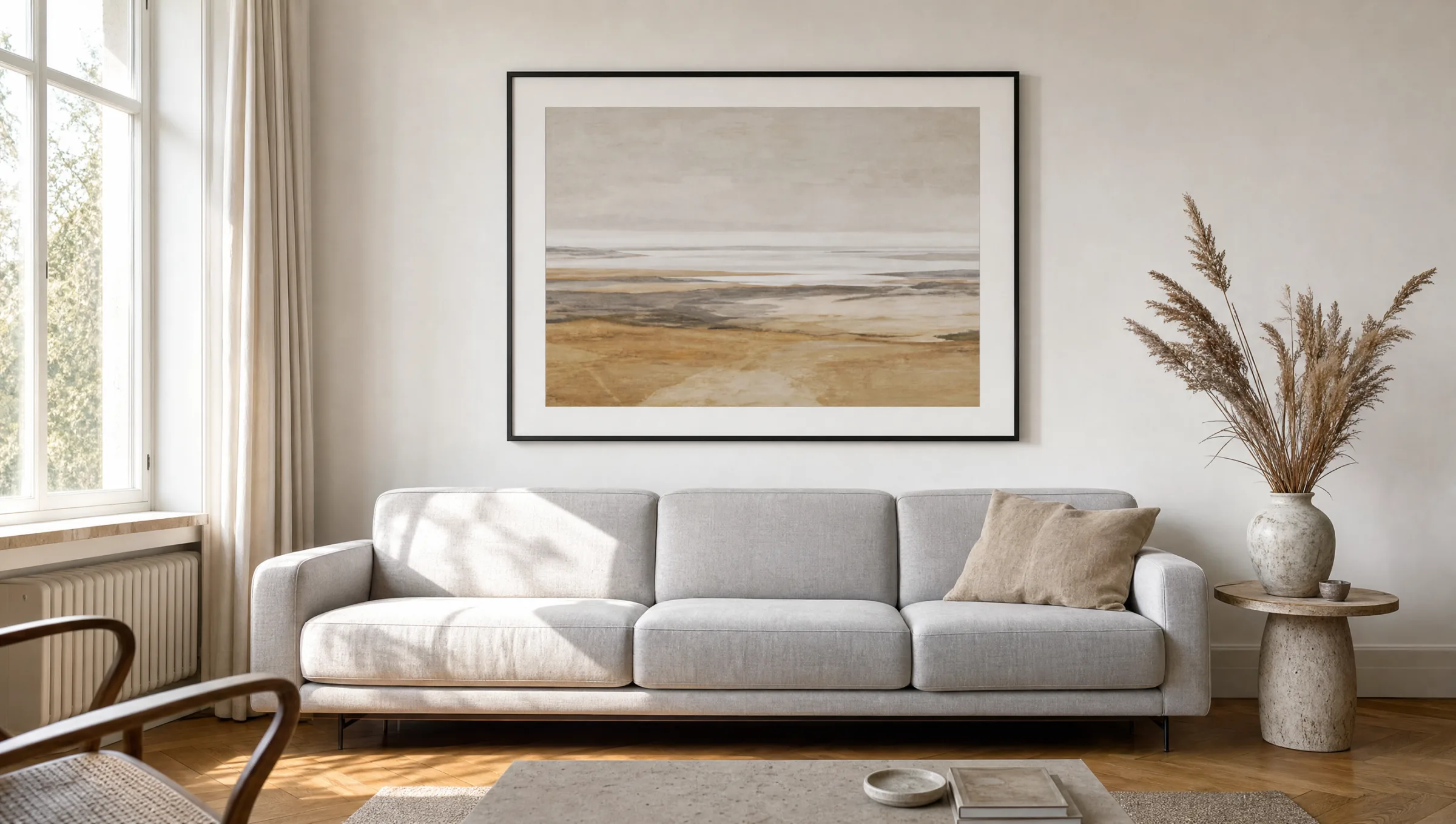
Picture Frame 140 x 100: An Editorial Guide to Large Format
A picture frame 140 x 100 falls into the XXL category and places different demands on materials, profiles and hanging hardware than standard sizes do. This overview explains which frame types suit the large format, what to look for in glazing and mounts, and which motifs work well on a wall of this scale.
Why the 140 x 100 cm Format Is a Category of Its Own
At 140 x 100 centimetres, this format sits well above common poster sizes such as 70 x 100 or A1. A picture frame 140 x 100 is rarely stocked as a standard item in furniture retail and is more often made to order. The wall area a print of this size occupies is roughly 1.4 square metres – enough to hold its own above a three-seater sofa, a wide sideboard or a double bed as a single wall object.
The format also changes the structural requirements. While an A2 frame hangs comfortably on a single nail, a large format of this size needs at least two fixing points, appropriate wall plugs and ideally a horizontal aluminium hanging rail. The weight of the glazing – whether real glass or an acrylic sheet – becomes a more significant factor than it is with smaller frames.
Frame Profiles and Materials for a Picture Frame 140 x 100
Three construction types are regularly used at large format. They differ in weight, visual character and maintenance requirements.
Wood Frame with a Wide Profile
Solid wood or MDF frames with profile widths between 30 and 50 millimetres provide structural stability. Oak veneer, black-lacquered ash and whitewashed pine are common choices for living spaces. Fully fitted, the frame typically weighs between five and eight kilograms.
Aluminium Shadow-Gap Frame
Slim aluminium profiles in silver, black or champagne look understated while keeping large formats warp-free. A continuous shadow gap draws attention to the motif without letting the frame dominate – well suited to photographic works and graphic prints.
Frameless Clip Systems
With frameless picture holders, the print sits between a backing board and an acrylic sheet held in place by metal clips. This option reduces overall weight and gives the print an almost floating appearance, but works best with flat, well-rolled papers.
Glazing, Acrylic and Mounts at Large Format
Real glass at 140 x 100 centimetres weighs around nine kilograms and is vulnerable to breakage during transport or installation. Many manufacturers therefore use anti-reflective acrylic glazing two to three millimetres thick for large formats. Light transmission is comparable, while weight drops to roughly one third. Where direct sunlight is a factor, UV-protective acrylic should be chosen to slow colour shift in the print over time.
A mount changes the inner picture area of a picture frame 140 x 100 considerably. Inner cut-outs of 120 x 80 or 130 x 90 centimetres are typical. Acid-free, lightfast board at 1.4 to 2 millimetres thickness keeps the print away from the glazing surface and prevents paper from sticking to the inside of the sheet – a detail that matters especially for fine-art papers when thinking about long-term preservation.
At large format, what determines the visual effect is not the frame itself, but the relationship between profile width, mount depth and the calm of the motif.
Reetro Editorial
Choosing Motifs for a Picture Frame 140 x 100
Not every motif carries a format of this scale. Restrained landscapes, abstract colour fields, black-and-white architectural photographs and typographic works benefit from the surface area because they are read from a medium viewing distance. Highly detailed illustrations or dense collages, by contrast, can appear busy when scaled to 140 x 100 centimetres.
At Reetro, prints for this format are produced on FSC-certified papers from 200 g/m² upwards with a matte coating. Printing takes place to order with our production partner in the EU, and each image file is reviewed at the final output size before production to avoid visible rasterisation or soft edges. For the same wall area, premium canvases and framed XXL posters are also available – each with a stretcher or profile construction matched to the format.
Hanging and Wall Placement
For a picture frame 140 x 100, hanging on two heavy-duty fixings spaced roughly 80 to 90 centimetres apart is recommended. On plasterboard walls, toggle or cavity anchors rated to at least 25 kilograms per fixing point are advisable. The centre of the image should sit approximately 145 to 150 centimetres above the floor at normal ceiling height; when the frame hangs above a piece of furniture, the bottom edge should be around 15 to 25 centimetres above the top of that furniture.
The format can also be hung in portrait orientation. Horizontally, 140 x 100 reads as panoramic and echoes the line of a sideboard or sofa. Hung vertically, the format emphasises ceiling height and suits narrower wall sections between two windows or beside a door.
Häufige Fragen
-
01
Is a picture frame 140 x 100 a standard size?
No. 140 x 100 centimetres falls into the XXL special-format category and is rarely held in stock. It sits well above common sizes such as 70 x 100, 100 x 70 or A0 (84.1 x 118.9 cm). Frames of this size are usually made to order or sourced from specialist suppliers that produce large formats on a planned basis. Because of the scale, the format is often offered together with a matching print as a complete unit, since the frame is tailored precisely to the motif.
-
02
Which glazing is best for a picture frame 140 x 100?
At large format, acrylic glazing is often preferred over real glass. A real glass sheet at 140 x 100 centimetres weighs around nine kilograms and is fragile during transport. Anti-reflective acrylic two to three millimetres thick reduces that weight to roughly one third while offering comparable light transmission. Where direct sunlight is a factor, UV-protective acrylic is recommended to slow colour change in the print. Real glass remains a sound choice when the frame will hang in a fixed position and a particularly hard, scratch-resistant surface is required.
-
03
How do you hang a picture frame 140 x 100 safely?
Use two fixing points spaced roughly 80 to 90 centimetres apart, with wall plugs rated to at least 20 to 25 kilograms each. In solid masonry, standard expansion plugs of the appropriate size are sufficient; in plasterboard walls, hollow-wall or toggle anchors with a clearly stated heavy-duty load rating should be used. A horizontal aluminium hanging rail distributes the weight across the full frame width and prevents any tilt, making it the most reliable solution for a frame of this size.
-
04
Which motifs work best at 140 x 100 cm?
Calm, spacious compositions carry the format most reliably. These include restrained landscape photographs, abstract colour fields, minimalist architectural shots and generous typographic works. Dense illustrations or tightly packed collages can appear busy because the eye struggles to find a clear focal point across 1.4 square metres. With figurative subjects, ample negative space around the main element helps the composition breathe at XXL scale.
-
05
What print types does Reetro offer in the picture frame 140 x 100 format?
Reetro produces framed posters, unframed XXL prints, premium canvases on stretcher frames and hexagonal aluminium wall art as an alternative for unconventional wall spaces, all in the 140 x 100 cm format. Paper prints are made on FSC-certified materials from 200 g/m² upwards with a matte coating, and all printing is done to order by our production partner in the EU. Every image file is checked at the final output size before production to ensure sharpness and consistent colour gradation at large format.