
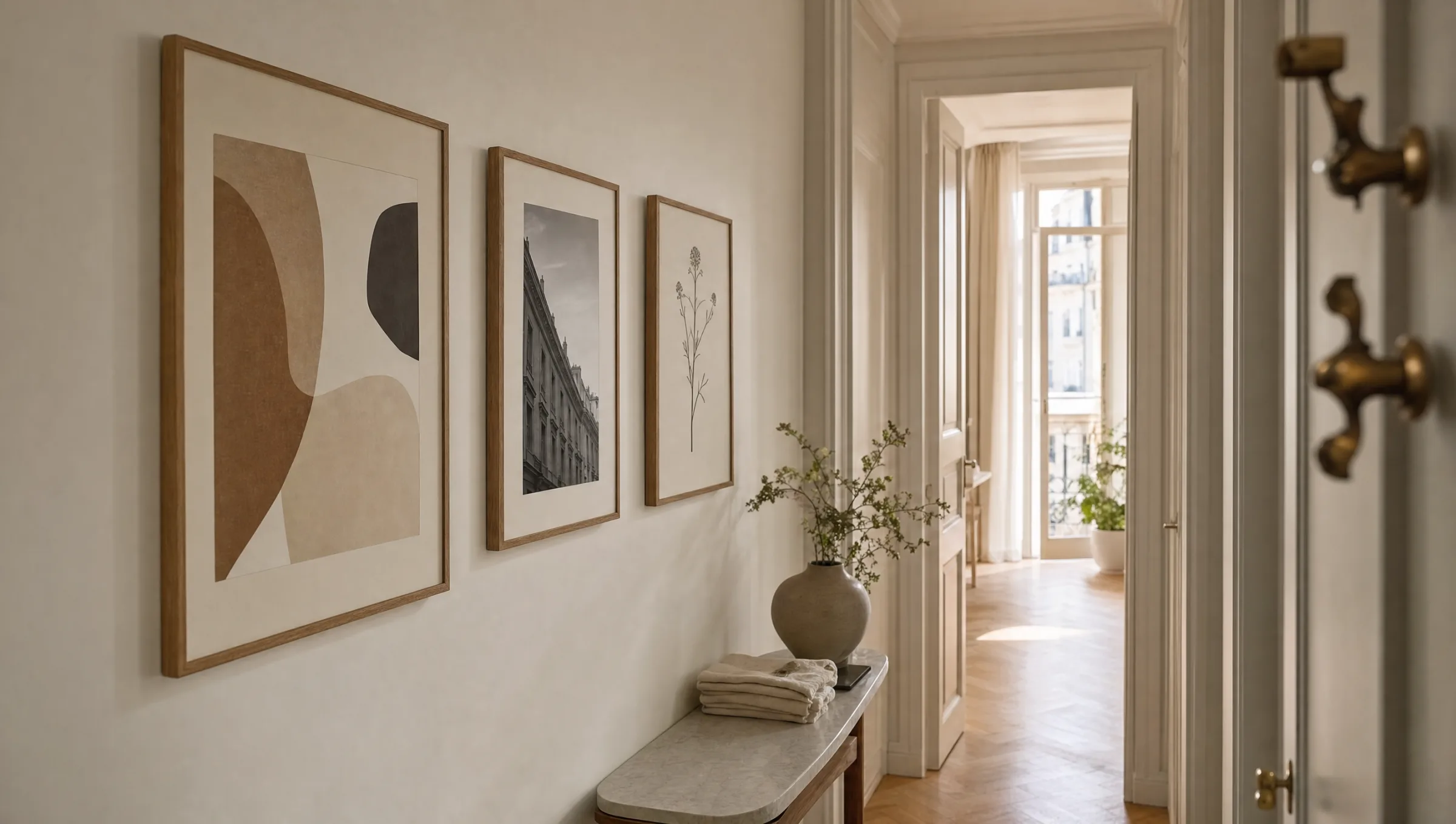
Modern Hallway Pictures: Considered Design in a Compact Space
The hallway is the first room guests see, and at the same time the hardest to dress with wall art. Modern hallway pictures must contend with limited daylight, short sightlines and narrow walls — and yet those very constraints define their design potential.
Why the Hallway Calls for Its Own Design Rules
Hallways are transitional spaces. They are perceived in passing — often within a matter of seconds — and must still set the tone for an entire home. Unlike a living room, they rarely have windows, generous furniture or enough distance between walls. Instead, doors, light switches and coat racks dominate. Anyone selecting modern hallway pictures is not designing for prolonged contemplation, but for clear, immediate impact at a glance.
That has direct consequences for motif and format. Complex compositions with a great deal of fine detail can feel restless in a narrow corridor, because the eye is simply too close to take them in. Clean graphic motifs, reduced areas of flat colour, strong lines and calm photography all carry far better. The distance to the opposite wall also determines how large a single work can be before it starts to feel oppressive.
Four Styles for Modern Hallway Pictures
Not every hallway calls for the same visual language. These four directions have proved especially well-suited in our editorial selection, because they hold up under artificial light and at close range.
Abstract Colour Fields
Expansive, quiet gradients in ochre, sage or muted blue give the hallway a background note without being intrusive. They work particularly well on long, unbroken walls where a single format is meant to carry the space.
Architectural Photography
Black-and-white images of facades, staircases or bridge structures extend the corridor visually. Their strict geometry echoes door frames and skirting boards, bringing order to the wall.
Botanical Illustrations
Minimal line drawings of leaves, grasses or branches bring a sense of nature into a windowless passage. On a light ground they act as a calm counterpoint to coat hooks and shoe racks.
Mid-Century Graphics
Geometric shapes, semicircles and warm earth tones drawn from the design language of the 1950s and 60s suit period hallways with high ceilings, and also work well when grouped in a series.
Format, Hanging Height and Lighting for Modern Hallway Pictures
The most common question in planning discussions is this: a single large format or a series? For modern hallway pictures a straightforward rule applies. If the wall runs longer than three metres without a door opening, a single work at 70 × 100 cm or larger can hold the space. On interrupted walls with doors, sockets or radiators, a series of two or three smaller formats tends to work better, because it picks up the existing rhythm rather than fighting it.
The usual advice to centre a picture at eye height applies only loosely in a hallway. Because people are typically standing and moving rather than sitting, the midpoint of the picture can sit a little higher — around 150 to 155 cm from the floor. The gap to the ceiling also matters: leaving at least 30 cm of clear wall above the frame prevents the work from looking cramped.
Artificial light is decisive in a hallway. Warm-white LED spots at around 2700 Kelvin let pigments in matte prints read naturally, while cooler light distorts colours. Anyone wanting to highlight a wall deliberately should plan a small directional spotlight angled slightly from above — not head-on, to avoid reflections on the surface.
A hallway does not have to be loud to show character. Often a single, well-chosen picture is enough to turn a passageway into a proper opening note.
Reetro Editorial
Materials That Hold Up in a Hallway
In a hallway, pictures share space with coat hooks, damp jackets and the occasional shoe leant against the wall. The material and finish should be up to that. Matte FSC paper from 200 g/m² behind anti-reflective glass reduces glare from ceiling lights and stays legible even under raking light. Those who prefer to forgo glass can turn to premium canvas or aluminium prints, which are less susceptible to knocks.
Hexagonal aluminium prints are a particularly good fit where the hallway transitions into a bathroom or kitchen, as they handle temperature fluctuations and higher humidity well. Large-format posters on premium paper, meanwhile, are the most cost-effective option for rented homes where wall art changes with every move. Reetro produces all these formats printed to order by our production partner in the EU, using pigment inks that remain colour-stable even under artificial light, on FSC-certified papers from 200 g/m² with long-term quality in mind.
Häufige Fragen
-
01
What colours work best for modern hallway pictures?
Most hallways receive little or no daylight, which means very dark or heavily saturated motifs can quickly feel heavy. Muted earth tones, warm white, sage green, sand and a single accent in deep blue or terracotta have proved reliable — they absorb artificial light gracefully and make the space read as longer. If your hallway is unusually bright you can move towards higher-contrast black-and-white work; in darker corridors, light backgrounds carry the motif far better.
-
02
How large should modern hallway pictures be?
Size depends largely on the distance to the opposite wall. In narrow corridors under 1.2 metres wide, formats between 30 × 40 cm and 50 × 70 cm tend to work best, because the eye can take them in without needing to step back. In wider entrance halls or open-plan entries from about 1.8 metres, a single large format of 70 × 100 cm or even 100 × 140 cm can work well. As a general rule, leave at least 30 cm of clear wall both above and below the frame.
-
03
Single picture or gallery wall in the hallway?
Both approaches have their place. A single, calm work suits shorter wall sections and creates a clear focal point — for instance opposite the front door. A gallery arrangement of three to five pieces in varied formats works well on a long, uninterrupted wall and introduces a sense of rhythm into the corridor. If you are unsure, start with one central picture and add to it after a few weeks; the wall can grow alongside your feel for the space.
-
04
At what height should modern hallway pictures be hung?
Because people are mainly standing and moving in a hallway rather than sitting, the ideal centre of a picture sits slightly higher than it would in a living room — around 150 to 155 cm from the finished floor. For a series, align to the notional midpoint of the whole arrangement rather than to each individual frame. Above a console or sideboard, allow roughly 20 to 25 cm between the top of the furniture and the bottom of the frame, so the picture reads as its own element rather than an extension of the piece below.
-
05
Which materials are most durable for hallway wall art?
Matte premium paper behind anti-reflective glass reduces ceiling-light glare and is the classic choice for modern hallway pictures. Premium canvas needs no glass and shrugs off the small knocks that inevitably happen near coat hooks. Aluminium prints — including hexagonal formats — tolerate light moisture and are well-suited to hallways that open onto a bathroom or kitchen. Reetro produces all these options printed to order by our production partner in the EU on FSC-certified papers from 200 g/m², with pigment inks that stay colour-true under artificial light.