
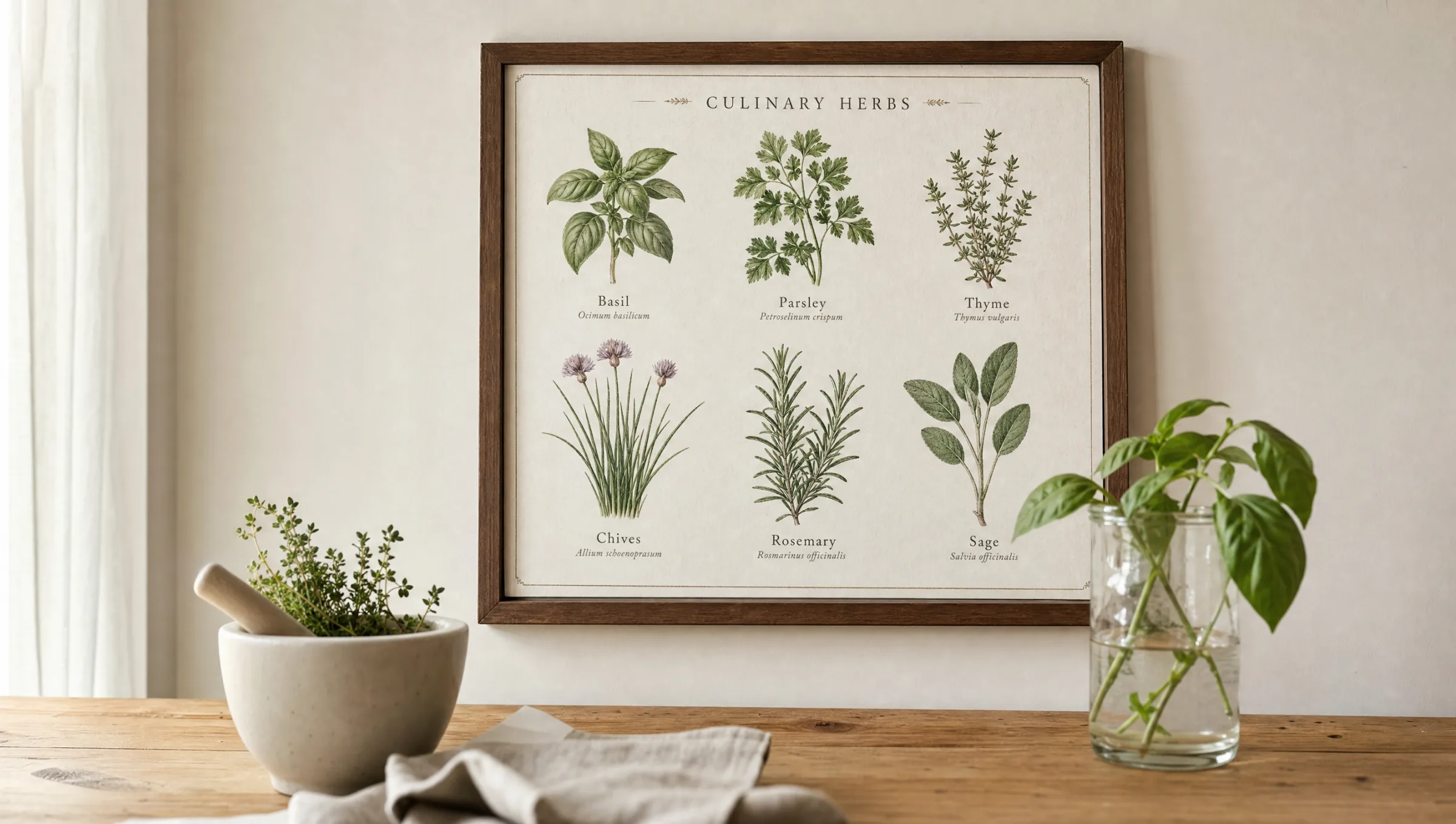
Culinary Herbs List with Pictures: Editorial Overview and Wall Art Inspiration
A well-organised culinary herbs list with pictures helps with identifying, classifying and selecting the most important cooking herbs. This article brings together brief botanical portraits with notes on kitchen use and on presenting herbs in print form — as calm wall decoration for a kitchen, dining room or workspace.
Why a Culinary Herbs List with Pictures Is Useful
Anyone who has laid parsley, chervil and coriander side by side on a kitchen counter quickly sees how similar leafy herbs can look. A culinary herbs list with pictures reduces exactly that risk of confusion: it pairs each plant name with a clear visual impression of leaf shape, growth direction and colour, turning abstract terms into a reliable identification grid.
In everyday life such an overview serves two purposes. First, as a learning aid — for example when shopping at a weekly market or observing herbs growing on a balcony. Second, as a design element: botanical charts have been part of the illustration tradition since the 18th century, and they still read as ordered, calm and factual when hung as a print on the wall.
Culinary Herbs List with Pictures: Key Varieties in Portrait
Four herbs found in almost every Central European kitchen, briefly profiled by characteristics, aroma and typical use.
Basil (Ocimum basilicum)
Smooth, oval leaves in a rich mid-green, slightly glossy. Sweet, spicy aroma with a hint of anise. A classic in Italian cooking alongside tomato, mozzarella and pesto. It does not tolerate prolonged heat and is best added raw or just before serving.
Parsley (Petroselinum crispum)
Flat-leaf and curly varieties, a deep, strong green with tripartite pinnate leaves. Fresh and mildly peppery in flavour. A versatile herb for soups, sauces, potato dishes and salads. Visually distinguishable from coriander by its firmer, less delicate leaf margin.
Thyme (Thymus vulgaris)
Small, lance-shaped leaves on woody stems, greyish-green. Intensely aromatic with a slightly earthy note. Heat-stable and ideal for braises, bread crusts and Mediterranean vegetable dishes. Dries well without losing much of its aroma.
Chives (Allium schoenoprasum)
Hollow, tubular stems in a fresh green, often topped with violet flowers. Mild and onion-like in flavour. Used raw in quark, salads, soups and on buttered bread; should not be cooked but added afterwards as a finishing herb.
Visual Language: How a Good Culinary Herbs List with Pictures Is Structured
A well-executed presentation follows three principles: consistent scale, a neutral background and uniform lighting. When herbs are photographed or illustrated against light natural paper or matte linen, leaf shape and colour come to the fore. If plants are shown individually in separate pots with varying depths of field, the overview loses its composure.
Labelling also contributes to the overall effect. Restrained typography — for instance a calm serif for the plant name and a modest sans-serif for the Latin term — recalls classical herbaria and sits well in modern kitchens. Playful handwritten scripts, by contrast, quickly feel busy once several plants are displayed side by side.
A herb chart on the wall is more reference work than decoration — it brings order to what so often lies in chaotic heaps on the chopping board.
Reetro Editorial
From Reference Sheet to Wall Print: Formats and Materials
Botanical overviews rely on detail. Anyone wanting to display a culinary herbs list with pictures as a wall print should therefore allow enough surface area: formats from 50 × 70 cm give individual leaves sufficient room without making the labels a test of eyesight. Portrait orientations work well for lists of six to twelve species arranged vertically.
For material, matte surfaces have proven themselves. Glossy prints in a kitchen often reflect ceiling lights and distort the greens. An FSC-certified natural paper from 200 g/m² upward has a calm presence and stands in the tradition of printed herbaria — printed to order by our production partner in the EU, as is Reetro's standard. For a more robust print in areas directly exposed to splashing or steam, coated aluminium wall panels are the more practical choice.
Placement and Care in the Kitchen
Directly above the hob or sink, prints are less well placed — grease and steam gradually settle on every surface. A wall beside the dining table, opposite a worktop, or at the transition to a living area offers more distance and better sightlines. Where daylight is involved, a pigment print is worth considering, as it fades less readily than standard inks.
Häufige Fragen
-
01
Which herbs belong in a complete culinary herbs list with pictures?
A thorough culinary herbs list with pictures typically covers twelve to fifteen species: basil, parsley, chives, dill, chervil, tarragon, coriander, thyme, rosemary, sage, oregano, marjoram, savory, lovage and bay. These address the core of Central European and Mediterranean cooking. The list can be extended to include mint and lemon balm when sweet applications and drinks are also to be considered.
-
02
How do I tell parsley from coriander in pictures?
Both herbs have tripartite green leaves and look very similar when sold in bunches. In a good photograph, coriander is recognisable by its slightly lighter, yellow-green tone and its rounder, more softly toothed leaf margins. Parsley is darker, firmer and more sharply serrated. When in doubt, the smell test helps: coriander has an intense citrusy-soapy scent, while parsley is subtly fresh and mildly spicy.
-
03
Is a culinary herbs list with pictures suitable as kitchen wall art?
Yes, provided the format and material suit the space. A culinary herbs list with pictures works best as wall art when printed at a generous size — from around 50 × 70 cm — and featuring calmly designed illustrations or photographs. Matte papers or coated aluminium panels have an advantage over glossy prints: they reflect less light and render the natural greens of the plants more faithfully.
-
04
Which style suits botanical herb charts?
Botanical herb charts draw stylistically from the 18th and 19th centuries and harmonise well with understated interiors: natural wood, linen, ceramics, simple metal frames. In very modern, high-gloss kitchens they act as a calm counterpoint. A consistent background on the print — usually cream-white or a broken paper white — is important so that the overview does not feel restless.
-
05
What size should a print be for a kitchen wall?
For a single image above a sideboard or dining-table wall, a portrait format between 50 × 70 cm and 70 × 100 cm is common. If many herbs are included in one motif, the format should not drop below A2 so that labels and leaf veins remain legible. On very large walls, XXL formats from 100 × 140 cm look balanced when the viewing distance is at least two metres.
-
06
What does Reetro look for when producing herb motifs?
At Reetro, botanical motifs are printed on FSC-certified natural paper from 200 g/m² with a matte coating, complemented by premium canvases and hexagonal aluminium panels for areas closer to moisture. Production takes place to order with our production partner in the EU or the US, using pigment inks that reproduce greens with lasting accuracy. Editorially, we pay attention to consistent visual language, legible typography and correct botanical names — so the overview is not only decorative but also reliable.